

|
Getting your Trinity Audio player ready...
|
JERUSALEM — The Palestinians needed a win.
Not on the battlefield, or at the United Nations, or in The Hague — but on the soccer field.
For the first time, the Palestinian national soccer team had made it into the quarterfinals of the Arab Cup, a regional tournament dating back to 1963.

And on Thursday night, in packed cafes in Cairo, restaurants in Ramallah in the West Bank, hookah bars in Arab towns in Israel and even in tents in the war-ravaged Gaza Strip, Palestinians were out together, riding the emotional roller-coaster of watching their team fight for its survival against an opponent with a much stronger record.
For many watching the game, the parallels with other struggles were inescapable.
‘We Didn’t Win the War, but Maybe We Can Win the Match’
“We didn’t win the war, but maybe we can win the match,” said Muhammad Abu Erjaila, 24, a Palestinian from the Gaza Strip now living in Cairo.
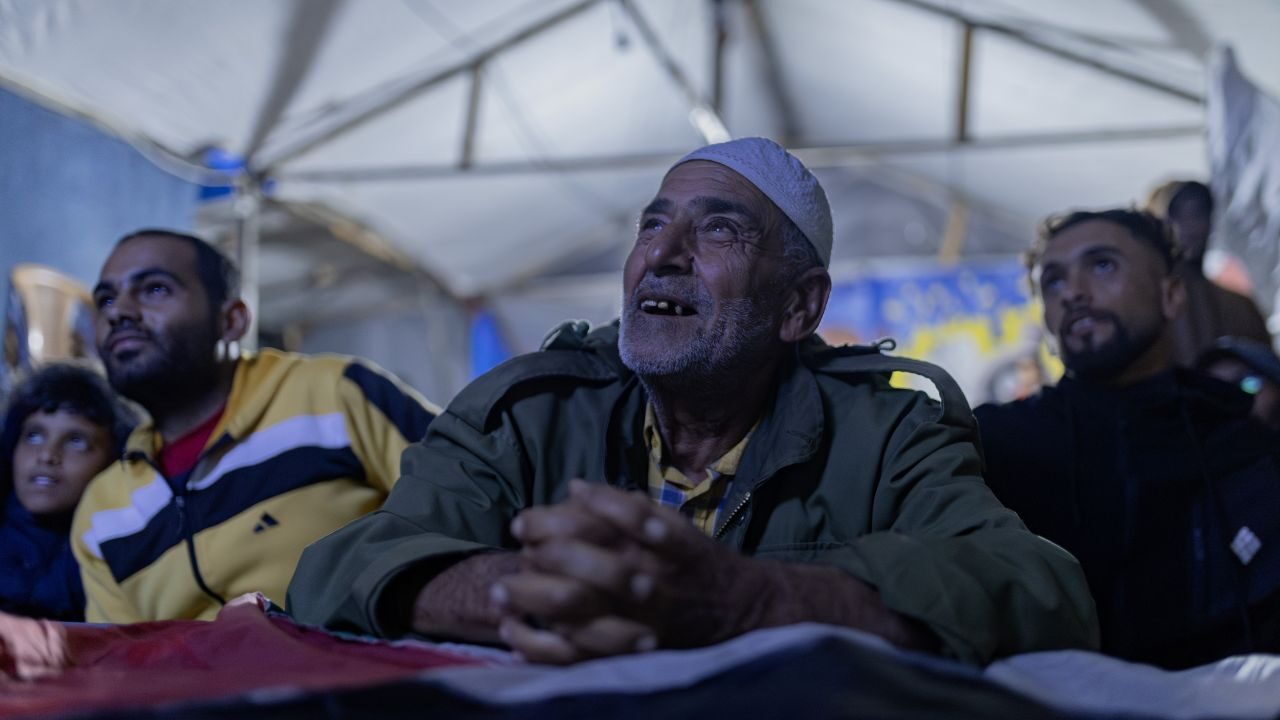
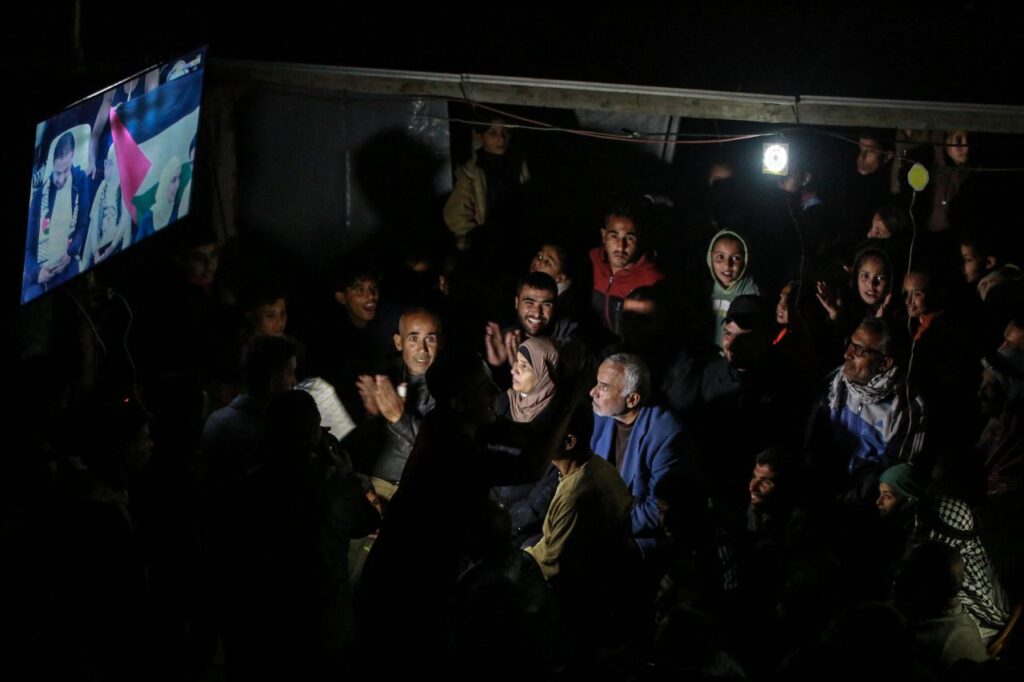
In Gaza, nearly 50 men, teenagers and boys made their way through a stormy night and muddy, flooded streets to a makeshift cafe in a tent on the outskirts of Khan Younis, where a technician worked frantically to get the game’s livestream playing on a big TV powered by solar panels and batteries, and the cafe’s owner fed cardboard boxes and paper scraps into a fire to make hot drinks and heat the room.
Ismail Nasser al-Din, 20, sat dripping wet, clutching a Palestinian flag. He said he had lost his brother, a cousin and a friend in the war. “I hope our team will win,” he said. “We need any reason to laugh, enjoy and get some relief.”
Ibrahim Abu Mosabeh, 67, from eastern Khan Younis, watched with a quiet intensity. A former builder who once worked in Israel, he said he had lost more than 30 members of his extended family in the two years of fighting that began with the Hamas-led attack on Israel on Oct. 7, 2023. That attack killed about 1,200 people and prompted a devastating Israeli response that left much of Gaza’s infrastructure in ruins and killed tens of thousands of Palestinians. “I am here to disconnect from our miserable life,” he said. “I want to see the joy in our faces after two years of suffering and displacement.”
In Ramallah, scores of people crowded into Maramia, a restaurant in an upscale mall, including some who said they had never paid much attention to soccer before.
“It feels good to have a different reason for stressing out, to be able to stress out over your national team like the rest of the world,” said Mahmoud Erekat, 27. “This is a feeling that Palestinians truly miss and need.”
Palestinians Stunned Qatar in Previous Match
A victory didn’t seem out of reach. The Palestinian squad had stunned the host team, Qatar, 1-0, in its first match After tying Tunisia, all it needed was another draw with Syria to have enough points to make it out of group play and into the knockout round.
Sunday’s group play match with Syria — which, like the Palestinian team, was buoyed by an underdog national narrative and needed only a tie to advance — wasn’t exactly hard-fought. Few were shocked at the 0-0 result, or at the scene as the two teams celebrated together afterward, though some soccer purists cried foul.
The team’s continued celebration after the Syria match, however, led to some controversy, after several videos surfaced online that appeared to show a star Palestinian player exulting while singing along to songs glorifying Yahya Sinwar and Muhammad Deif, two Hamas leaders killed by Israel in the Gaza war. The videos prompted Palestinian officials to chastise anyone seeking to politicize the soccer team’s run in the tournament.
The unlikely run by Syria ended with a loss to Morocco earlier Thursday. And Palestine’s Cinderella story was also at risk of an unhappy ending: Its quarterfinal opponent was Saudi Arabia, whose team, unlike Palestine’s, is headed to the World Cup next year.
The knockout round matchup had set off speculation about a different possible plot twist: Last week, the Saudi government delivered $90 million in much-needed financial support for the Palestinian Authority, which administers large parts of the West Bank. So no one should be surprised, people joked, if the Palestinian players took a nap on the field Thursday and let Saudi Arabia win.
They did no such thing.
Instead, the Palestinians lived up to their nickname, the Fedayei — which translates loosely as “patriots willing to sacrifice for the cause” — by scrapping, shoving and frequently fouling their way to parity with the Saudis.
At the sprawling Piatto Café in Cairo, which has become popular with refugees from Gaza, each save by the Palestinian goalie set off whistles, cheers and chants of “You’re a hero!”
“For the first time in our lives, we’re happy!” Abu Erjaila said.
At halftime, with the score tied at zero, fans in Ramallah linked arms to dance the dabke, a traditional Levantine folk dance.
A Rare Moment of National Unity for the Palestinians
For the Palestinian people writ large — Gaza residents, West Bankers, Jerusalemites, and Arab citizens of Israel — uplifting moments of national unity rarely come along.
But for two hours Thursday, soccer provided one.
Haneen Thaher, 38, had come to Maramia, the Ramallah restaurant, for dinner with friends, not to watch the game. But she found herself unable to tear herself away from it.
“What kept me was this communal sense of joy and unity among the people,” she said. “It’s the first time I’ve felt this — being part of something bigger that was not sorrow — in a very long time.”
In a cafe in Kfar Qassem, a largely Arab town north of Tel Aviv in Israel, one TV showed the Palestine-Saudi Arabia match, and another showed a game between Maccabi Tel Aviv and a German team.
“This is coexistence,” joked Muhammad Taha, 28.
He is related to Ahmed Taha, a player from Kfar Qassem who was denounced by many Israelis after he agreed to play for the Palestinian national team.
Saed Issa, 50, said he hadn’t cared much about the Palestinian team until that fracas. “But after the campaign against Ahmed and the incitement,” he said, “I’ve been rooting for the Palestinian team as if it were my local one.”
Thursday’s match with Saudi Arabia was closely fought and thrilling, with the Saudis scoring first, on a penalty kick, and the Palestinians tying it up minutes later on a picture-perfect play.
In the tent in Khan Younis, the crowd erupted in joy, leaping from chairs, clapping and chanting “Fedayei!” and “God is great!”
Only in the waning minutes of overtime did Saudi Arabia score the winning goal.
Mohammad al-Qutati, heading back out into the rain and mud in Gaza, shrugged. “They scored that goal in an amazing way,” he said of the Palestinian evener. “And that was enough for me to feel so good, for nearly two hours.”
This article originally appeared in The New York Times.
By David M. Halbfinger, Bilal Shbair and Fatima AbdulKarim/Saher Alghorra
c.2025 The New York Times Company