
|
Getting your Trinity Audio player ready...
|
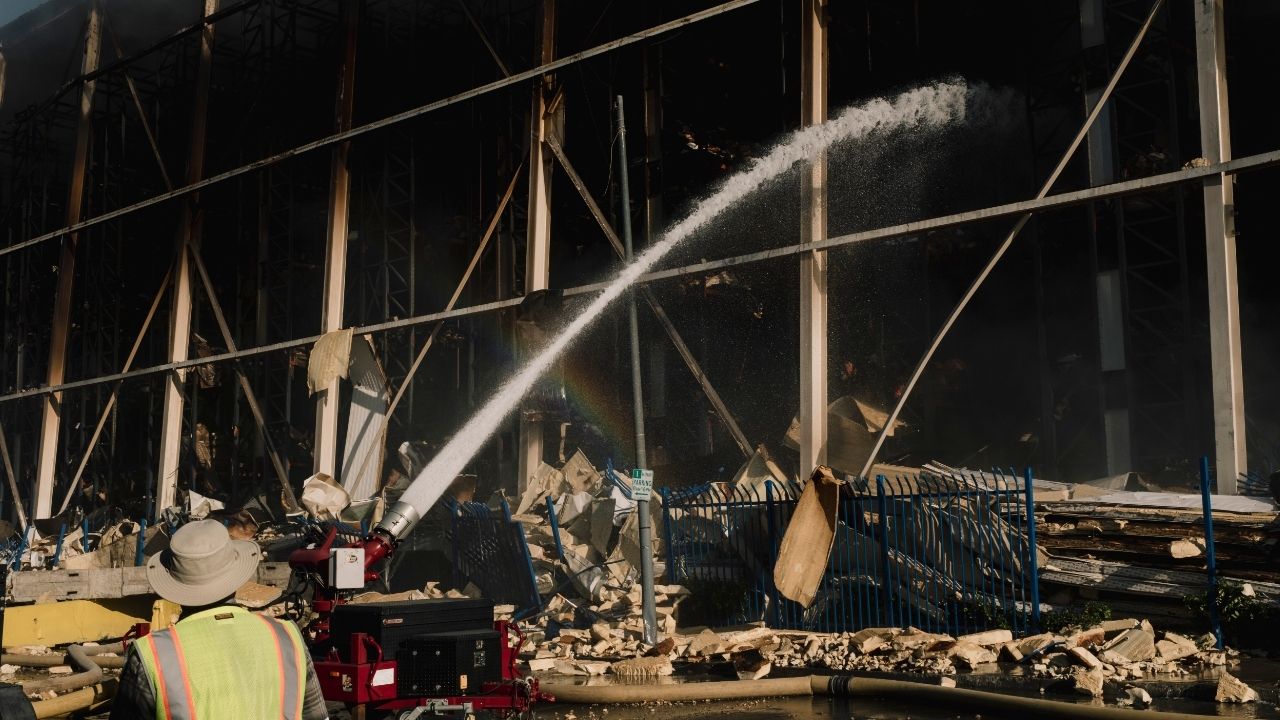
LOS ANGELES — Investigators in Los Angeles executed a search warrant Tuesday at the site of a massive warehouse fire that burned for a week and left millions of pounds of rotting food next to a residential neighborhood, officials said.
The Los Angeles County District Attorney’s Office said its investigators were on the scene Tuesday to assist the California Department of Toxic Substances Control, a state environmental agency, in its investigation into the fire at the cold storage warehouse, which stored frozen food. It was operated by Lineage Logistics.
It was unclear what the investigators were looking for Tuesday. The district attorney’s office prosecutes only criminal cases, and the DTSC, which does regulatory enforcement dealing with hazardous waste, has a criminal investigations unit.

However, it was the biggest and most visible step that the government has taken in investigating the role that Lineage and other companies connected to the warehouse played in the blaze and its aftermath.
The office of Los Angeles Mayor Karen Bass confirmed the investigation and search warrant Tuesday. “The residents of Boyle Heights and East LA deserve environmental justice and corporate accountability,” her office said in a statement.
The fire, which broke out June 17, upended life for several months in the Boyle Heights neighborhood of Los Angeles and in neighboring East Los Angeles. Many residents who live near the warehouse wound up in emergency rooms while it burned, and residents continued to report and seek treatment for various health issues as 88 million pounds of rotting food left in the fire’s wake unleashed a noxious odor into the neighborhood before it was cleaned up in late August.
People have reported nosebleeds, difficulty breathing, nausea, eye irritation and mental health issues since the fire began.
There has been widespread outrage from residents who say the government bungled its response. In the early days of the fire, officials distributed masks and air filters and offered some temporary housing to those living closest to the warehouse, but many residents reported challenges obtaining help and said it ultimately was inadequate.
Bass, who faces a tight reelection race in November, has acknowledged the frustrations of residents and has vowed to hold Lineage, the operator of the warehouse, and other responsible parties accountable. An emergency executive order the mayor issued in June directed the city attorney to look into pursuing an investigation with the Department of Toxic Substances Control. Bass has also repeatedly threatened to sue Lineage.
Lineage has blamed rooftop solar panels, which were undergoing maintenance when the fire broke out, for the blaze, and it has sued Altus Power, a separate company that owns the panels, over the fire. A fire department investigation could not determine the fire’s cause, but said that it could not rule out the solar panels.
Residents and community groups have demanded that Lineage and the government do more to address concerns about possible toxic contamination of the environment and nearby homes.
On Tuesday, a coalition of community environmental groups announced a lawsuit against the Environmental Protection Agency. The lawsuit, filed under the Freedom of Information Act, says that the agency has not responded to requests for data about chemicals released during the fire. The plaintiff, California Communities Against Toxics, and its allies said they were also pursuing litigation against local agencies in state court on similar grounds.
The EPA did not immediately respond to a request for comment Tuesday.
Much of the concern from community groups has centered on the possible release of ammonia from the warehouse during the fire. The chemical was used to help refrigerate the food. Lineage has said it pumped the chemical out of its refrigeration system before the fire could reach it and said testing had not detected harmful levels of it.
When asked about the investigation Tuesday, Lineage said in a statement: “Our industry is regulated by dozens of agencies, and we regularly work with them collaboratively and transparently. To be clear, we do not store hazardous chemicals or products in this facility. We store food.”
The sight of the investigators milling around the site on Tuesday initially prompted concerns in Boyle Heights, a largely Latino neighborhood with a large immigrant population, that the officials were with Immigration and Customs Enforcement.
Claudia Mancia, 40, said she got a text at around 9 a.m. about a possible ICE sighting at the site and went to check it out.
“We asked one of the officers if they were working with ICE and he said no,” Mancia said. “They were with the DA.”
Mancia, a Boyle Heights native, welcomed the investigation.
“I think it’s part of justice being served,” she said.
—
This article originally appeared in The New York Times.
By Orlando Mayorquín/Mark Abramson
c. 2026 The New York Times Company