
|
Getting your Trinity Audio player ready...
|
The FBI and prosecutors shared on Thursday new footage of the man charged with trying to assassinate President Donald Trump during the White House correspondents’ dinner at the Washington Hilton last weekend, leading up to when shots were fired.
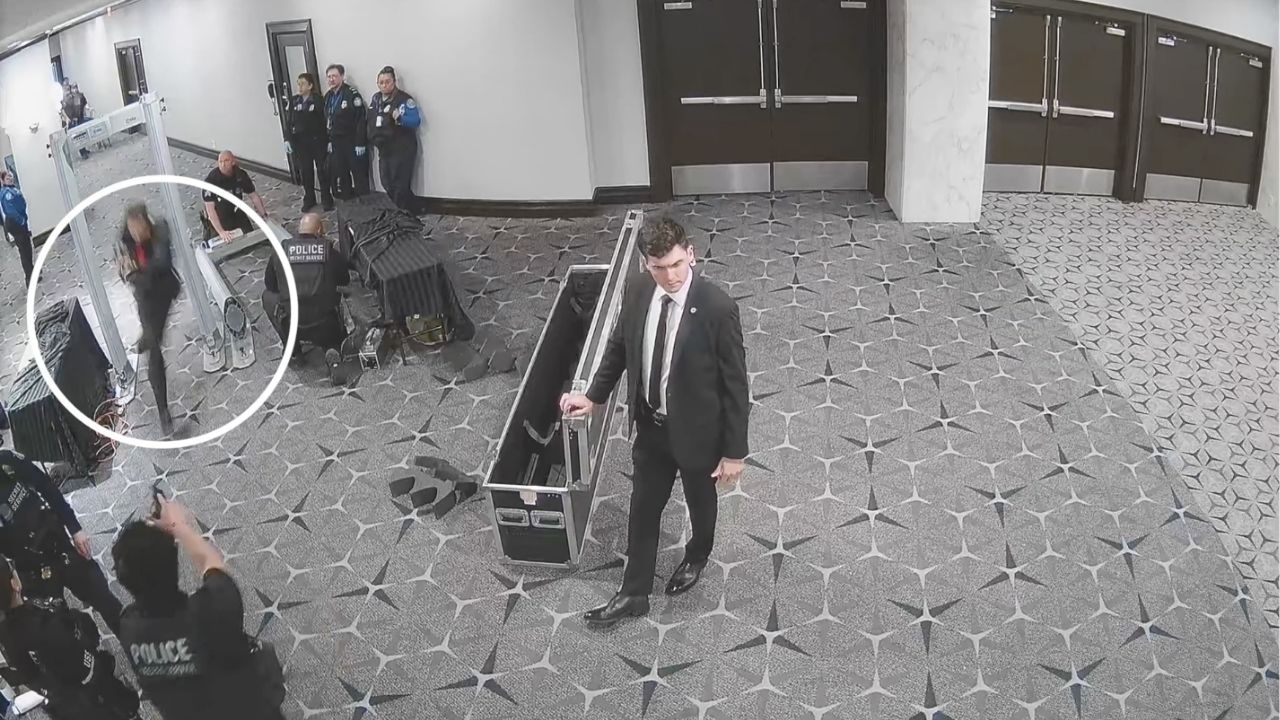
The video contains more than five minutes of edited and annotated surveillance footage that is sped up and slowed down in parts. It was shared on social media by the FBI and Jeanine Pirro, the U.S. attorney for the District of Columbia.
In her post Thursday, Pirro asserted that the video resolved uncertainty about whose gunfire had struck a Secret Service officer, who was protected by his bulletproof vest. The video, she wrote, showed that the man charged in the case, Cole Tomas Allen, had shot the Secret Service officer, and that there was “no evidence the shooting was the result of friendly fire.”

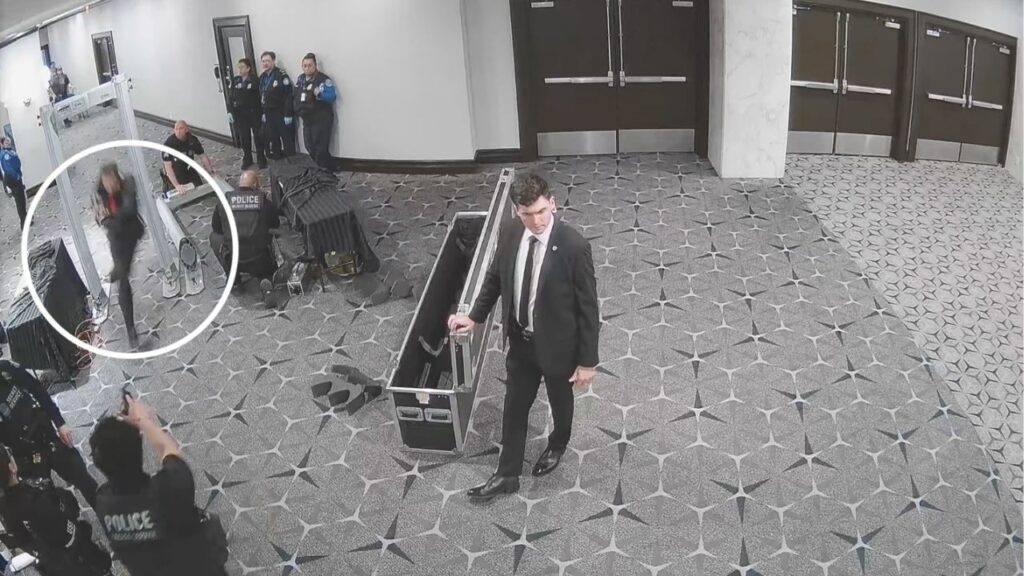
Trump shared similar footage Saturday, showing the assailant running through a magnetometer before law enforcement officers drew their guns. He was brought down and disarmed at the top of a staircase leading down to the floor where the dinner was being held, and officials said they recovered a shotgun, a handgun and knives from him.
Law enforcement and administration officials had previously stopped short of definitively saying whose gunfire had struck the officer’s vest, and the charges lodged against Allen on Monday, including attempted assassination, did not include shooting a federal officer, only with firing a weapon. In a court filing Wednesday, prosecutors said they believed that Allen fired his shotgun “in the direction of the stairs leading down to the ballroom.”
Most of the newly released video is focused on other elements of Allen’s actions. It opens with footage authorities have time-stamped as occurring on April 24, the day before the episode, and shows him walking through the hotel corridor and entering the gym.
In the segment showing Allen running through the magnetometer, officers appear to be breaking down the security station. He raises the shotgun as he races past them and aims it at security officers. The video has no sound, and it is unclear whether he discharges a shot.
The video then replays the footage at a slower speed, pausing and placing a circle around Allen as he runs through the magnetometer, then pausing and placing circles around officers’ guns as they appear to fire them.
A frame-by-frame analysis suggests Allen may have fired his 12-gauge shotgun during that confrontation. The clue is in the dust in the ceiling lights unsettled by the gunfire. In the frame after Allen aims at the security officers, the video shows that dust resting in two ceiling lights has been disturbed and is drifting downward. It is possible that this was caused by a muzzle blast from Allen’s shotgun. It is not until the next frame in the video — after the dust has been unsettled — that an officer returns fire.
Public defenders for Allen argued in a court filing that there had been contradictions in the description of the shots fired, and that the video evidence did not show a muzzle flash from his shotgun.
Prosecutors have countered that the evidence showed Allen fired the shotgun at least once as he ran past the magnetometers and that one spent shell was found in the recovered weapon.
—
This article originally appeared in The New York Times.
By Isabella Kwai, Malachy Browne and Devlin Barrett/FBI
c. 2026 The New York Times Company