

|
Getting your Trinity Audio player ready...
|
This story was originally published by CalMatters. Sign up for their newsletters.

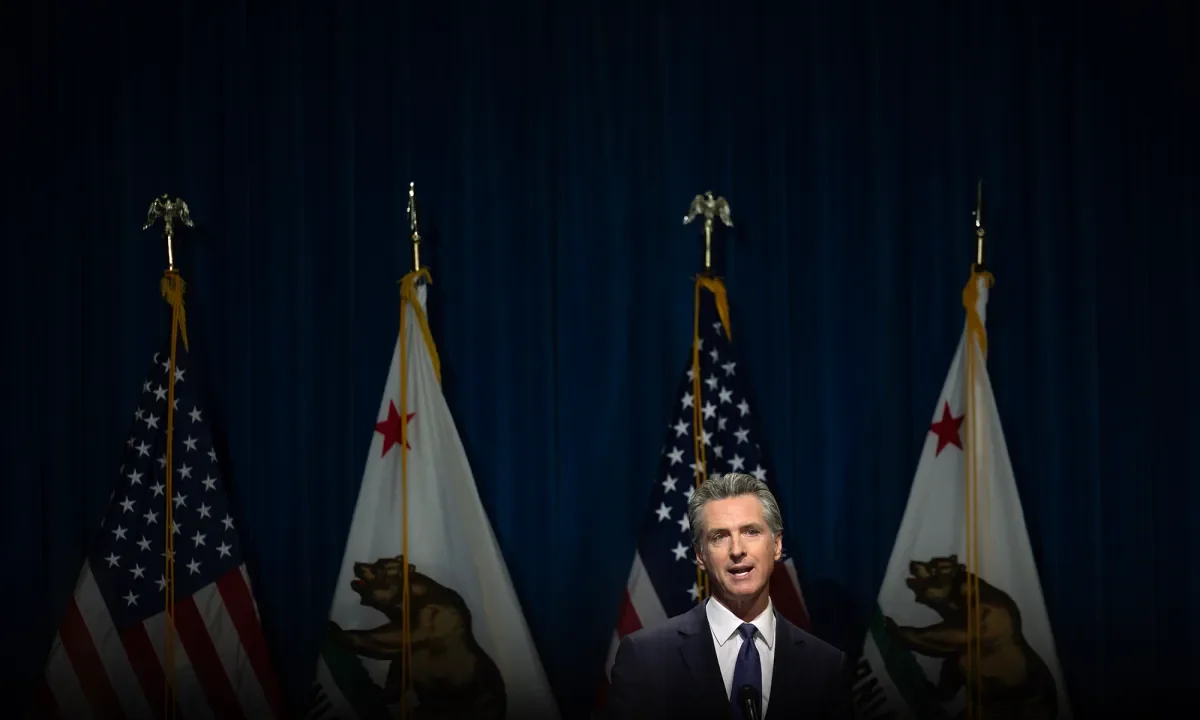
Gov. Gavin Newsom will promote California as an antidote to the Trump agenda on Thursday, telling lawmakers during a wide-ranging State of the State address that the state still leads in a host of critical areas such as manufacturing, technology and agriculture.
“Every year, the declinists, the pundits and critics suffering from California derangement syndrome look at this state and try to tear down our progress,” he said in prepared remarks released ahead of delivery. “California’s success is not by chance — it’s by design.”

He will tout a 9% reduction in unsheltered homelessness, cheaper insulin and increased clean energy use in California as among his accomplishments, in a speech delivered with an eye toward higher office.
The address is his first State of the State to lawmakers in the Assembly chambers since 2020. He will use it as an opportunity to highlight progress on some of his most ambitious promises, some of which haven’t been met, while positioning California and its leader as worthy of national leadership.
Related Story: Newsom K-12 School Proposal Would Shift More Power to Governor
Newsom Attacks Trump Administration
He targeted the Trump administration on a range of issues, including excessive policing and immigration raids, saying the state “faces an assault on our values unlike anything I have seen in my lifetime.” And in a common talking point for Newsom recently, he criticized the president for deprioritizing clean energy as China surges forward in electric vehicle production.
“In California, we are not silent. We are not hunkering down. We are not retreating. We are a beacon. This state is providing a different narrative,” he said in the prepared remarks.
On homelessness, the announced reduction in 2025 of unsheltered people, or the number of people who sleep outside, in cars or anywhere else not meant for habitation, is an important figure for the governor as he seeks to show improvement on one of California’s most stubborn challenges in his final year in office.
A humanitarian and public health crisis and the most visible consequence of California’s housing shortage, homelessness is sure to be an issue on which Newsom faces national criticism should he make an expected presidential run in 2028.
But the reduction came after years of increases in homelessness despite Newsom’s campaign promises to address the issue and his administration pouring over $24 billion into it during his two terms. In 2024, the year before the announced reduction, homelessness in California hit a record high: 123,974 were unsheltered while 63,110 were sheltered. That year, homelessness also spiked nationally.
Newsom on Thursday will not announce the number who were homeless overall in 2025. He will tout his administration’s focus on sweeping street encampments and building new mental health facilities paid for with Prop. 1, a bond he promoted and which voters approved in 2024.
Improving California’s Affordability
He will also speak about making the state more affordable, an issue over which Democrats and Republicans nationally are jockeying for credit after the 2024 presidential election showed voters were heavily motivated by the high cost of living.
He plans to seek out policies in his final year in office to crack down on large-scale investors buying up houses, forcing would-be homebuyers to compete — a day after Trump also announced a similar effort. It’s a new area for him in housing policy, after years seeking to boost construction. Newsom ran on a promise of building 3.5 million new housing units; the state has fallen far short of that.
Newsom also ran on a promise of a universal public health care system; he has since shifted to expanding access to Medi-Cal, the state health program for low-income residents that faces punishing federal cuts under Trump. On Thursday, he will tout the state’s production of $11 insulin as one way his administration has tackled health care costs.
This article was originally published on CalMatters and was republished under the Creative Commons Attribution-NonCommercial-NoDerivatives license.