


|
Getting your Trinity Audio player ready...
|
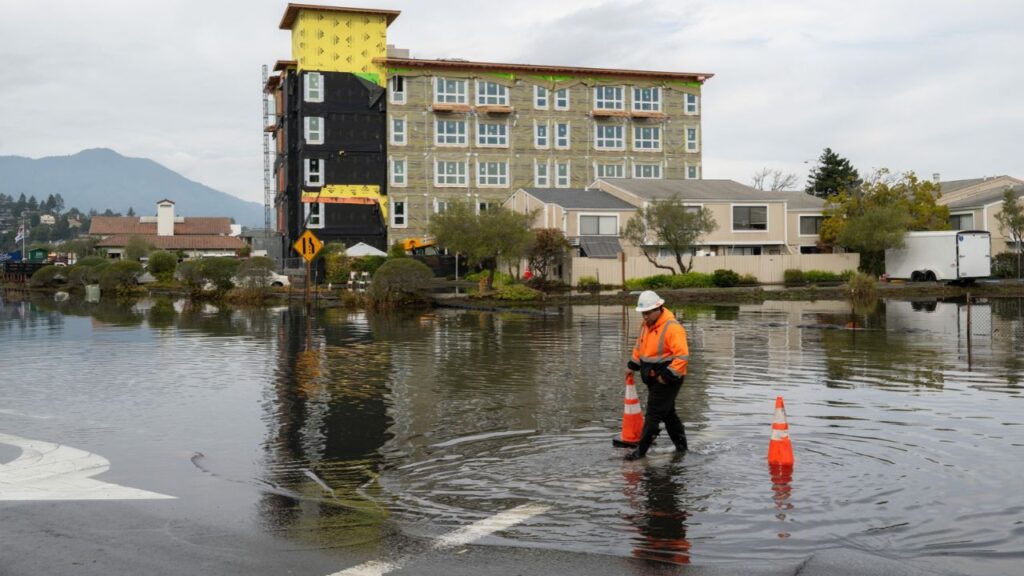
California was experiencing another day of extraordinarily high tides Wednesday as a mix of seasonal king tides, an unusually strong El Niño and incoming Pacific swells began to push ocean water into coastal neighborhoods across the state.
“We’re kind of in uncharted territory,” said Robbie Munroe, a meteorologist with the National Weather Service in Los Angeles.
After a storm cleared out Wednesday morning, the waves began cresting under sunny November skies, attracting gawkers and surfers. The tide in La Jolla, a neighborhood in San Diego, reached 8.11 feet in a preliminary measurement, breaking the record of 7.98 feet set Oct. 27.

Santa Barbara also experienced its highest tide ever measured, though the data there dates back only to 1990. And the tide in Los Angeles preliminarily tied the record set Oct. 27.
Wednesday morning’s high tides began arriving in the southern part of the state after 8 a.m., and they were expected to reach Northern California in the subsequent hours.
In San Francisco, Tuesday’s high tide appeared to reach just over 8.2 feet, enough to make it one of the highest there but falling short of the 8.82-foot record set in 1983.
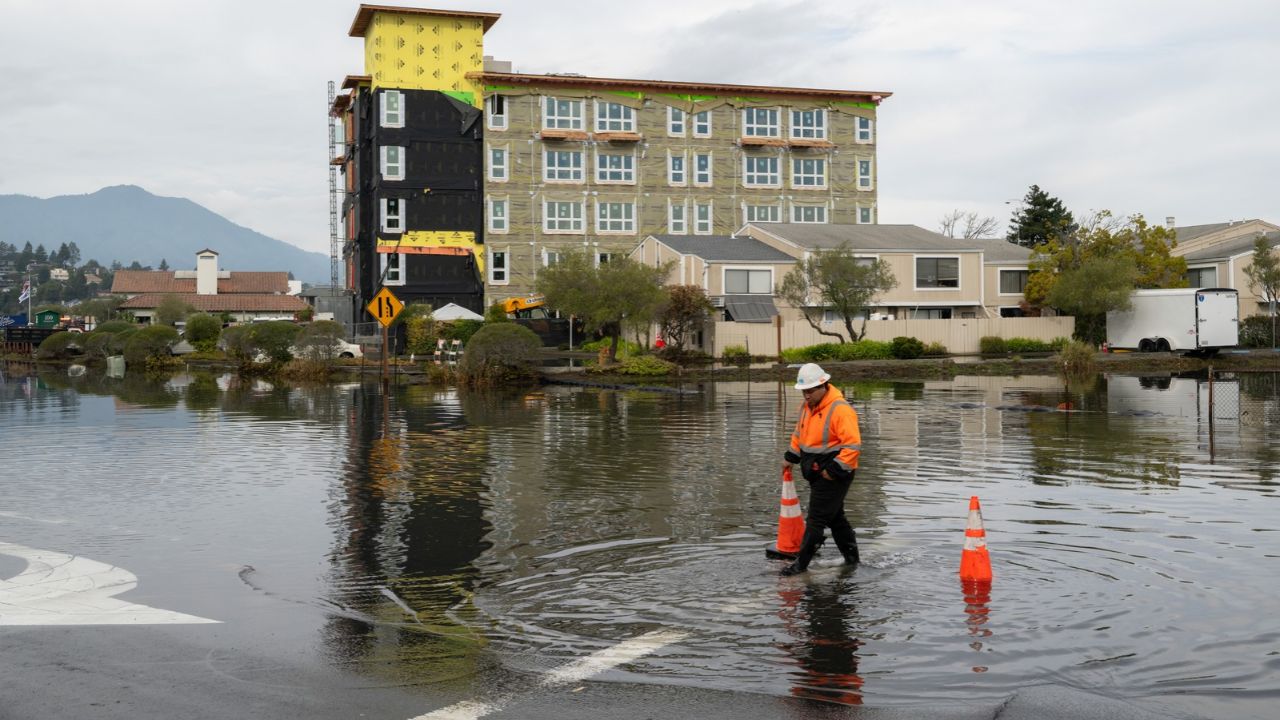
On Tuesday, floodwaters inundated low-lying areas in Marin County, just north of San Francisco. In Humboldt County, more than 200 miles north of San Francisco, residents in the community of King Salmon were ordered to evacuate and told they might have to stay away until Friday. Tuesday’s high tide there reached just over 10 feet, the second-highest on record.
In Santa Cruz County, just south of San Francisco, evacuation warnings were issued Tuesday afternoon for about 200 homes along a few coastal roads in anticipation of higher tides Wednesday.
“Large waves have the potential to reach homes and cause dangerous coastal flooding and road closures,” the Santa Cruz County Sheriff’s Office said.
In Southern California, high tides were paired with surging waves and threatened areas Tuesday that were still recovering from high water levels over the past few months. That afternoon, evacuation warnings were issued in parts of Santa Barbara County along the coast and will remain in effect until further notice.
Valerie Cimmarusti, a homeowner in the Sunset Beach neighborhood of Huntington Beach, said she and her family had been working to prevent her house from flooding again after its garage had gotten 3 inches of water last month.
Water from a canal behind her home breached its wall Tuesday “but nothing like October, where it was coming over like a river,” she said.
King tide is a nonscientific term for the highest tides of the year. It was popularized by environmental efforts that sought to document dramatically high tides as a way to help communities conceptualize what sea level rise would look like in a changing climate.
King tides are caused by a unique alignment of the sun, moon and Earth that maximizes the gravitational pull on the oceans. Because El Niño has raised the sea level of the Pacific higher than normal, these winter tides have forced emergency officials in towns across the state to install temporary flood walls and pile sandbags, hoping to keep the water at bay.
On Wednesday, forecasters warned that unique weather conditions might nudge the already high tides even higher in Northern California, where a storm system that brought light to moderate rain early Wednesday had exited by late morning.
Scientists knew going into this winter that the strength of the El Niño pattern would probably lead to some of the highest tides on record. But in many ways, this week has exceeded their expectations.
“Typically with an El Niño in San Diego, you might get a half a foot to maybe a foot,” said Mark Merrifield, an oceanographer at the University of California, San Diego. “But we’re well above that with this El Niño event.”
He added that water levels were “higher than my expectations.” Tides at their peak in La Jolla were about a foot higher than experts had predicted going into the week. Merrifield said he expected that conditions would worsen Thursday with the arrival of additional high-swell waves.
Weather forecasters have issued rarely used coastal flood warnings through Thursday.
It isn’t just the travel disruptions that could come with flooded roads Wednesday. Meteorologists in San Francisco and Los Angeles expressed concern for anyone heading to the beach over the holiday.
“When we get up to near 80 in late November, with water temperatures near 70, it’s pretty unheard-of in terms of beach conditions,” said Munroe, the meteorologist in Los Angeles. “People will be probably be trying to head to the beach if they’re not taking our warning seriously.”
Cindy Palmer, a meteorologist with the weather service’s Bay Area office, said the larger waves could push the already elevated tides farther up the beaches and even produce sneaker waves, which happen when wave energy combines and sends a sudden surge much farther up the shore than preceding waves.
Pounding waves on top of a high tide could erode beaches, making them more vulnerable to future storms, experts warned.
There are still two more rounds of king tides to come this winter, one during the week of Christmas and one in late January. Palmer said she expected the tides then could be even higher.
–
This article originally appeared in The New York Times.
By Judson Jones and Amy Graff/Mike Kai Chen
c. 2026 The New York Times Company