

|
Getting your Trinity Audio player ready...
|
David Hunter, known for sporting colorful ties printed with art palettes and paintbrushes, is popular among his elementary students. Not only for his eccentric fashion sense, but also because, for many young children in Fresno Unified School District, he is their introduction to the arts.

By Vani Sanganeri
EdSource
“Every kid knows who I am and what I’m there to do, and that gives them a lot of joy,” Hunter, a former traditional classroom teacher, said. “They all enjoy having art, and I’m actually there tying it into what they’re learning.”
California’s third-largest school district has dramatically expanded arts education over the past three years, largely due to Proposition 28. The 2022 voter-approved measure sets aside roughly $1 billion annually for California schools to expand the arts for TK-12 students.

This story was originally published by EdSource. Sign up for their daily newsletter.
New Funding, New Challenges
But that windfall has brought new challenges for California schools. For decades, arts programs were the first to go with budget cuts. Now, school leaders must quickly spend millions in annual arts funds while navigating a shortage of credentialed arts educators, confusion around spending rules and new standards for art, music, dance and theater programs.
California schools spent about 96% of their Prop. 28 funds from the 2023-2024 school year, the first year of Prop. 28’s rollout, according to the California Department of Education. About 340 school districts, charter schools and county offices of education that did not spend all of their funds will lose a total of $32.9 million in arts education funding next year.
Fresno Unified, with the state’s third-largest allocation of Prop. 28 funds, spent all of its $13 million allocation for the first year. The district hired itinerant instructors to serve all school sites and focused on expanding arts education for elementary schools.
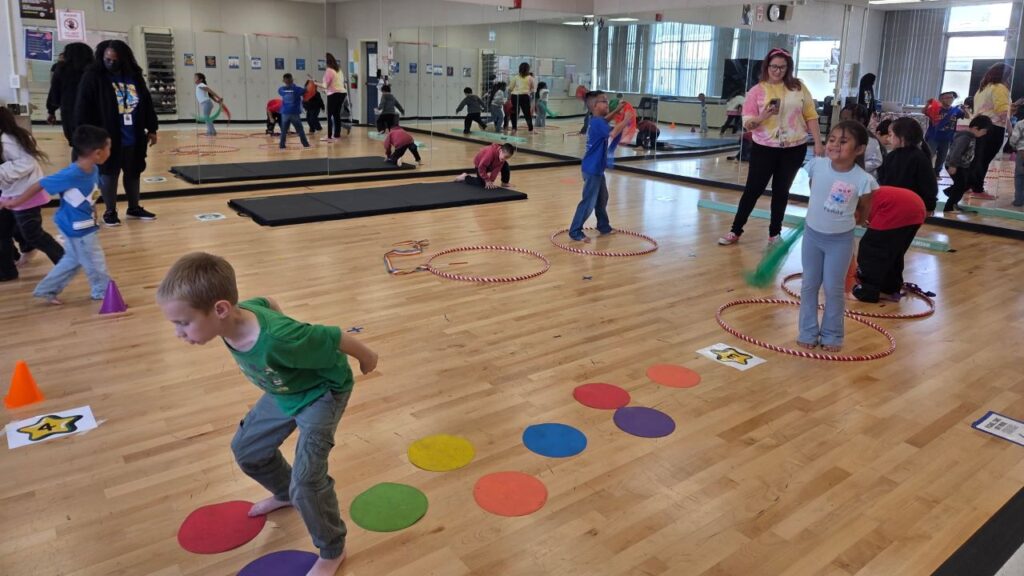
Heather Kuyper-McKeithen, arts education manager for Fresno Unified, said the district zeroed in on two elementary school programs: arts integration (which incorporates the arts into core academic instruction) and dance. Elementary schools must choose to participate in one or the other.
Kuyper-McKeithen said Fresno Unified was able to build its arts programs because it recruited arts teachers early in the rollout of Prop. 28 and educators were “willing to paint the bus while it is going down the road.”
“Everyone was also so used to grant money disappearing after a few years, that we had to think more strategically with an eye towards the long term,” Kuyper-McKeithen told EdSource in October.
Related Story: FUSD Superintendent Receives Positive Evaluation, Forgoes Raise
56 New Full-Time Arts Teachers Since 2023
Since 2023, Fresno Unified has hired 56 new full-time equivalent arts educators, including 25 full-time dance teachers and 20 elementary arts integration teachers for its 72 elementary schools.
Like a lot of other districts, Fresno Unified has struggled to find enough credentialed arts educators. The district expanded its dance and arts integration programs largely by transferring existing staff into arts teaching roles as they worked to earn new credentials.
Most arts integration teachers, for example, previously taught as traditional classroom teachers and already have multiple-subject teaching credentials. They must earn their supplemental arts credential, or pass the California Subject Examinations for Teachers, within three years on the new assignment.
Many dance instructors also taught under physical education credentials, and can earn their dance credential — which can take up to two years — while teaching in their Prop. 28-funded roles.
Arts Integration May Improve Learning
Hunter, the arts integration teacher and coordinator at Fresno Unified, helped launch and grow the arts integration program from eight teachers serving 16 schools to 20 teachers serving 40 schools since 2023. Arts integration has gained traction in recent years as a teaching model that may improve learning in core subjects, strengthen retention and support cognitive and social-emotional development by weaving arts into academics.
Hunter previously worked as a classroom teacher and now teaches arts integration lessons in seven elementary classrooms a day between Thomas Elementary and Holland Elementary.
“I’ve been in multiple rooms where students have a hard time engaging with the content, and then, through art, I can help them engage more — that’s stronger than even art as a standalone subject,” Hunter said.
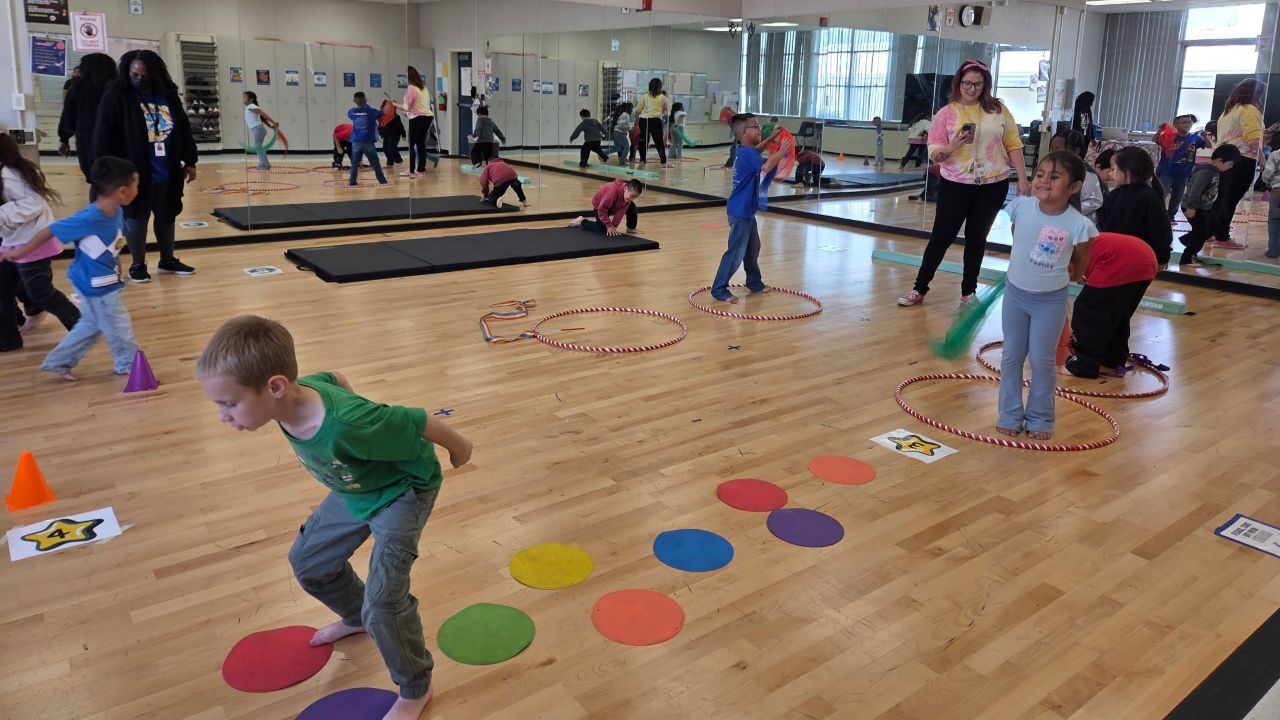
Saima Nunez, a dance teacher at Del Mar Elementary in central Fresno, helped expand the district’s new dance program from four dance instructors teaching at one elementary school to about 25 instructors teaching at 33 school campuses since 2023. She recruited many dance teachers from an existing pool of teaching artists, or non-credentialed instructors who may have taught students outside of regular school instruction.
“Most of the experiences that we were giving (students) were only for kids who were in after-school programs, usually put on by teaching artists, not teaching by the (state) standards,” Nunez said. “Now, they’re getting an actual dance curriculum during their school day. They love it.”
Related Story: Fresno Unified Trustees Now Have the Power to Investigate Student Deaths
Teacher Credentialing Remains a Barrier
Despite the dance program’s expansion, Nunez, also Fresno Unified’s dance coordinator, said the district has struggled to hire and retain enough dance teachers. Because the state now requires districts to hire instructors with dance credentials, Fresno Unified has lost nine dance teachers since 2023, Nunez said.
“We lose them because the credentialing process is difficult — they’re essentially leaving because they’re not finishing the credentialing, or they’re not getting into the (credentialing) programs,” Nunez said. “Even if we hire them as an intern, if they don’t get into the program, we have to cut them.”
Many of the district’s dance teachers taught under physical education credentials, and those with a career technical education credential can only teach in high school, Nunez said. A dance credential can take roughly two years to earn, and most dance instructors also teach full-time.
“The state is asking us to support the arts, and right now, our universities aren’t doing their part to feed our system,” Nunez said. “People can’t give up their day job to go take those classes.”
Hunter, who has a credential in multiple-subject teaching, said he has found it challenging to balance his classes at Fresno City College and Fresno Pacific University, where he is earning his supplemental arts credential, with full-time teaching. He currently teaches under California’s limited teaching assignment permit.
Prop. 28 Requires a ‘District-Wide’ Vision
Although Prop. 28 funds are allocated per school site, districts can pool funds and hire itinerant instructors who travel between schools rather than teach at a single school site.
For Rita Prescott, an arts integration teacher at Fresno Unified, that approach is more sustainable and equitable. Prescott teaches arts integration to about 20 classrooms per week, and she said her lessons have helped students build their imaginations, explore storytelling and self-expression, and learn creative ways to recognize patterns.
Arts integration teachers “don’t come for the worksheets,” Prescott said. “We come for experiences.”
Nunez said Prop. 28 funds have helped schools to pay for the higher costs that come with sustaining a dance program, including space for studios and props or attire for cultural dances. Most schools that opted into dance, instead of arts integration, were in communities that had long advocated for cultural dance, such as the Latin American dance Folklorico and Hmong dance.
Kuyper-McKeithen said other districts can similarly put their Prop. 28 funds — which is ongoing, unlike grant funding — toward programs that serve their students’ long-term needs.
“Thinking strategically and creatively and being willing to lead with a vision are essential in the execution of a district-wide Prop 28 plan,” Kuyper-McKeithen said.