



|
Getting your Trinity Audio player ready...
|
At Cayucos State Beach, a stretch of idyllic coastline in an old California seaport village, surfers bobbed in the shimmering swells. The air was damp and sticky with salt.
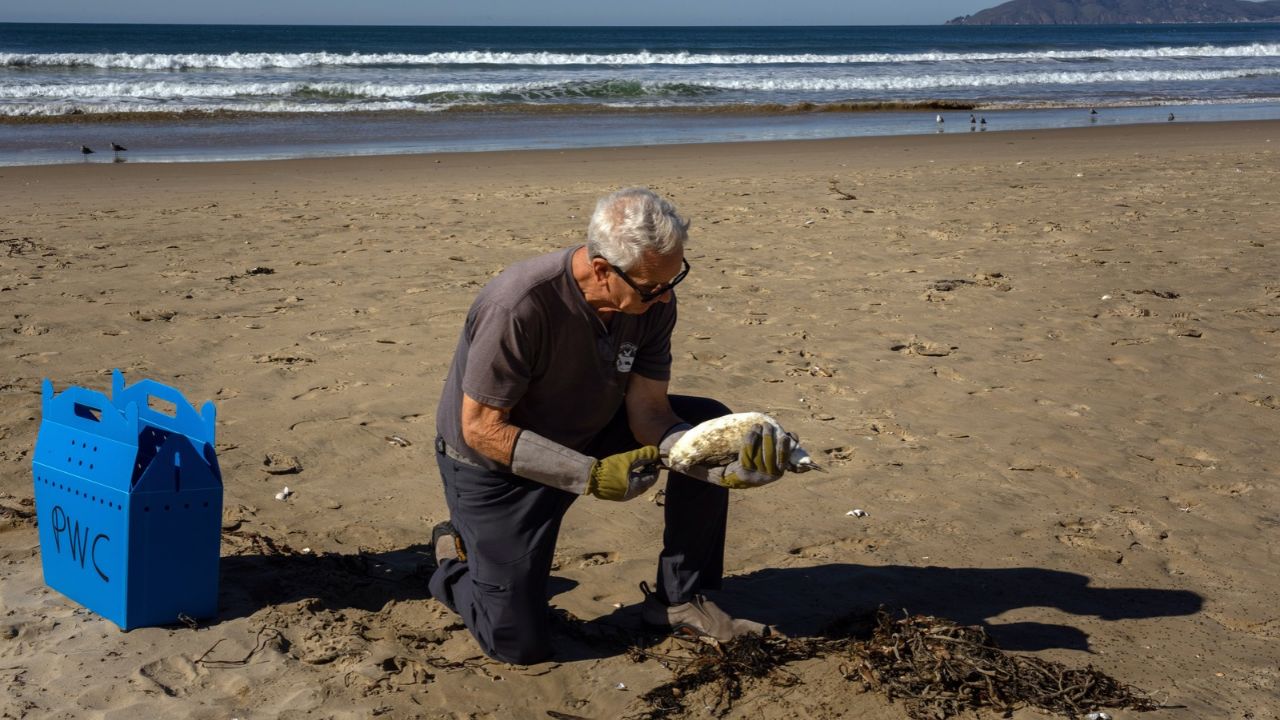
And the carcasses of dead birds crowded the sandy shoreline.
Over the past few months, thousands of starving seabirds have been washing up on California’s Central Coast between San Francisco and Los Angeles. The situation has distressed scientists, who say the animals are struggling to survive in waters that have become much too warm.

The effects of climate change have been compounded this year by El Niño, a climate phenomenon that drives warm water across the Pacific Ocean and is predicted to be extreme this winter.
The exact number of bird deaths is not yet known. But at one Central Coast beach, rangers have found more than 1,900 dead seabirds and 750 requiring medical attention since September. During the same time period last year, they counted about 120 sick and dead birds on their sands.
“We use this phrase ‘the canary in the coal mine,’” said JD Bergeron, CEO of International Bird Rescue, a Bay Area-based wildlife hospital that has treated hundreds of birds this year. “We’re seeing indications from seabirds that something is really not right.”
In recent weeks, the warming waters off California have been viewed as a novelty, bringing tropical sea turtles, hammerhead sharks and crystal-clear conditions. But the rising temperatures also spell danger for native plants and wildlife that rely on cold water to survive, such as giant kelp, sea lions and seabirds.
Common murres, crow-sized birds that typically dive underwater to hunt anchovies and rockfish, have been particularly hard hit. Record ocean temperatures appear to have driven fish into deeper, colder waters, scientists say. So the murres are starving to death and washing ashore.
The public has grown alarmed at the feathered bodies lining the sand. Murres can live for more than 20 years but spend their lives almost entirely at sea, so most people have never seen one in the wild. The birds have a guttural, low-pitched call and striking plumage in a black-and-white tuxedo pattern.
“We keep getting calls for penguins at the beach,” said Joanna Iwanicha, a senior environmental scientist at Oceano Dunes State Vehicular Recreation Area in San Luis Obispo County.
California’s Central Coast stretches for roughly 300 miles and is recognizable to road trippers who have stopped to tour Hearst Castle, snapped photos of Big Sur’s crystalline pools or gazed upon Morro Rock, known as the Gibraltar of the Pacific. It’s in this region, home to about 1.5 million people, where the most murres have washed up in recent months.
In Cayucos, a beachside community of 2,500 people about 200 miles north of Los Angeles, fishermen cast lines into the water from a rickety wooden pier. Out-of-towners lined up to eat breakfast tacos on a sunny seaside patio below squawking seagulls. And a boy kicking a soccer ball on the beach swerved to avoid the black-and-white dead birds littering the tide line.
Dexter Marquardt, 27, said he has been surfing here without a wet suit lately because the ocean is so balmy. Scientists recently reported that temperatures in Monterey Bay, also on the Central Coast, were 13 degrees Fahrenheit higher than average.
“I don’t know if it’ll ever go back to normal,” he said. “Or what’s normal at this point.”
It’s likely that more species will be affected in greater numbers in the coming months as El Niño warms the ocean further, said Tammy Russell, a marine ecologist at the Scripps Institution of Oceanography.
Brown pelicans, Brandt’s cormorants and murres had already been dying this spring amid a marine heat wave, and it now appears that the murres are part of a second large die-off in California.
Murres primarily breed on rocky islands off Northern and Central California, with the largest colony on the Farallon Islands near San Francisco. Dead murres are most likely washing ashore in huge numbers on the Central Coast because the waters have warmed there more than in the northern part of the state, Russell said.
She said scientists are still trying to understand exactly what is driving the starvation deaths and whether there may be factors beyond warming waters pushing fish deeper into colder waters.
“We don’t have all the answers, and science doesn’t either right now, because we’re still in this event,” Russell said.
The last time a marine heat wave overlapped with El Niño, about a decade ago, there were huge die-offs of salmon, sea lions and seabirds along the West Coast. An estimated 4 million murres perished in Alaska, representing the largest recorded die-off of a single species in modern history, according to scientists.
In Morro Bay, south of Cayucos, Pacific Wildlife Care has treated more seabirds this year than ever before in its 40-year history.
The clinic, which sits in the shadow of three power plant smokestacks that built the city’s economy, has admitted 924 murres since September, compared with 24 in the same period last year. On a recent afternoon, a veterinary technician injected fluid under the feathers of a sick bird with tiny socks on its webbed feet. She then updated a color-coded whiteboard listing each seabird patient, nearly all of whom had “emaciation” listed as the reason for admission.
“It’s been something like we’ve never seen before,” Kelley Boland, development coordinator, said over the loud puffs of an oxygen machine that was keeping a sick bird alive.
—
This article originally appeared in The New York Times.
By Soumya Karlamangla/Loren Elliott
c. 2026 The New York Times Company