

|
Getting your Trinity Audio player ready...
|
Facing a student housing crisis and flush with a historic budget surplus, California leaders in 2021 made an unprecedented $2 billion investment to build more dorms at public universities and colleges.

Since then, universities and colleges have leveraged that funding to collectively build more than 9,000 beds for students. But higher education institutions have also encountered a distinctly California reality in trying to expand student housing: It’s very expensive to build in the Golden State.
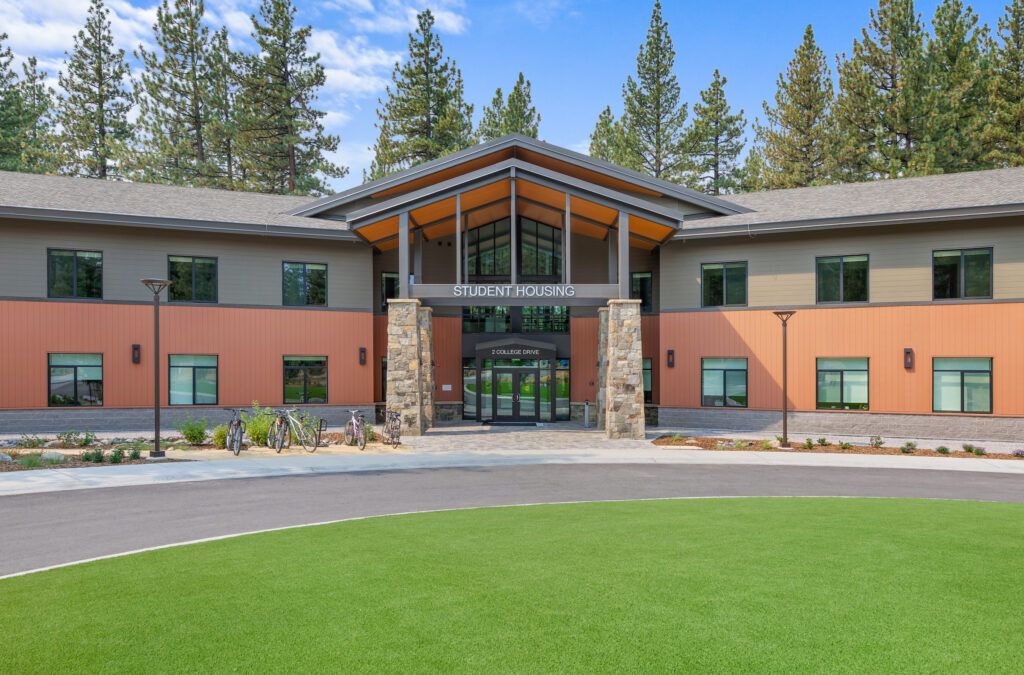
At UC San Diego, for example, a 1,423-bed dorm opened in 2024 cost $260,000 per bed to build. At California State University, Northridge, the 200 beds in two residence halls that opened in 2025 cost $360,000 each. And at Lake Tahoe Community College, the per-bed cost for a 100-bed dormitory stretched to $400,000.

This story was originally published by EdSource. Sign up for their daily newsletter.
Those cost-per-bed figures, which are based on the latest available reports colleges and universities submitted to the Legislature, could ultimately be higher considering those projects were funded with bonds, which the state has agreed to pay interest on.
The high cost of building — partly stemming from inflated construction expenses, strict building regulations and legal challenges — presents a conundrum for California’s higher education institutions. There is a near-constant demand for more on-campus affordable housing for students, but skyrocketing building costs make it difficult for universities and community colleges to create more supply.
State funds have played a pivotal role in completing projects that expanded affordable on-campus housing options for students, university officials said.
“We didn’t create the housing crisis in California, but I think we’ve been a big part of the solution in terms of our growth plans and the number of beds we’ve added in our communities,” said David Phillips, a UC associate vice president who oversees capital programs, energy and sustainability initiatives.
University students have struggled with the state’s high cost of housing. About 1 in 4 students recently reported feeling unable to afford housing and utilities, according to a California Student Aid Commission survey.
There is still a “significant need” for more student housing, Kate Rodgers, the outgoing chair of Student Homes Coalition, said. But there has been progress, she noted, pointing to UCLA’s four-year housing guarantee for freshmen as one example.
Some California universities have recently tried to move more first-year students onto campus as a means to help improve academic outcomes. Sacramento State recently rolled out a new two-year, on-campus housing requirement.
For many campuses, the priority is to provide affordable housing, considering how expensive market rate housing is in the state. The state funding will enable campuses to charge cheaper rent for students, but affordability remains a challenge.
“Unless there is a significant source of funds available for housing, I believe their hands will continue to be tied in terms of how affordable they can make it,” said Kashia Amber Arnold, the assistant director of UCSB’s Blum Center on Poverty, Inequality, and Democracy.
What Makes Student Housing So Expensive?
On a square-foot basis, constructing market-rate housing in California costs more than twice as much as it does to build in states like Texas. Affordable student housing is no exception.
A recent study of CSU housing projects examined why student housing costs more than privately developed multi-family housing. It found that rigorous standards related to energy usage and planning decisions, such as hallway width, all contributed to the elevated price tag.
The location of these projects, which is often limited to sites on or near campuses, can significantly drive up costs, as well.
“Our communities are all in the most expensive communities in the whole state,” said Michael Bedard, UC’s deputy director of state governmental relations, noting UC Merced may be an exception. “The median home price is like a million dollars or more in every other UC town — $2 million in some.”
Lawsuits designed to obstruct housing projects have also led to delays — such as the People’s Park Project at UC Berkeley — which have led to ballooning construction and legal costs. Between 2018 and 2023, seven UC housing projects were challenged by community members under the California Environmental Quality Act, a state environmental law that has been used routinely by opponents to delay construction.
At 200 beds, the CSU Northridge project was a relatively small project. But site work, utilities and shared infrastructure do not scale down proportionally with size, Ken Rosenthal, the university’s associate vice president of facilities development and operations, said in a statement.
Rosenthal said student housing helps advance the university’s goals of improving academic success and retention, while offering students affordable housing options in the notoriously expensive Los Angeles market.
Lake Tahoe Community College’s remote location presents a challenge in drawing construction bids, and strict regional permitting requirements limit construction from May to October, driving up overtime and weekend building costs, according to the college. The dorm’s construction included additional features to insulate and fortify against heavy snowfall during Tahoe winters, adding to building costs, LTCC spokesperson Mark Thomsen said in a statement.
A Novel Experiment With State Funding
The Legislature approved the Higher Education Student Housing Grant Program in 2021 when California had a staggering budget surplus. The grant allocated $2 billion to housing projects on public college and university campuses and marked the first significant attempt by the state to finance student housing. Previously, UCs and CSUs had largely funded housing projects with rent paid by students.
Two years later, the state’s budget situation had worsened and Newsom asked universities and colleges to return their grants to help plug California’s deficit. In lieu of the grants, Newsom asked the UC and CSU segments to issue revenue bonds to cover the projects’ costs. The state agreed to cover the bonds’ interest. (The State Public Works Board is issuing bonds on behalf of CCC, because the segment does not have the authority to do so on its own.)
The change to the projects’ funding structure will ultimately cost the state at least 50% more than the original $2 billion the state planned to fund through grants.
CSU estimated that interest on the revenue bonds will reach $661 million. UC estimated its interest will cost $460 million paid over 30 years. A Finance Department spokesperson said that only one bond had been sold so far to finance the Lake Tahoe project. The total debt service of that bond, which includes the cost of the 100-bed facility, is projected to be $53.9 million.
A 2025 report from the California State Auditor found that the funding changes delayed construction of some housing projects. The CCC student housing director told auditors that those delayed projects are now facing higher construction costs due to inflation.
“The projects got funded a little bit later than we had anticipated,” Paul Gannoe, an assistant vice chancellor at CSU, said. “We went through a couple cycles of higher than usual escalation in construction costs.”
‘Affordability Is Really Paramount for Us’
State funding has been critical to build several intersegmental projects, such as UC Merced and Merced Community College’s “Promise Housing,” a dorm that houses community college and UC or CSU students, university officials said.
“It’s very unlikely that we would have built them in partnership with the community colleges without that support from the state,” Phillips said.
Construction of a 488-bed dormitory for Merced College and UC Merced students on the university campus is expected to be completed in October 2026.Ricardo Cano / EdSource
The value of housing everyone together is that community college students see themselves as peers with the UC students, Bedard said.
“When they see themselves in that community . . . they can see the future when they are able to transfer,” he said. “It’s very encouraging.”
California public universities stand to receive even more in funding for building affordable student housing if voters pass Proposition 1 this November. The measure would provide funding, via bonds, for various affordable housing programs across the state, including $175 million to UC and CSU each to help spur more construction.
Higher education leaders commended the state funding for helping lower universities’ financial barrier to building housing. That support allows campuses to offer more affordable beds for students.
“We’re really acutely looking at financing of the housing because affordability is really paramount for us,” said Ray Murillo, an interim assistant vice chancellor at CSU.