

|
Getting your Trinity Audio player ready...
|
Brittney Camacho was in disbelief after she received the call from the Visalia Police Department in Tulare County in September 2025. An officer told her something that her children could not — that they may have been the victim of physical abuse.

The alleged suspect? Her children’s teacher.
“I would never have assumed that was happening at the school,” she said. “I was in shock.”

The allegations prompted Camacho and other Visalia Unified parents to push for cameras in special education classrooms, arguing they could protect students who may be unable to tell their parents what happens at school. Parents in Bakersfield, about 80 miles south of Visalia, mounted a similar effort.
This story was originally published by EdSource. Sign up for their daily newsletter.
Online Petition Attracts 2,700 Signatures
Parents’ concerns in two Central Valley school systems have raised a broader question: Should California schools be required to record classrooms serving students with significant disabilities?
An online petition urging Visalia Unified to install cameras in special education classrooms has received more than 2,700 signatures. A separate petition has garnered over 12,800 signatures in an online petition to outfit special classrooms with surveillance cameras in Bakersfield City School District.
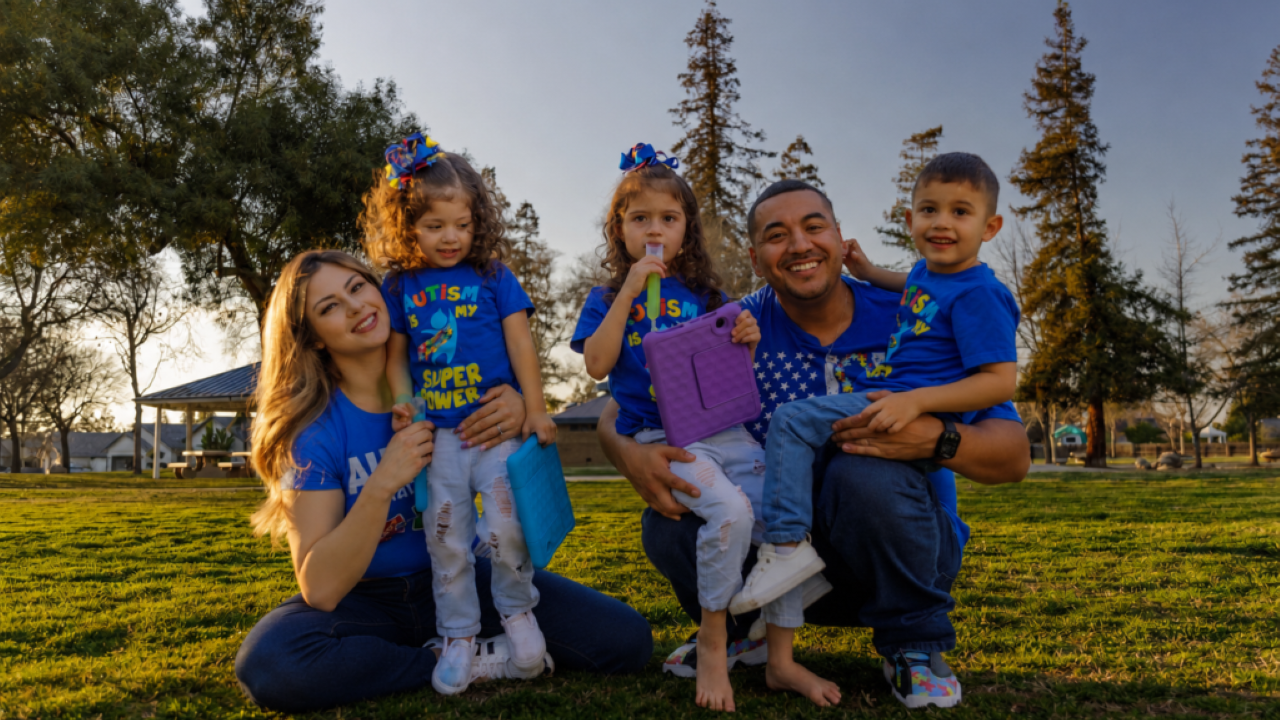
Camacho said three of her children — two girls who are now 9 and a son who is 7 — were taught by the same kindergarten teacher who police investigated for suspected misdemeanor child abuse. Two of them are nonverbal and a daughter has echolalia, a condition in which she repeats words others say.
She confirmed to EdSource that her three children were among the victims in complaints reported to police.
“Cameras are so, so important because these children don’t have a voice,” Camacho said. “From our experience, putting a child’s safety in the hands of adults’ word of mouth has failed our children.”
Classroom aides at Highland Elementary School in Visalia told police that the teacher was “aggressive” and “rough” with students, according to a police report obtained by EdSource. One aide told police she witnessed the teacher kick the chair of Camacho’s son, “causing him to fall.” The same aide also said she saw the teacher knock a student to the ground by kicking him in the chest.
Another aide told police the teacher would forcefully grab students by the neck or wrist. A third aide told police that the teacher threw a shoe at a student’s face, after saying, “Don’t judge me for what I’m about to do.”
Teacher Removed From Classroom
Police opened an investigation into the teacher, Lacie Ann Horsting, 34, in September 2025 after receiving suspected child abuse reports.
In April, the Tulare County District Attorney’s Office filed 10 misdemeanor charges of child abuse that allegedly occurred during the 2024-25 school year. However, Horsting was ultimately not charged because the one-year statute of limitations for the charges ran out, according to District Attorney spokesperson Stuart Anderson.
“While this remains an active legal matter, Ms. Horsting was immediately removed from the classroom as soon as the district became aware of the situation, and has not been employed by the district since the 2024-2025 school year,” said district spokesperson Cristina Gutierrez.
School district officials declined to say whether Horsting resigned or was fired. Her teacher credential remains valid, according to the Commission on Teacher Credentialing.
Efforts to reach Horsting for comment via her attorney were unsuccessful.
Visalia Unified’s school board directed district administrators at a recent meeting to explore adding cameras inside special education classrooms.
“Are we solving the problem that is being brought to us? Or are there other ways to solve it?” Deputy Superintendent Mark Thompson said in an interview. “The answer is that I’m not sure yet.”
In April, four Visalia Unified families with nonverbal children who were taught by Horsting filed notice with the district that they intend to file a civil suit. One of the claims on behalf of a student, identified as A.C., alleges that two aides reported two suspected child abuse incidents to school administrators shortly after they occurred in March 2024, yet the child’s parent wasn’t notified until October 2025.
“The District’s silence, combined with A.C.’s communication disability, meant that A.C.’s parent had no reasonable means of discovering the abuse during the period in which it occurred,” the claim stated. The child experienced emotional and psychological harm, including fear of adults, regression in toileting and sleep disturbances, according to the claim.
California Law Limits Cameras in Classrooms
The issue of cameras has gained traction across the country in recent years from families of students with disabilities, said Chris Roe, a Louisiana-based director of state policy for the Council of Parent Attorneys and Advocates.
“A lot of students in these classes are unable to explain what is happening,” said Roe, the father of two children with learning disabilities. “Students have come home that have had injuries or marks or signs of trauma that they can’t explain.”
Ashley Hopwood, whose two daughters spend most of their school day in special education classrooms, authored the Bakersfield petition. She wants state lawmakers to pass legislation to allow cameras in special education classrooms across the state.
When a paraprofessional raised concerns about a teacher’s suspected mistreatment of one of her daughters, the only instance that could be verified was an incident on the playground where there were cameras.
“There are cameras throughout the hallways, the playgrounds, the cafeteria, sometimes even offices,” Hopwood said. “Why not in the classroom?”
District officials at the Bakersfield City School District say it’s not so simple. Installing cameras in classrooms involves “significant legal, privacy and labor considerations,” a spokesperson told EdSource. A broad requirement to install cameras in special education classrooms would require action by the state Legislature.
“We recognize that some parents and advocates believe cameras could enhance transparency and student safety in special education classrooms,” said Tabatha Mills, spokesperson for the Bakersfield district. “We appreciate their advocacy and their commitment to protecting students. However, the district cannot implement such a measure unilaterally.”
One California law the district cited as a possible barrier prohibits the use of any recording device, including video surveillance, without the prior consent of a teacher and principal. During the era of remote learning, the California Teachers Association (CTA) argued that this 1976 law prevented school districts from requiring teachers to do live online instruction or record asynchronous lessons — even as many teachers did so voluntarily.
CTA doesn’t have an official position on cameras in special education classrooms, according to CTA board member and special education teacher Angela Normand.
‘Cameras Don’t Lie’
Parents in Visalia did not learn about their children’s suspected mistreatment during the 2023-24 and 2024-25 school years until after police began investigating in September 2025.
One classroom aide told police that she did not previously report her concerns about Horsting’s conduct because of her personal connections with administrators, and feared retaliation, according to a police report.
Another aide told police that when she first reported Horsting had kicked a student, then-Highland Elementary Principal Jessica Peredo told her the teacher was “taking supplements which made her act that way.” Peredo did not respond to a request for comment.
Camacho, the Visalia mom, said that the current system, which relies on adults to report suspected misconduct or abuse, failed her children and their classmates.
“Cameras don’t lie, and people do,” she said.
States That Allow Cameras
Hopwood, the Bakersfield mother, said parents are not advocating for cameras in bathrooms or locker rooms or other sensitive areas where there’s an expectation of privacy. Several states, including Texas and Louisiana, allow or require cameras in special education classrooms.
Those states are all in the South, where many teachers unions or professional organizations do not have collective bargaining rights.
In 2015, Texas became the first state to pass a law to allow cameras into special education classrooms. Steven Aleman, senior policy specialist at Disability Rights Texas, a nonprofit that pushed for the law, said advocates worked to ensure that the cameras would be used solely to protect vulnerable students rather than monitor teachers or provide live surveillance of classrooms.
Under Texas law, public schools must install video cameras in self-contained special education classrooms when requested by a parent, staff member, principal or school board. These cameras record whenever students are present, and footage is retained for 90 days. It cannot be viewed unless a report is made alleging that a child has been abused or neglected.
Aleman said the footage has been used to verify allegations of abuse or misconduct in Texas. It has also helped exonerate teachers. In one recent disciplinary hearing, he said, camera footage cleared a teacher who faced misconduct allegations.
In Visalia, Camacho recalled changes in her children’s behavior during their time in Horsting’s classroom. One daughter frequently tried to escape the classroom and run away at recess, she said. Another began yelling frequently and pulling out her eyelashes and hair. Her son suddenly became so aggressive that she took him to a psychiatrist.
For months, Camacho struggled to understand what was causing the changes. Then she got a call from the police.
“Everything started making sense,” she said. “Abuse is the last thing you think of when your kids come home from school.”