
|
Getting your Trinity Audio player ready...
|
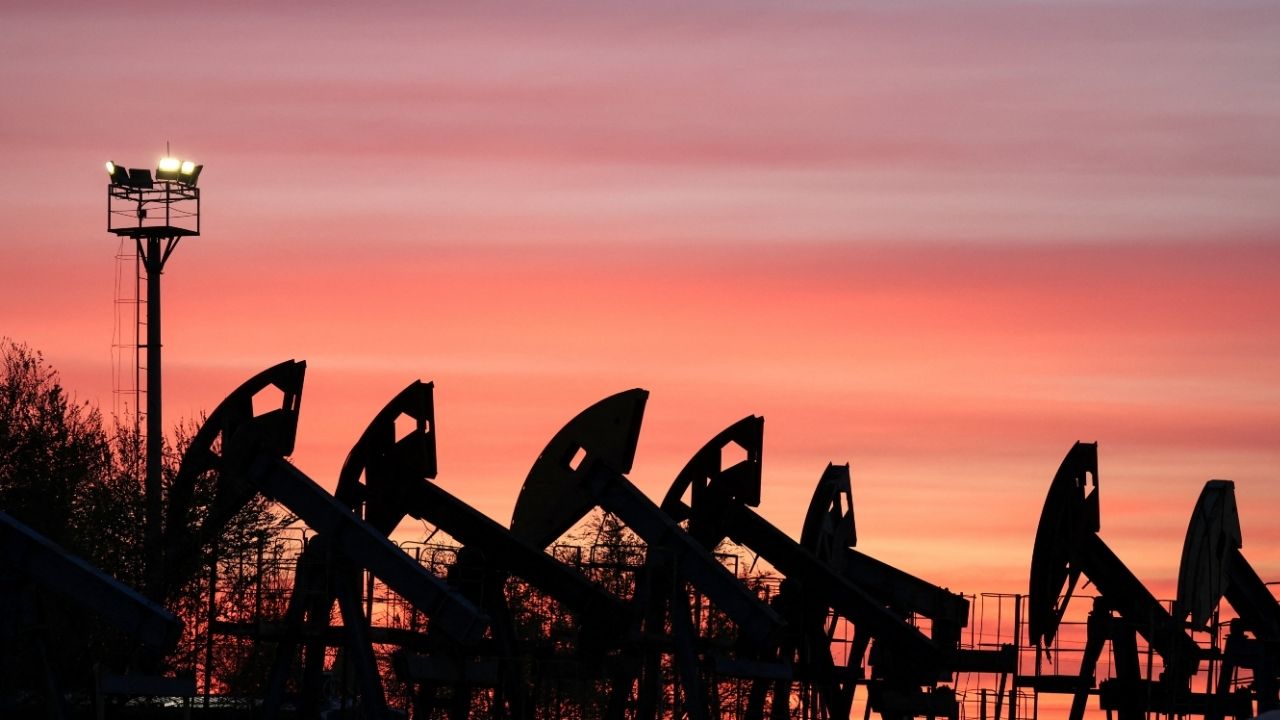
Oil prices were near six-week highs on Monday, creeping closer to $100 a barrel, as tit-for-tat strikes between the U.S. and Iran on vessels sailing in the Strait of Hormuz and other areas kept crude oil flows in the Middle East low.
Brent crude futures were up 89 cents, or 0.92%, at $97.17 a barrel by 1333 GMT, having earlier hit their highest point since July 24 at $97.93.
U.S. West Texas Intermediate crude also hovered near a recent six-week high at $92.27 a barrel, up 79 cents.

In Saudi Arabia, Saudi Aramco’s Jazan oil refinery was attacked on Monday and the damage is being ascertained, the Financial Times reported, citing two people with knowledge of the matter.
Monday’s gains come on top of Brent rising around 8% last week, while WTI was boosted nearly 10% after the U.S. and Iran resumed attacks.
U.S. forces struck three Iranian oil tankers on Saturday, the U.S. Central Command said, including one off the coast of Kharg Island, an oil export hub.
Iran’s Islamic Revolutionary Guard Corps said on Saturday it targeted three oil tankers that were travelling through unauthorized routes in the Strait of Hormuz, as well as three U.S.-linked vessels in other areas.
The Saturday attacks represented a “major escalation”, said Marisks, a maritime intelligence firm.
“Commercial tankers are now being deliberately used as instruments of reciprocal economic pressure, substantially weakening the previous distinction between military confrontation and commercial shipping,” it added.
A week ago a Saudi-owned tanker was attacked by Iran, with Saudi Arabia saying two seafarers had died. Oman said on Monday it had evacuated 16 crew members.
An average of 10 commodity ships transited the Strait of Hormuz per day over the past 10 days, the lowest since May, data from analytics firm Kpler showed on Monday.
“If tanker traffic begins to slow materially, the market could price in a much larger supply shock. And there are already signs that this is happening,” said Priyanka Sachdeva, head of market insights at Phillip Nova.
Goldman Sachs said oil prices may rally to as much as $120 a barrel if attacks on shipping rise.
A restricted zone will be announced outside the Strait of Hormuz in the coming days, said Mohsen Rezaei, the secretary of Iran’s Supreme National Security Council.
Meanwhile, the United Arab Emirates is building alternative routes for its energy exports and trade to ensure they are not “held hostage” by the ongoing war between the U.S. and Iran, UAE presidential adviser Anwar Gargash said on Monday.
OPEC+ kept its oil output policy unchanged for October at a meeting on Sunday, the producer group said in a statement, as it needs to agree on new quotas before deciding its next output steps.
(Additional reporting by Florence Tan and Sam Li; Editing by Susan Fenton and Jan Harvey)