


|
Getting your Trinity Audio player ready...
|
Unlike most other musicians, pianists rarely carry their instruments with them. Wherever they go to perform, they work with what’s there.
“We’re nomads,” pianist Adam Tendler said. “The pianos we play are strangers to us, and we usually have a very short time to make a home in them. We become experts in making a home wherever we are.”
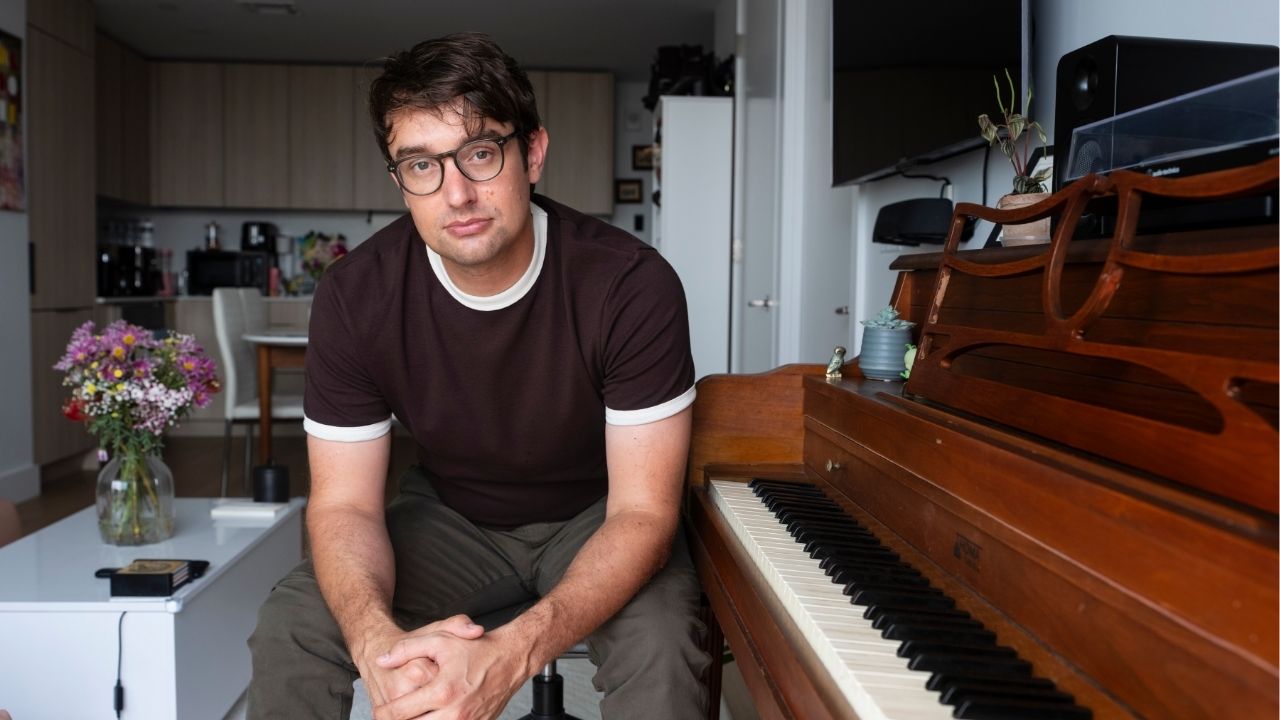
Composer Ellis Ludwig-Leone was thinking along that line two years ago when he took the big step of moving into an apartment with his girlfriend and a friend gave them an old upright.

“I was trying to make the place feel like home,” he said, “so I started playing the piano a lot.”
This led to the idea of composing “Quiet Hours,” an intimate album of nine solo piano pieces released on Friday. They’re all nocturnes, a form he associates with the magic and mystery of the night, he said, “when you can’t quite know what’s real and what isn’t.” He wrote each for a different pianist friend, including Timo Andres, Tendler, Simone Dinnerstein and Aaron Diehl. And he asked them to record on an instrument they considered a home piano.
Ludwig-Leone reserved a nocturne for himself and recorded it on the piano he’s been playing since he was 10, a 1999 Steinway L at his parents’ house in the Brooklyn borough of New York City. He’s used it on several recordings, including the debut album of San Fermin (2012), the indie-rock collective he leads.
For many years, Ludwig-Leone’s artistic output has been split. On the one hand, there’s his work for San Fermin. And on the other, there are his classical music compositions (for Attacca Quartet, Eighth Blackbird and other forward-looking ensembles) and theatrical pieces like “The Night Falls,” his 2023 collaboration with author Karen Russell and choreographer Troy Schumacher.
“I’ve thought of composition as building a house or making structures,” he said, “and songwriting more as inviting someone in for coffee.”
While the nocturnes on “Quiet Hours” are formally complex contemporary classical compositions, they are at heart songs, even lullabies. The idea of creating an album of piano music struck Ludwig-Leone as an uncomfortably navel-gazing and exposed endeavor, he said. But thinking of the project as writing songs for friends put it more in his comfort zone of collaboration.
Dinnerstein described all the nocturnes as “sort of odd,” stressing a resemblance to the music of Charles Ives. “Sometimes they’re extremely songful and lyrical and then there’s a quirk or a little joke,” she said.
“Everything feels a bit off,” Tendler said of his nocturne, adding that when he confessed to Ludwig-Leone that sections were confusing him, the composer “nodded his head like a happy dog.” That’s when Tendler understood that the odd bits were intentional.
Tendler incorporated the piece into his daily practicing, and when he performed it in concert, “listeners weren’t confused by it all,” he said. “They hear a dialogue between the nostalgic, quaint bits and the Ivesian dissonances and outbursts.”
For the recording, Tendler said he didn’t want to use his home piano, “a glassy working girl from the ’80s, which I forbid almost everyone to hear.” Instead he played a 2022 Yamaha Concert Grand at the Yamaha Artists Services Studio. “It’s kind of a home away from home,” he said.
But Tendler talked about the importance of the Miller baby grand that most of his family played at their home in Vermont, the one he fell in love with — from underneath — as a toddler. “I still carry the DNA of that piano with me,” he said.
Although Dinnerstein recorded on her home instrument during the pandemic — “when there was no traffic outside,” she said — for this project she chose a piano with a different sentimental value. It was the 1906 Steinway D in the studio of her longtime producer Adam Abeshouse, who died in 2024. Recording in that space, it “felt like Adam was around us,” she said. “Even his dog was there.”
Other pianists took the “home piano” prompt more literally. In Andres’ case, the instrument — a Bösendorfer 200 from the 1920s — was not only the one in his apartment; it was also the one that had belonged to his childhood piano teacher. After the teacher died, he bought it from her children, paying in installments.
“I like to think I could pick it out in a blind listening test,” he said. “It’s kind of like a member of the family at this point.” He started recording on it when the pandemic kept him homebound, and now he does so all the time.
Diehl, best known for his work in jazz, was recording for the first time on his home piano, a 1986 Steinway M acquired a dozen years ago through an estate sale. He said the title of Ludwig-Leone’s album reminded him of the “quiet hours” in his apartment building, enforced by neighbors who complain about his practicing.
“There’s a comfort in recording on an instrument that’s familiar, a level of confidence and trust,” Diehl said. But he also noted that jazz virtuoso Art Tatum would intentionally play on instruments that were subpar just to see what he could get out of them. “It’s like that old saying, ‘A master doesn’t blame their tools,’” Diehl said.
That comfort is what Ludwig-Leone was after, a homeyness for his sometimes unsettling music. And he has even more home pianos in mind for his “Quiet Hours” nocturnes. Along with the album, he’s releasing the sheet music in a PDF songbook.
“It’s nice to imagine these pieces living in someone else’s house,” he said.
–
This article originally appeared in The New York Times.
By Brian Seibert/James Estrin
c.2026 The New York Times Company