
|
Getting your Trinity Audio player ready...
|
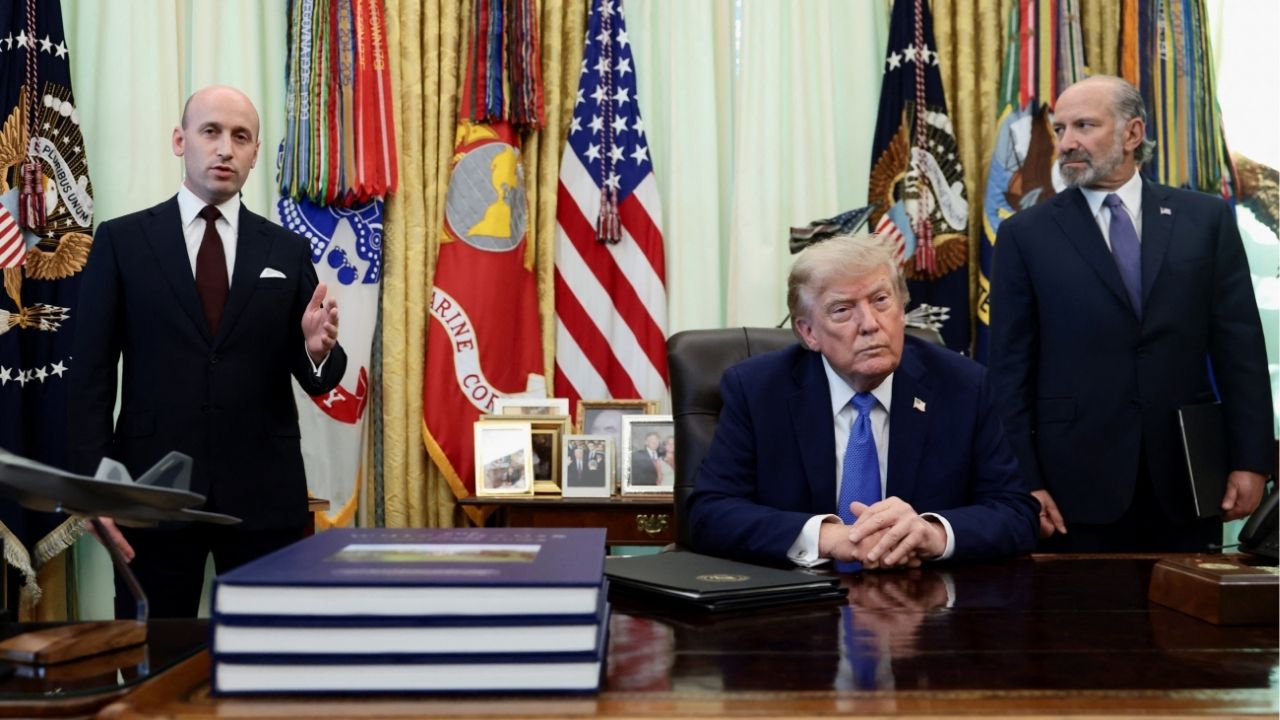
WASHINGTON — President Donald Trump on Monday described Democratic candidates in the midterm elections as “jihadists,” adding to Islamophobic statements recently made by Republican elected officials.
Trump also delivered another tirade against people of Somali descent, saying: “They’re not smart, they have no aptitude, they have nothing going, and they’re telling us how to run our country.”
Asked about the candidates representing the Democratic Party in the midterm elections, Trump told reporters in the Oval Office that “we have jihadists being elected all over the place. We have this — whether it’s communism, jihadism.”

White House officials did not respond to requests for comment about Trump’s statements Monday, and about how the comments could alienate Muslims in the United States.
Throughout his rise in politics, Trump has vilified Muslims and people of Arab descent, stoking anger among his backers and building support for immigration restrictions, including banning Muslims from the United States. But in the past few months, anti-Muslim rhetoric has become increasingly normalized in the ranks of the GOP, particularly after the election victories of prominent Muslim politicians, including Zohran Mamdani in the New York City mayoral race and Dr. Abdul El-Sayed in the Michigan Senate primary last week.
Trump has declined to condemn such rhetoric, and, as was the case Monday, has leaned into it.
While the president did not name a specific candidate, he targeted El-Sayed hours later when he posted an image depicting the Democratic candidate standing in front of a crowd that included two women wearing head scarves. “They are coming for your home and your belongings,” a caption read along the image.
And his rant came two days after he posted on social media an image of himself with first lady Melania Trump, next to an image of El-Sayed and his wife. The text above the image read: “Two VERY DIFFERENT America’s.”
Asked Sunday about the social media post, El-Sayed hit back at Trump, telling CNN that the image of the Trumps displayed “people who don’t like each other but joint in the interest of making billions of dollars off of you.” The image of himself and his wife, he added, showed “two people who genuinely love each other.”
Trump’s post also included El-Sayed’s full name, Abdulrahman Mohamed El-Sayed. After El-Sayed’s primary victory last week, the National Republican Senatorial Committee debuted a campaign ad showing his full name, accusing him of being “the most radical Senate candidate in America.” The ad tried to link El-Sayed to a designated terrorist group.
Sen. Tim Scott, R-S.C., chair of the senatorial committee, denied in an interview with CNN that the GOP was trying to use the ad to spotlight El-Sayed’s Muslim faith.
“We’re going to focus and bring attention to the fact that not only is he sympathetic for Hamas, not only does he run around with Hasan Piker — someone who said that Americans deserved 9/11 — he should be held account for exactly where he stands and what he’s for,” Scott said, referring to the progressive podcaster who campaigned with El-Sayed and has since described his comments about Sept. 11 as “inappropriate.”
A number of other Republicans have ramped up their anti-Muslim language since El-Sayed’s primary win. Sen. Tommy Tuberville, R-Ala., wrote on social media that “Abdulrahman Mohamed El-Sayed is a RADICAL ISLAMIST,” calling him a “TERRORIST.” Rep. Nancy Mace, R-S.C., said on social media that “every single Muslim holding public office in America is a trojan horse, and a threat to both national security and our republic.”
Most senior Republican officials have remained silent, except Sen. Bill Cassidy, R-La., a physician, who condemned the language used by some of his peers.
“The Muslims that I typically work with are doctors working in a remote area of Louisiana who otherwise would not have a physician unless Dr. Mohammed actually agreed to move there and be their doctor,” Cassidy said, adding that “you have to take every community in its totality.”
“I condemn those statements,” he said on CBS. “And everyone should be treated as an individual.”
Edward Ahmed Mitchell, national deputy director for CAIR, a Muslim civil rights and advocacy group, criticized Trump’s statement about Muslim candidates.
“All Americans have the right to engage in public service, regardless of their race or faith,” he said. “By describing American Muslim public servants as threats to our nation, President Trump is putting a target on the back of Muslim elected officials across our nation.”
Trump’s comments about people of Somali descent were his latest targeting the community. Last December, he said that Somali immigrants were “garbage,” and that he did not want them in the United States. Last month, the president shared a video on social media of Somali kindergartners in Minnesota, along with the comment, “Every girl is in a hijab… in kindergarten.”
“They come from, let’s say, as an example, Somalia,” Trump said Monday. “They come in and then they tell us how to, how our Constitution, how our Declaration of Independence, how it works. It doesn’t work that way.”
Asked during an interview with The New York Times this year if he was concerned about painting members of the Somali community the same way, Trump said, “I don’t care.”
—
This article originally appeared in The New York Times.
By Zolan Kanno-Youngs
c. 2026 The New York Times Company