
|
Getting your Trinity Audio player ready...
|
A federal judge has ordered a Virginia school board to again remove the names of three Confederate officers from two of its schools, after determining the board violated the civil rights of its Black students.
The school board’s decision to rename the schools after Stonewall Jackson, Robert E. Lee and Turner Ashby “cannot be divorced from racial discrimination,” Judge Michael Urbanski wrote in his ruling.
Those Confederate generals “fought to preserve a political system that enslaved Blacks, and their legacy was used as a tool to fight school desegregation,” added the judge, of the U.S. District Court for the Western District of Virginia.

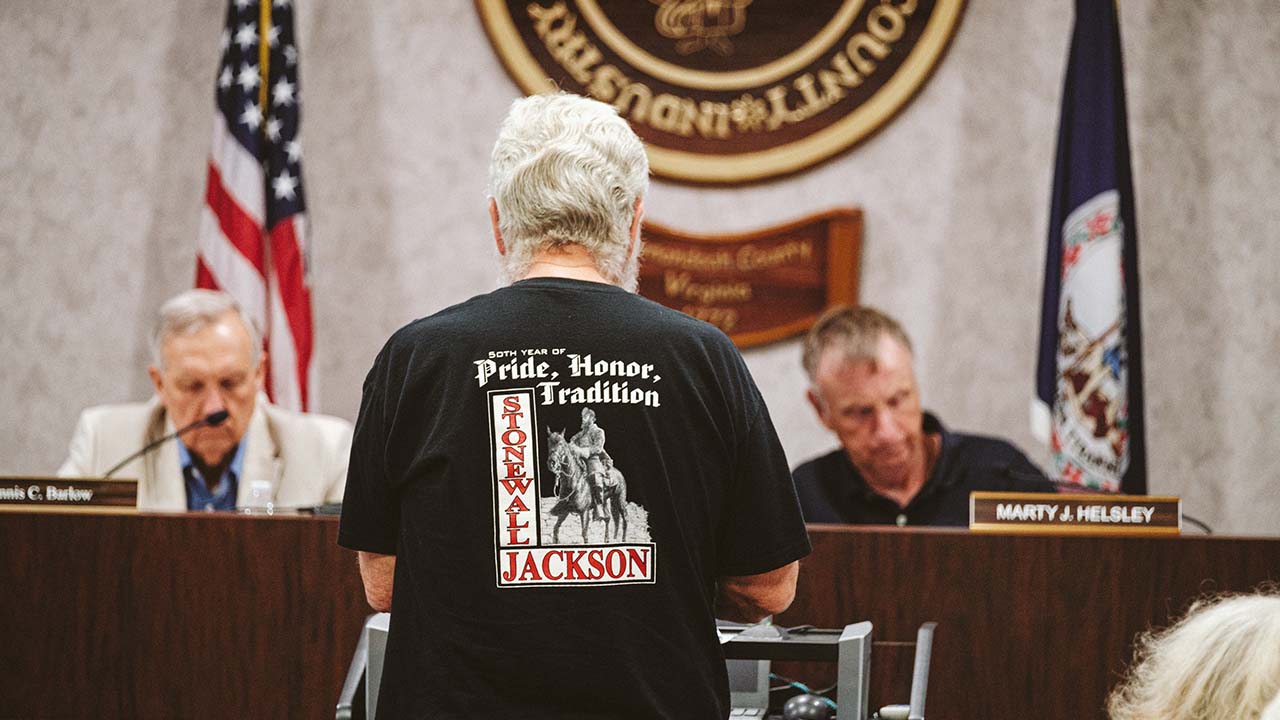
The ruling comes two years after the Shenandoah County School Board reinstated the names to Stonewall Jackson High School and Ashby-Lee Elementary after removing them in the summer of 2020, amid protests over racial injustice.
The killings of George Floyd, Breonna Taylor and Ahmaud Arbery, all unarmed Black people, led to a cultural reckoning with racism in 2020.
But many symbols of that reckoning have been reversed during President Donald Trump’s second term. Some Confederate symbols have been returned to public areas, while “divisive” topics such as slavery have been removed.
The Shenandoah County school renamings were challenged in court by the Virginia State Conference NAACP and students at the schools.
In court, a lawyer for the plaintiffs, Kaitlin Banner, argued that the board had reinstated the names in 2024 with “full awareness” of the racist ideology the Confederacy fought for and the 1950s era of resistance to school integration in which those names originally went up.
Not only that, she said, but the board also had ignored public comments from residents who said the racist association with the Confederacy was deeply offensive, glossing over the historical truth that white supremacy was the Confederacy’s defining ideology.
But the defense was ready with a counter: What is truth?
“There is no real ‘capital T’ truth in history,” a defense lawyer, Jim Guynn, retorted.
Rather, he said, history is a matter of perspective, therefore making it difficult to understand what truly motivated Virginians to name Stonewall Jackson High School in the 1950s: “We’ll never know.”
It was an unusual hearing in that part of the plaintiffs’ strategy involved putting the Confederacy itself on trial and proving that the names Stonewall Jackson and Robert E. Lee could not be separated from the white supremacist ideology for which the men fought.
A witness testified that Lee and the Confederacy had killed their fellow countrymen for the “protection and expansion” of chattel slavery.
And the defense argued that there were other reasons to honor the Confederates, such as military prowess.
In an interview Friday, Guynn said he planned to quickly file an appeal and speculated that the case may make it to the Supreme Court.
He added that the case opened up “a real Pandora’s box when it comes to school names for persons.”
Urbanski ruled a year ago that Stonewall Jackson High School students participating in extracurricular activities had their First Amendment rights violated when they were forced to serve as “mobile billboards” by carrying the “Generals” name on their uniforms.
In a statement Thursday, Banner recalled the “heartfelt and unwavering” testimony from students during the trial, “describing how Confederate school names make them feel unwelcome, devalued and ultimately inferior to their white peers.”
Banner, the deputy legal director at the Washington Lawyers’ Committee for Civil Rights and Urban Affairs, added that the renaming “diminishes” the students’ “educational opportunities.”
Shenandoah County, which is about 90% white, was rocked by the June 2020 racial justice protests and passed a resolution proclaiming: “We urgently must act to stop the racial injustice that harms and anguishes Black people, who are our family, friends, neighbors, students, staff members and fellow Americans.”
Encouraged by Virginia’s then-governor, Ralph Northam, a Democrat, the board voted 5-1 to removed the Confederate names. Stonewall Jackson High School became Mountain View; Ashby-Lee Elementary became Honey Run.
A swift backlash followed, and an initial effort in 2022 to reinstate the names failed. Then, in 2024, a new school board voted to restore the Confederate names.
—
This article originally appeared in The New York Times.
By: Clyde McGrady/Eze Amos
c.2026 The New York Times Company