
|
Getting your Trinity Audio player ready...
|
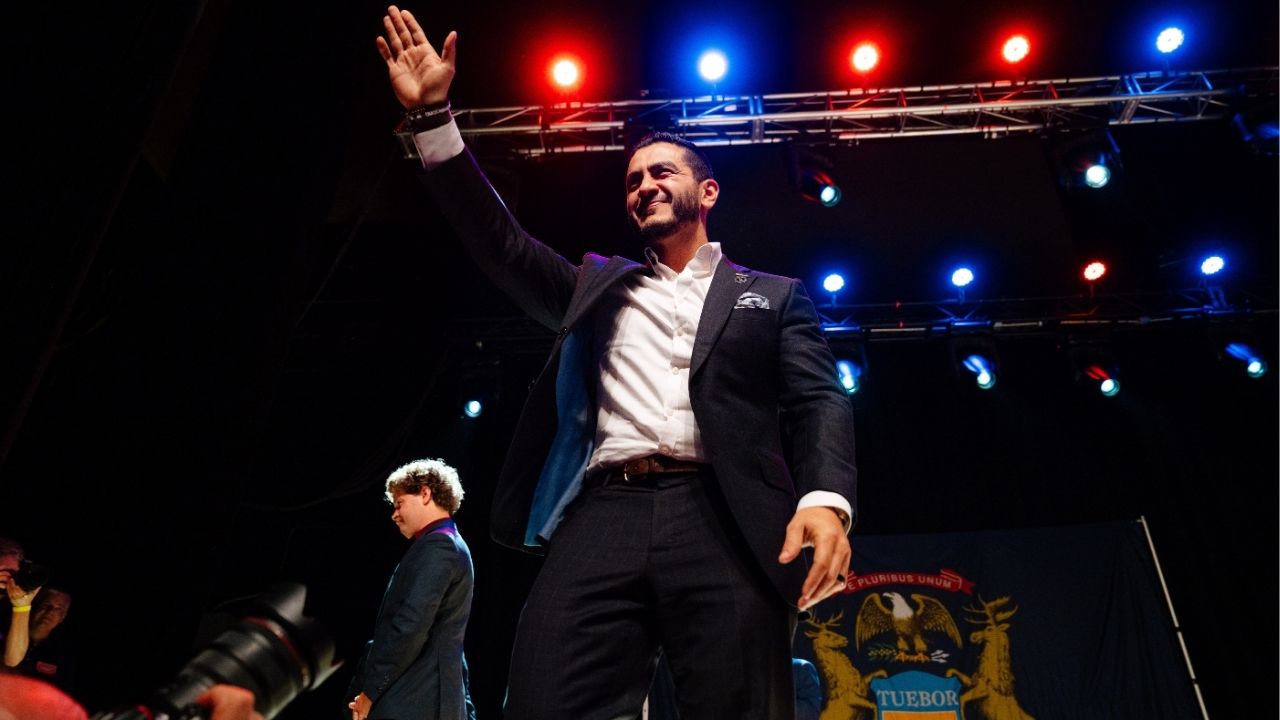
Dr. Abdul El-Sayed, a progressive former public health official, won a razor-thin victory in the Democratic primary for Senate in Michigan that serves as the most significant triumph for his party’s left wing this year.
El-Sayed prevailed in a highly contentious contest against Rep. Haley Stevens, who argued to the end that he was unlikely to win a general election in a battleground state.
Now El-Sayed will test the long-standing progressive hope that left-wing candidates can energize enough voters to beat Republicans in swing terrain. He will face former Rep. Mike Rogers, a Republican who narrowly lost the state’s 2024 Senate race and ran unopposed in this year’s primary. They are competing for the seat of Sen. Gary Peters, a Democrat who is retiring.

The stakes for both Rogers and El-Sayed are perhaps higher than two years ago. Michigan is widely seen as a crucial state for Senate control. And how a progressive like El-Sayed performs in a must-win state in November is likely to have ramifications on how Democratic primary voters perceive their presidential candidates’ ideology and electability in 2028.
Here are eight takeaways from a big primary night in Michigan and four other states:
The Left Beat the Establishment, but the Results Showed Its Limits
El-Sayed campaigned hard against the Democratic political establishment. That was enough to win, but enough voters backed Stevens to suggest that the establishment still has plenty of influence.
Stevens showed strength among Black voters in Detroit and Flint and carried most of the state’s interior rural counties, aside from a few with college towns and resort communities.
El-Sayed was strongest in communities with young voters, college students and educated and wealthy white voters. That coalition carried him through the primary, but he will have work to do to beat Rogers in November.
In all, the Michigan map demonstrated the limitations — for now, at least — that face a dyed-in-the-wool progressive running on a foreign policy platform to the left of Sen. Bernie Sanders, I-Vt.
The Ground Has Shifted Under Pro-Israel Democrats
The Democratic Party’s rapid retreat from support for Israel has been well documented in polls, election results and votes in Congress.
But El-Sayed’s primary success in Michigan was arguably the most remarkable victory yet for the pro-Palestinian movement in the United States — and maybe the biggest setback for pro-Israel Democrats.
El-Sayed, the Michigan-born son of Egyptian immigrants, won by putting Israel squarely at the center of the campaign. He labeled Israel’s actions in the Gaza Strip a genocide. He said he would cut U.S. military aid. And he said he did not believe Israel should exist as an explicitly Jewish state.
Throughout the race, El-Sayed hammered Stevens over her pro-Israel stance. Her defensiveness on the issue was clear to all: She consistently dodged questions about her support from the American Israel Public Affairs Committee.
El-Sayed has said for months that if he becomes a senator, he would hope to influence U.S. policy on Israel — particularly among Democrats seeking his party’s 2028 presidential nomination. Last month, the Democratic National Committee announced that Michigan was likely to be one of the early nominating states in 2028.
AIPAC Was Dealt a Narrow but Costly Defeat
More than any other Democrat running this year, Stevens was the candidate of AIPAC.
AIPAC used its super political action committee to invest more money, at least $30 million, to help her than any other outside group spent on any primary candidate in any race this year. It was almost, but not quite, enough for her to win.
The defeat, even by a narrow margin, serves as a rebuke to AIPAC, which has won far more Democratic primaries than it has lost in recent years.
El-Sayed, like other Democrats who have toppled AIPAC-backed candidates this year, leaned into the group’s antipathy for him and used it as a selling point.
Stevens Was Unable to Match El-Sayed’s Gifts as a Communicator
One candidate danced to Taylor Swift videos on his social media pages. The other used her final campaign ad to complain about “cool kids on the internet.”
It was not hard to figure out which candidate was a more gifted political communicator.
El-Sayed is a skilled orator. His stump speeches are easily clipped for viral consumption online. And he also worked the state hard. Since beginning his campaign in April 2025, he crisscrossed Michigan, holding more than 500 in-person events.
Stevens, by contrast, held relatively few public events. She spoke often about her love for Michigan and its manufacturing industry — important issues in her home state but hardly ones to energize Democratic voters furious with President Donald Trump. She was, by most accounts, good at one-on-one retail politics, but in a state with 10 million people, that can do only so much.
Democratic Socialists of America Candidates Had a Mixed Night
The primaries Tuesday had the biggest stakes for progressive Democrats of any night on this year’s political calendar.
El-Sayed was the headliner, but three House candidates with ties to democratic socialism also faced primary voters.
Will Lawrence, a co-founder of the Sunrise Movement who once called himself a democratic socialist but no longer does, won a three-way primary for a battleground House seat in central Michigan.
Another left-wing candidate in Michigan, Donavan McKinney, who remains a democratic socialist, narrowly defeated Rep. Shri Thanedar, a Detroit member of Congress who was not beloved either in his district or among his congressional colleagues.
And Yousef Rabhi, a democratic socialist, ousted the incumbent mayor of Ann Arbor, Michigan, Christopher Taylor.
But in Missouri, Rep. Wesley Bell, a moderate, easily held off a challenge from Cori Bush, a democratic socialist whom he ousted from the seat two years ago.
The Michigan Senate Primary Was Way Closer Than the Polls Showed
Michigan Democrats on Tuesday delivered the latest message about putting too much stock in polls.
The last eight public polls, which included three from groups that backed El-Sayed and another from a Republican group that would prefer him to be the Democratic nominee, all showed him with a double-digit lead.
Instead, the race came down to about 1 percentage point when it was called.
Michigan Was Another Defeat for Schumer
Before this year, it had been a long time since a Democrat backed by Sen. Chuck Schumer lost a Senate primary. Now it has happened twice this summer.
Schumer’s endorsement of Stevens may have signaled to donors to get behind her, but it cemented her position as the establishment candidate in a year when Democratic primary voters are furious with the establishment.
Plenty of things have gone right for Schumer this year. His recruits in Alaska, North Carolina and Ohio went unchallenged and appear in solid shape heading into November. His choice in Iowa cruised through a primary. And Stevens was not his first choice in Michigan; he initially tried to draft Gov. Gretchen Whitmer into the race.
But after Schumer’s primary stumbles in Michigan and Maine — where he recruited Gov. Janet Mills only for her to end her campaign a month before the primary — he has been left with two Democratic nominees in battleground states who have explicitly campaigned against him.
Republicans Are Going to Go After El-Sayed Hard
Stevens said throughout the final weeks of the primary that Rogers and his fellow Republicans were itching for El-Sayed to win the primary because they thought he would be easier to beat in November.
Now Republicans will get their chance to prove Stevens correct.
Republicans are about to turn El-Sayed into a left-wing boogeyman of epic proportions. They will highlight pieces of his resume that did not get a close vetting by Democratic voters, including his association with Hasan Piker, the left-wing streamer who once said “America deserved 9/11.” (He later walked back the remark.)
The Senate Republican campaign arm highlighted Piker’s remark, and El-Sayed’s refusal to disavow it, in a digital ad released Wednesday morning that referred to the Democratic candidate by his full given name — Abdulrahman Mohamed El-Sayed — and called him “the most radical candidate in America.”
Whether the strategy works remains to be seen. Trump is so unpopular that Democrats are preparing to contest seats previously thought to be out of reach. But plenty of left-wing and right-wing candidates in both parties have won wave-year primaries only to blow general elections their compatriots thought were eminently winnable.
—
This article originally appeared in The New York Times.
By Reid J. Epstein/Nick Hagen
c. 2026 The New York Times Company