


|
Getting your Trinity Audio player ready...
|
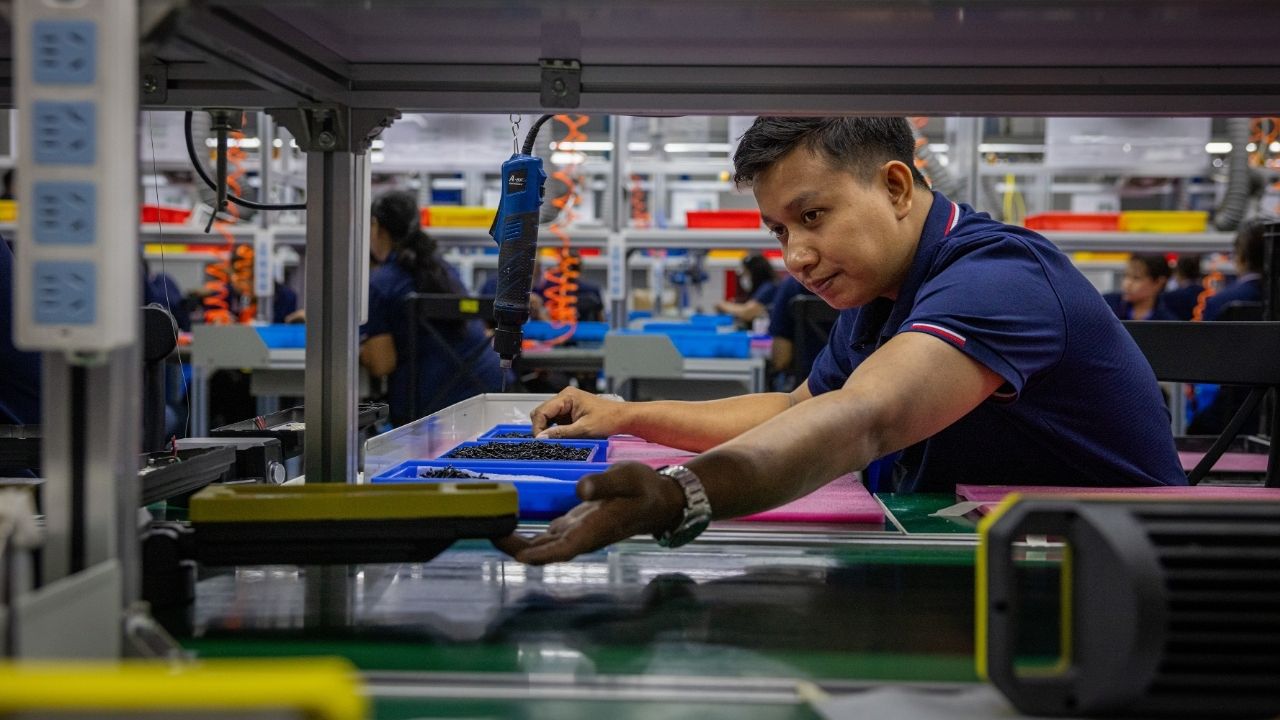
MAP YANG PHON, Thailand — On a dusty piece of land south of Bangkok, a flashlight factory stands full of promise. Workers hunch over tables gluing components. But only half the land has been built. Parts of the factory stand empty, waiting for future production lines.
The factory is owned by a Chinese manufacturer that makes flashlights for American customers. When President Donald Trump’s tariffs on China hit 145% last year, companies embarked on a panicked search for cheaper alternatives in countries such as Vietnam and Thailand, including this facility.
But since then, U.S. tariffs on China have come down sharply, leaving the leaders of some of those same companies with second thoughts.

“Have we pulled back to China? Yes, we have,” said Phil Laster, chief operations officer of Alliance Consumer Group, a Texas-based company that sells flashlights made in the Thai factory to U.S. customers. Laster had encouraged the Chinese manufacturer, Ningbo Bright Electric, to build a factory outside China to make his products, but he is hitting the brakes on the strategy now that U.S. duties on Chinese goods are more comparable to those on products from Thailand.
One of the most surprising outcomes from a whiplash year of tariffs may be that China has emerged in a position of relative strength, with significantly lower tariffs than last year. The Trump administration last week imposed a new tariff rate on Chinese exports of 12.5%, similar to rates for dozens of other countries, as it works to resurrect the tariffs struck down in February by the Supreme Court.
Chinese exports are still subject to other duties, including from Trump’s first term, and more tariffs could be on the way. But many industry executives and analysts speculate that the Trump administration will keep future tariffs on China relatively restrained to try to stabilize a rocky relationship.
The overall U.S. weighted tariff rate on Chinese goods is slightly above 23%, according to an analysis by Guojin Securities, a Chinese financial firm. And for some products, the tariff rate for China is identical to the rate on exports from Southeast Asian countries, where many companies have moved their supply chains.
This has created a conundrum for executives such as Laster, who would prefer to diversify his supply chain. But making flashlights in Thailand costs as much as 15% more than it does in China, as a result of higher costs for materials and transport. Laster is also under pressure from Chinese competitors that are selling flashlights on Amazon for less than it costs ACG to ship its products to the United States.
“We don’t want to go back to China, but at the same time, we’ve got a business to run,” he said.
Trump has long blamed China for undercutting American competitors and has imposed punishing tariffs in an attempt to force manufacturers back to U.S. shores. In his first term, he waged a trade war on China, imposing tariffs on about two-thirds of its exports beginning in 2018. In his second term, China was his first target. He raised duties on Chinese exports to triple-digit levels before China responded by cutting off the supply of critical minerals, forcing him to back down.
Amid all that uncertainty, many executives found factories outside China. As a result, U.S. goods imports from China have plummeted since peaking in 2018. Chinese imports fell by nearly a third last year, while goods from Mexico, Vietnam and Taiwan surged.
But Mary E. Lovely, an economist at the Peterson Institute for International Economics, said that China had a large cost advantage and that if its ultimate tariff differential with other countries ended up small, that shift of business out of China could reverse.
“If tariffs on China settle near those on alternative locations, we expect to see some companies returning to their Chinese suppliers,” Lovely said.
Torch City
To see why it has been so hard for companies to break with China, look no further than “Torch City.” Similar to the many Chinese cities that have specialized in buttons or wedding dresses, Xidian, a low-lying industrial town near the East China Sea, produces about 60% of the world’s flashlights, according to Chinese state media.
The town is packed with hundreds of manufacturers that pump out LED bulbs, circuit boards and switches at competitive prices. And Xidian is near some of the world’s biggest ports and low-cost shipping lanes that ferry vast quantities of goods across the Pacific to American shoppers.
“China keeps doing really well because they just have the scale to produce things that much cheaper,” said Deborah Elms, who is head of trade policy at the Hinrich Foundation in Singapore.
“Economic logic is going to drive you to have a very large share of manufacturing in China,” she added.
ACG, which is based near Fort Worth, Texas, and has about 300 employees in North America, owns five brands that make flashlights, headlamps and lanterns, as well as products such as knives, power banks and hand warmers. Its production had been heavily concentrated around Xidian.
But the pandemic and its effect on snarling supply chains exposed the risks of being too dependent on any one location. When Laster joined ACG in 2023, he started talking to ACG’s suppliers to see if they were willing to invest outside China, and he began researching new factories in Asia, Mexico and Eastern Europe.
Over 18 months, the company poured millions of dollars into buying equipment and certifying new factories in Thailand, Vietnam and Cambodia. But by October, the United States and China had reached an agreement, and Trump dropped the tariffs by another 10 percentage points.
Many Chinese exports were subject to extra duties from Trump’s first term, but other products ended up with tariffs that were on a par with those on goods from Southeast Asia. Flashlights, for example, faced a 20% duty coming out of China and a 19% duty coming out of Vietnam, Thailand and Cambodia.
And Laster said that, even before tariffs were applied, costs were 12% to 15% higher leaving Southeast Asian ports than Chinese ones because the region’s supply chains weren’t as developed.
Semiconductors and aluminum used in the products, for example, had to be imported into Thailand from China and South Korea. Southeast Asia tended to have more complicated bureaucracy and worse infrastructure, making it more difficult to get goods to port. And Chinese companies often had access to subsidies and low-cost loans.
By 2025, ACG had the capacity to manufacture more than three-quarters of its products outside China, but two-thirds were still made there.
North American brands have shifted more of their sourcing back to China in recent months as fuel shortages from the war with Iran further strained factories in countries such as Vietnam, said Sebastien Breteau, the founder of Qima, which audits supply chains for thousands of companies, including Costco, Amazon and Ralph Lauren.
“As soon as you have a little stress, you find that because all those factories have no more fuel to power their factories, companies rush back to China,” Breteau said.
“Now that companies have been manufacturing elsewhere, they see the massive benefit of manufacturing in China, even with the risk of having all their supply-chain eggs in one basket,” said Steve Okun, CEO of APAC Advisors.
The Deciding Factor
The question now is where U.S. tariffs on China will end up.
The administration is expected to issue more tariffs in the coming weeks, through a trade investigation into the policies that governments use to build up their manufacturing sectors, like industrial subsidies.
With its surging exports and an annual trade surplus that tops $1 trillion, China seems like a natural target. But some analysts said the administration might be reluctant to increase overall tariffs on China beyond where they were late last year, at 20%. Rates higher than that could be seen by the Chinese as violating their trade truce and prompt retaliation.
Elms said that “if you listen to Chinese interpretations of the ceiling, for them it is quite clearly 20%.”
But that rate could be a problem for Thailand, Vietnam and Indonesia, which expect to face lower tariffs than China.
“The assumption that everyone is making is that no one is going to go above China,” she said.
Still, with Trump frequently altering tariffs, and longer-term tensions running high, many companies may not rule out the possibility of higher tariffs on China.
For now, Laster is still sending some shipments to his Southeast Asian factories to try to maintain that supply chain, despite the higher costs. But the company’s upstream investments in moving certain components outside China, like lithium-ion batteries and printed circuit boards, are at risk of returning to China, he said.
“If we can make the numbers make sense, then absolutely we want to invest in other places,” he said. But, he added, “We can’t just continue to throw away money.”
—
This article originally appeared in The New York Times.
By Alexandra Stevenson and Ana Swanson/Lauren DeCicca
c. 2026 The New York Times Company