

|
Getting your Trinity Audio player ready...
|
He was not 6 feet, he had never been 6 feet, and it was clear at this point in Miguel Rojas’ life that he was never going to be 6 feet. But his height was close enough to 6 feet to get away with it.
“I always pressed the guys who did the measurement to leave me as 6 feet,” said Rojas, a Los Angeles Dodgers infielder. “Because I was like: ‘I’m so close to being 6 feet. What can we do? What can we do to put me at 6 feet?’ I think it’s better optics.”
Today, Rojas is like more than half the hitters in MLB: shorter than ever.

Once listed at 6 feet, Rojas is now listed at 5-foot-10. It reflects his true height. He is one of more than 200 players who shrank under the microscope of MLB’s strict and standardized new measuring system, one far more accurate than the loose and relaxed ways of the past.
225 Hitters Are Now Officially Shorter
Of the 430 hitters on opening day rosters, 225 lost at least 1 inch off their listed heights in 2024 and 2025, according to data compiled by The Athletic through players’ official and historical heights on MLB.com. Six have lost 3 inches, 48 have lost 2 inches and 171 lost 1 inch. On the other side, 45 players gained an inch, and two players gained 2.
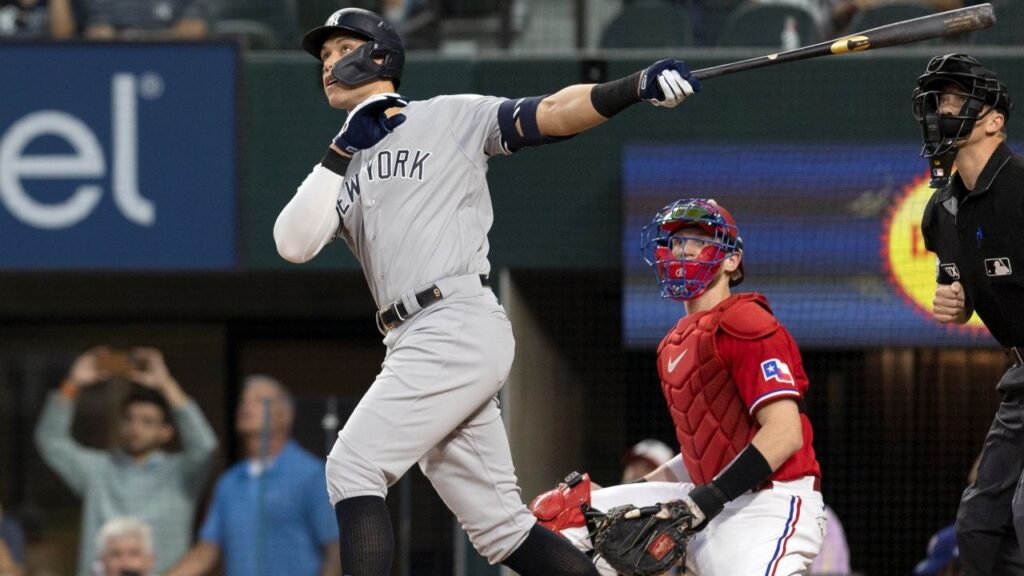
In total, baseball players collectively lost nearly 20 feet of height because of the more precise measurements. That equates to three Aaron Judges vanishing from the sport. An issue once reserved for the NFL combine or dating app disasters has now reached MLB.
“It’s age,” Los Angeles Angels catcher Travis d’Arnaud, 37, said with a smile. “Everybody gets shorter with age.”
D’Arnaud went from 6-2 to 6-0. He noted that he had been listed at 6-2 since he entered the league 14 seasons ago.
“It’s always been like that, from what I remember; I feel like everybody always put an inch or two taller,” he said, expressing relief with the number he was ultimately assigned. “At least I still got a 6.”
There are many who can no longer say the same.
The players most likely to have lost height are players currently listed at 5-11. That accounts for 74 players, who, since automated-ball strike system measurements were introduced, have lost more than 5 total feet combined (61 inches). Compare that with the 72 players who are currently 6 feet. They dropped less than 4 feet (44 inches).
“That’s a tough day for those guys,” San Diego Padres outfielder Gavin Sheets said.
Sheets went from 6-5 to 6-3, but is still a card-carrying member of the 6-foot club.
Tampa Bay Rays infielder Gavin Lux shrank from 6-2 to 5-11, as did Dodgers infielder Alex Freeland. Detroit Tigers infielder Gleyber Torres dropped from 6-1 to 5-10, as did Boston Red Sox catcher Connor Wong. Philadelphia Phillies infielder Bryson Stott, once 6-3, can at least take solace in his 6-foot stature.
Guardians Catcher Shrinks from 6 Feet to 5-9
The same could not be said for Cleveland Guardians catcher Bo Naylor, who was an even 6 feet before. Now, he’s only 5-9, the same as the average American man. Welcome to the club, Bo.
Guardians teammates have enjoyed ribbing their backstop, with his fellow catcher Austin Hedges joking, “Yeah, Bo is 5-foot-2, apparently.”
Naylor was at peace with it — and saw the silver lining.
“If it gets me a smaller zone, then I’m with it,” Naylor said. “It’s been funny seeing all the memes.”
Naylor makes an important point. Being shorter is now an advantage. The taller your listed height, the larger the strike zone used in the ball-strike challenge system. Rojas said it would force him to learn his strike zone in a way he had never thought of previously.
In the past, teams might use data from players’ physicals, or they might just repeat the previous year’s height. In some instances, the team might simply ask the player for his height. No longer.
How to Pose for the Official Measurement
The process of measuring players now includes a strict pose — feet together, no shoes allowed, pants rolled above the knees. If you have thick hair, they will make sure the measuring tool is pushed firmly against your skull. There are lasers conducting a separate measurement, to compare to the hand measurement.
Players are later given their measurements in centimeters. Everyone is measured three times. All measurements must take place between 10 a.m. and noon, to standardize the process and avoid risks of growth or shrinkage later in the day, which is apparently a thing.
Several players have said they are happy to see a smaller number.
“It’s crazy how everybody across the league’s gone down,” Sheets said. “I think everybody’s all for it. I wish I shrunk more.”
The process of more stringent measurements began last year because the challenge system was used in spring training in 2025, so the changes in players’ heights have been a result of a process that has played out now for the past 14 months.
Surely not everyone’s dips are related to nefarious misrepresentations, as evidenced by the 47 players who gained height through this process — though only two went up by more than 1 inch. The severe disparity, however, between players who lost height, compared with those who gained it, suggests the changes overall were not random.
“That’s a baseball card thing, also,” noted Guardians outfielder Steven Kwan. “It’s common knowledge: You add 2 or 3 inches to it. I can’t really get away with that. I feel like when you’re 5-10 and up, you can get away with that.”
Kwan is listed at 5-8 now; he was listed at 5-9. But his point is generally salient — the game’s shortest, and tallest, players were the least likely to see any changes. Take José Altuve, for example. He has never been anything but 5-6. Likewise, Judge has known nothing but 6-7.
Several Stars Lose an Inch or More
Many other superstars, though, have seen shifts. Vladimir Guerrero Jr. dropped 2 inches, as did Bryce Harper, Jarren Duran, Austin Riley, and George Springer. Others, such as Francisco Lindor, Juan Soto, Mike Trout, Cal Raleigh, and James Wood, lost 1 inch.
Wong said his friends have been getting a kick out of his 3-inch decline. He is now 5-10. His initial listing, 6-1, was essentially a guess he made a decade ago.
“In college, I had a couple teammates that were shorter than me listed at 5-foot-10, which is what I was,” Wong said. “And I don’t know, I was just like, can I be listed at 6-foot-1 then? They said, ‘Yeah, sure.’ And then it never got changed.”
And now, at least in this one specific way, that is no longer allowed, and no longer possible. There is nothing left to do but accept that the game of baseball just got a little bit shorter.
“I don’t care anymore,” Rojas said. “It’s kind of like your age. When you’re young, and you don’t want to keep getting older, you hope that you’re still 25. As of now, I don’t really care about how tall I am.”
( Zack Meisel, Jen McCaffrey, and Dennis Lin contributed reporting.)
This article originally appeared in The New York Times.
By Sam Blum / The Athletic/Nathan Hunsinger
c.2026 The New York Times Company