


|
Getting your Trinity Audio player ready...
|
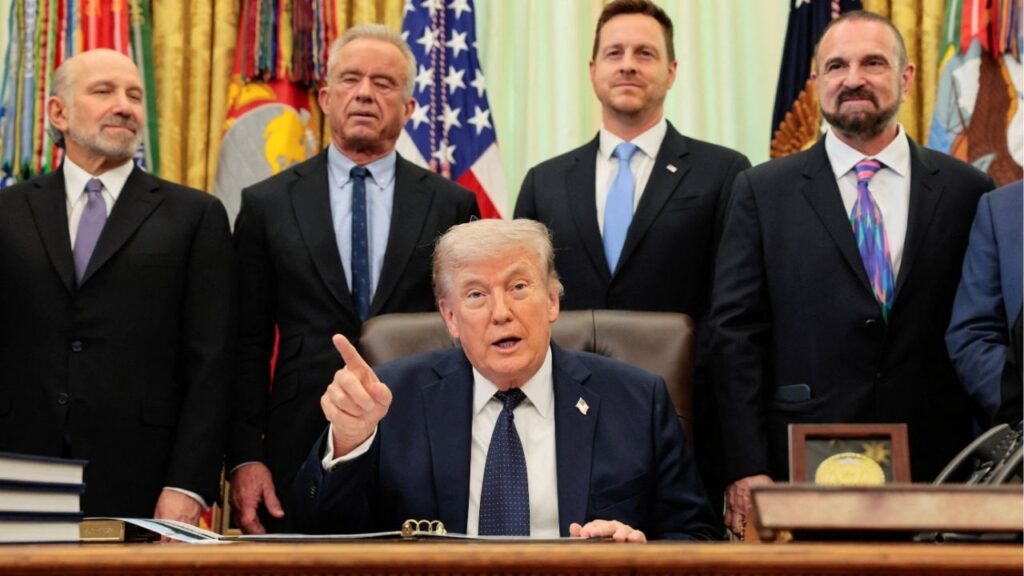
Oil prices surged and stock markets sank Thursday, hours after President Donald Trump declared in a national television address that the U.S. military campaign against Iran would escalate and failed to offer a clear exit strategy, though he insisted the war was an overwhelming success.
On Wednesday night, in his first prime-time address from the White House since the United States and Israel launched strikes on Iran on Feb. 28, Trump vowed to hit Iran “extremely hard” and threatened to bomb Iran “back to the Stone Ages.” He repeated his threats to hit Iranian infrastructure, including electrical plants, unless a deal was struck.
Investors hoping for clearer signals of a de-escalation appeared disappointed. The price of Brent crude, the global benchmark for oil, jumped more than 7% in early trading Thursday, the steepest daily rise in three weeks. Stock markets around the world fell, with indexes in Asia, where countries import vast quantities of oil and gas from the Middle East, hit particularly hard.

In Iran, commanders and political officials were defiant after Trump’s remarks.
“We will not tolerate this vicious cycle of war, negotiations, ceasefire and then repeating the same pattern,” Esmail Baghaei, a spokesperson for Iran’s Foreign Ministry, said in a statement on Iran’s state news broadcaster.
Iran’s Revolutionary Guard said U.S. and Israeli strikes had not decimated the country’s missile production centers, long-range drones, air defenses or electronic warfare systems. The United States and Israel “know nothing about our vast and strategic capabilities,” the Guard said in a statement Thursday.
The U.S. and Israeli militaries have destroyed many of Iran’s ballistic missiles and launchers in airstrikes. But a large number are undamaged, and Iran continues to launch missiles and drones.
Israel’s military said Thursday that its forces had intercepted missiles launched from Iran. Authorities in the United Arab Emirates said their forces had responded to drone and missile strikes from Iran, while Saudi Arabia reported intercepting a missile and drones without saying where they came from.
Here’s What Else We’re Covering:
— Strait of Hormuz: Britain’s foreign secretary, Yvette Cooper, was host to a virtual meeting with dozens of nations — but not the United States — about Iran’s de facto blockade of the critical shipping lane, which has caused oil and natural gas prices to surge. Britain will convene a meeting of military planners next week to discuss “viable options to make the Strait of Hormuz accessible and safe” for international shipping, the country’s defense ministry said in a statement.
— European frustration: President Emmanuel Macron of France snapped at Trump on Thursday, saying that his shifting statements about the Iran war were unserious and that his angry comments on the NATO alliance were unhelpful. Macron also said reopening the Strait of Hormuz by force was “unrealistic.”
— Energy: Iraq has begun exporting oil by land through Syria after disruptions to shipments through the Strait of Hormuz, Iraq’s Oil Ministry said Thursday. The pathway is the second Iraq has set up after halting most oil tanker shipments through its Basra port. Two tankers were attacked last month in Iraqi territorial waters near the Basra oil terminal.
— Death tolls: The Human Rights Activists News Agency said at least 1,606 civilians, including 244 children, had been killed in Iran since the war began. Lebanon’s health ministry said more than 1,318 Lebanese had been killed as of Wednesday since the latest fighting between Israel and Hezbollah began. In attacks blamed on Iran, at least 50 people have been killed in Gulf nations. In Israel, at least 17 had been killed as of Friday. The American death toll stands at 13 service members, with hundreds of others wounded.
—
This article originally appeared in The New York Times.
By Zolan Kanno-Youngs, Yan Zhuang and Jason Karaian/Diego Ibarra Sánchez
c. 2026 The New York Times Company