
|
Getting your Trinity Audio player ready...
|
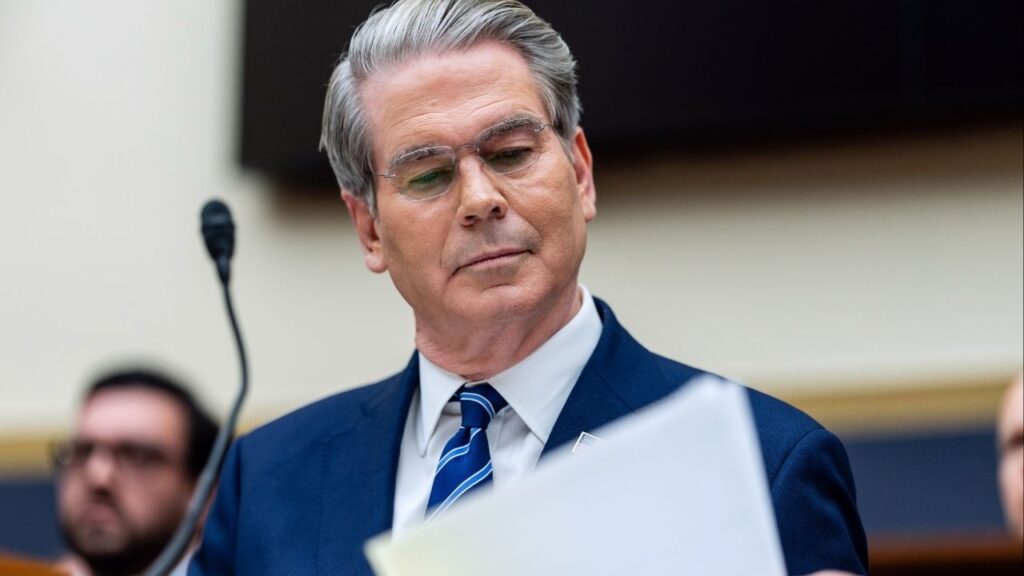
The U.S. may soon remove sanctions on Iranian oil stranded on tankers at sea, Treasury Secretary Scott Bessent said on Thursday as Washington seeks to curb prices soaring over Iran’s closure of the Strait of Hormuz.
“In the coming days, we may unsanction the Iranian oil that’s on the water. It’s about 140 million barrels,” Bessent told Fox Business Network’s “Mornings with Maria” program.
He said the release of the sanctioned Iranian oil into global supplies would help keep oil prices down for the next 10 to 14 days. Oil prices have been above $100 per barrel for much of the past two weeks as Iran has closed the Strait of Hormuz to shipping and has attacked tankers.

The Treasury recently took a similar step to temporarily allow the sale of sanctioned Russian oil stranded on tankers, which Bessent said added around 130 million barrels to global supplies.
A source familiar with the Treasury’s planning said that if the Trump administration eases sanctions on Iranian oil, one option would be a waiver similar to one used for Russian oil, allowing sales of crude already stranded at sea and confined to a narrow time frame.
“A potential waiver could accelerate the diversion of oil already destined for China into global markets more broadly, helping ensure adequate supply and blunting Iran’s leverage over the Strait of Hormuz,” said the source, who was not authorized to speak publicly and spoke on condition of anonymity.
US to Take Other Actions
Bessent said the U.S. would take other actions to increase oil supply, including a unilateral release of stocks from the Strategic Petroleum Reserve above last week’s coordinated joint G7 release of 400 million barrels.
He said the Treasury would “absolutely not” try to intervene in oil futures markets, but would take actions to increase physical supplies to try to make up for the 10 million to 14 million barrel-per-day deficit caused by the closure of the Strait of Hormuz.
“So, to be clear, we’re not intervening in the financial markets. We are supplying the physical markets,” Bessent said.
U.S. President Donald Trump lauded Japanese Prime Minister Sanae Takaichi during a White House meeting on Thursday for “really stepping up to the plate” on Iran.
Japan joined leading European nations in saying it would take steps to stabilize energy markets and join “appropriate measures” to ensure safe passage for ships through the Strait of Hormuz.
Bessent told Fox Business that Japan’s navy has some of the best minesweepers and mine-detection capabilities and that he believed Japan would release more of its large petroleum reserve to supply the strained oil market.
He said China had become an “unreliable” supplier of refined products, as it has stopped exporting jet fuel and other products to other countries in Asia.
—
(Reporting by Doina Chiacu and David Lawder; additional reporting by Trevor Hunnicutt and David Brunnstrom; Editing by Andrew Heavens and Chizu Nomiyama)