

|
Getting your Trinity Audio player ready...
|
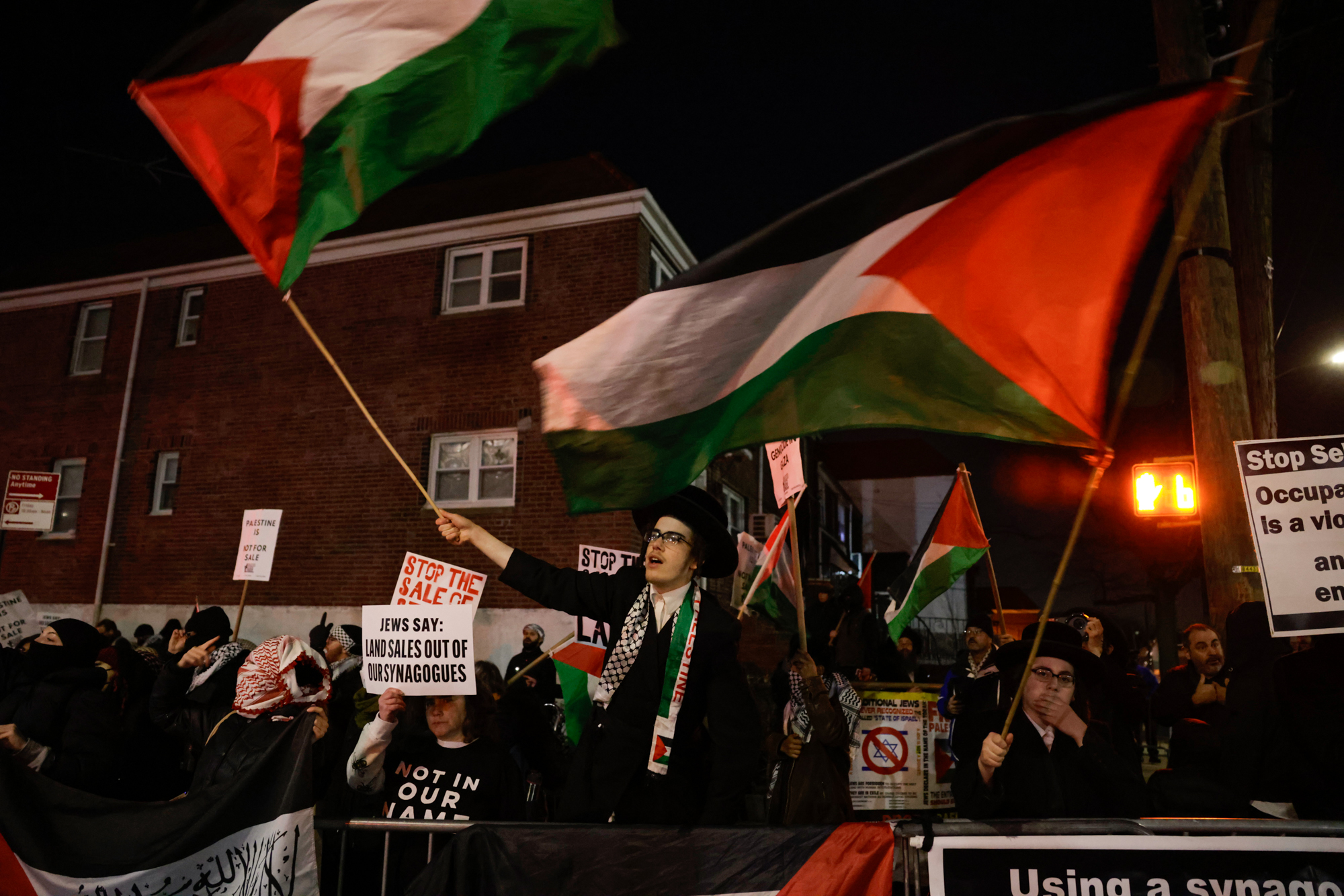
New York City Mayor Zohran Mamdani condemned the language used at a protest outside a synagogue in Queens on Thursday night, when pro-Palestinian demonstrators chanted in support of Hamas and pro-Israel demonstrators shouted racial and homophobic slurs.
Asked by reporters on Friday to respond to the protest, which included chants of “Say it loud, say it clear, we support Hamas here,” Mamdani said in a statement, “the rhetoric and displays that we saw” at the demonstration “are wrong and have no place in our city.”
“My team is in close touch with the NYPD regarding last night’s protest and counterprotest,” he added in the statement, which was sent to The New York Times hours after he made similar remarks at an event shortly after noon. “We will continue to ensure New Yorkers’ safety entering and exiting houses of worship as well as the constitutional right to protest.”

Mayor Condemns Pro-Hamas Chants After Protest Turns Volatile
Later in the day, after being criticized from some corners for not denouncing Hamas specifically, Mamdani went further. “Chants in support of a terrorist organization have no place in our city,” he wrote on social media.
The demonstration Thursday was held in Kew Gardens Hills, a neighborhood home to a sizable population of Orthodox Jews, outside an event promoting American real estate investment in Jerusalem, parts of which are viewed by much of the world as occupied territory.
The protest grew increasingly heated as the evening went on, with groups of demonstrators on both sides shouting invective and threats at each other from across a street that had been shut down by police.
Clashes Outside Queens Synagogue Draw Widespread Political Backlash
Video footage of the pro-Hamas chant spread quickly on social media after it was posted by an Israeli journalist. It drew widespread criticism from elected officials in New York, including Mamdani, whose denunciation of the chants represented something of a shift from his response to a similar demonstration in November.
That event took place outside a Manhattan synagogue holding an event that promoted American immigration to Israel and the occupied West Bank. In the aftermath, Mamdani chastised protesters for their use of language like “death to the IDF” and “globalize the intifada” but also criticized the synagogue for hosting the event.
Mamdani condemned the rhetoric at the protests after several other elected officials released statements criticizing the pro-Hamas chant, including Gov. Kathy Hochul, who said, “Hamas is a terrorist organization that calls for the genocide of Jews.”
Mamdani’s Response Marks Shift From Earlier Protests Involving Synagogues
“No matter your political beliefs, this type of rhetoric is disgusting, it’s dangerous and it has no place in New York,” she added.
New York Attorney General Letitia James said, “Hamas is a terrorist organization. We do not support terrorists. Period.”
And Julie Menin, who was elected City Council speaker this week, said, “Openly and proudly sympathizing with Hamas, especially while standing in the largely Jewish community of Kew Gardens Hills, stokes fear and division.”
“I will continue to fight against vile antisemitism such as this, and I urge everyone to come together at this time to combat rising hatred in all its forms,” added Menin, who is the first Jewish council speaker.
At the protest Thursday, pro-Palestinian demonstrators chanted their opposition to the sale of land in Jerusalem that they said had been “stolen” from Palestinians during the creation of the state of Israel. Later, they hurled antisemitic slurs at pro-Israel protesters across the street, expressing the view that Israel either should not or did not really exist.
The pro-Israel demonstrators chanted “death to Palestine,” “we love ICE” and expletive-laced slogans about Mamdani. They also threatened to rape or kill individual people in and around the crowd of protesters, including a journalist, and waved flags in support of President Donald Trump and of the far-right Orthodox Kach movement, which was banned from participating in Israeli elections in the 1980s for inciting racism.
The protest took place outside the synagogue Agudath Israel of Kew Gardens Hills, which was hosting the real estate event and which shares an address with a school, the Yeshiva of Central Queens.
A representative of the synagogue declined to answer questions. A spokesperson for the school said it had sent students home early Thursday, though he said the school was “not associated” with the event or with any protest activity.
William Maiman, 69, said he had attended the protest Thursday to show his support for Israel and for his neighbors in an area of Queens that he called “a modern Orthodox fortress.”
“For this rally to take place here is just sick,” Maiman said. He said he thought the protest was antisemitic because, in his view, “Zionism and Judaism and the Jewish people are intrinsically linked.”
Pro-Palestinian demonstrators across the street vehemently disagreed. Sam Finkelstein, 26, said he had come to protest land sales in Jerusalem.
“As a Jew, I will be at as many of these events as I can,” he said. “We will be on the side of justice no matter what.”
Tensions With Jewish Community Surface Early in Mamdani’s Mayoralty
After the similar protest in November, which was held outside the Park East Synagogue on the Upper East Side of Manhattan, Mamdani defended the right “to enter a house of worship without intimidation.”
But he also took issue with the synagogue’s decision to host the event, saying, “Sacred spaces should not be used to promote activities in violation of international law.”
The November event was hosted by Nefesh B’Nefesh, which helps American Jews move to towns in Israel and settlements in the occupied West Bank. That group said it did not host Thursday’s event, and the name of the real estate firm that did was not clear Friday.
The implication by Mamdani that Park East, a prominent modern-Orthodox synagogue, might have done something objectionable alarmed some Jewish leaders and turned the demonstration into the first high-profile episode since Mamdani’s election to involve the Israeli-Palestinian conflict.
In the aftermath, Mamdani expressed interest in a proposal to protect houses of worship from disruptive protests. And last week, in one of his first acts as mayor, he issued an executive order that directed police and the city’s Law Department to evaluate proposals that would impose some restrictions on protest activity outside houses of worship.
The mayor has struggled to earn the trust of segments of the Jewish community because of his criticism of Israel and his history of pro-Palestinian activism.
But he also won the votes of many Jews who said they were inspired by his campaign and either unbothered by or supportive of his views on the Middle East. He has repeatedly vowed to protect the security and celebrate the contributions of Jewish New Yorkers, and has been endorsed by many progressive Jewish public figures and groups.
Just one week into his mayoralty, he faced criticism from pro-Israel groups and explosive accusations of antisemitism from the government of Israel following his decision to rescind two pro-Israel executive orders issued by his predecessor, Mayor Eric Adams. Mamdani has defended that action as part of a push to give the city a “clean slate” after the scandal-plagued Adams administration.
This article originally appeared in The New York Times.
—
By Liam Stack and Nate Schweber/ Mini d’ Autremont
c.2026 The New York Times Company