

|
Getting your Trinity Audio player ready...
|
Fresno Mayor Jerry Dyer says he calmed Fresno Unified’s worries about the city’s southeast plan after saying he will recommend restrictions on how the plan will be rolled out.
Three days before Fresno City Council was set to vote on the 9,000-acre Southeast Development Area specific plan and environmental study on Thursday, Fresnoland published a story in which the Fresno Teachers Association and Fresno Unified said the decades-old SEDA plan poses an existential threat to the district.
FTA President Manuel Bonilla told GV Wire on Tuesday that the SEDA plan would cost the district $200 million over 10 years, possibly leading to 11 school closures — eight elementary schools, two middle schools, and one high school. Bonilla said the calculation was based on data from the city’s housing market analysis study released earlier this year and from district data.

Fresno Unified, however, said that information did not come from the district. A district spokesperson also told GV Wire that “due to our current declining enrollment, we could potentially close 3-5 schools in the future, however, that would be our last resort. Other actions that we might first consider include program realignment and boundary changes.”
Fresno Unified made that statement after Dyer’s appearance on KMJ’s Ray Appleton Show on Tuesday. On the show, Dyer called claims from FTA that SEDA approval would cause 11 Fresno Unified schools to shut down and cost the district $200 million “misinformation.” The mayor also said that Fresno Unified Superintendent Misty Her told him the district did not have that figure.
Additionally, Dyer said during his radio appearance that Her told him because of declining enrollment in Fresno Unified, the administration has considered plans to shut down three schools regardless of SEDA implementation.
Fresno Unified, City of Fresno Both Lost ‘Competitive Edge,’ Dyer Says
The other part of the projection comes from a housing market study on SEDA done by the city before Dyer changed his plan for the southern portion to be zoned for virtually all industrial companies. In response to objections to SEDA, he said he will also recommend restrictions on SEDA development based on population projections or voter referendum.
He said after presenting the plan to the district, they removed objections to SEDA.
He said akin to city’s lost “competitive edge” in housing and job creation, Fresno Unified has been losing families to neighboring areas such as Madera and Clovis.
“Families that have left Fresno to move to Madera or Clovis or Sanger because of available housing in Fresno, and so that’s the same concern that I have,” Dyer told GV Wire. “We have begun to lose our competitive edge for housing, which is clearly shown with Madera growing, with Riverstone, Tesoro Viejo. If we had available land that was suitable to the desires of those people that left Fresno, I don’t think they would have moved.”
Fresnoland claimed that GV Wire publisher Darius Assemi, president of Granville Homes, owns land “through out” SEDA.
Of the 9,000 acres in SEDA, Assemi owns a single 30-acre parcel near Highland and Shields avenues, land records show and Assemi confirmed to GV Wire.
Editor’s Note: GV Wire Publisher Darius Assemi is also president of Granville Homes.
Growth in Southeast Will Result in Decline in City’s Interior: Bonilla
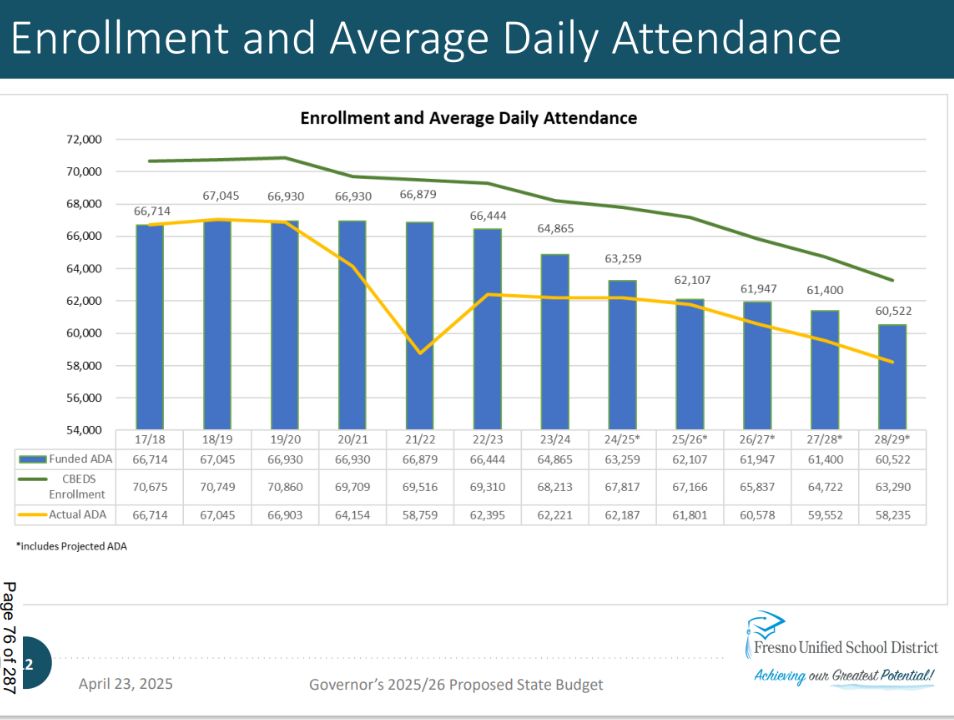
Bonilla said he came up with the figure after putting together the city’s housing study with Fresno Unified’s enrollment figures. Fresno Unified has been the only district to not recover from Covid enrollment declines. The district also has some of the lowest test scores in California.
Clovis, Sanger, and Central districts have all exceeded 2019 numbers, according to GV Wire research.
Bonilla, however, said a projected growth of homes in southeast Fresno would result in a decline in the interior of the city. The city’s projection shows after SEDA growth begins in earnest in early 2035, an average of 700 new homes would be built yearly in the new area.
“We have some historical examples of when these types of projects happen — most notably as we look northeast into Clovis West, Clovis North, in regards to the housing development,” Bonilla said.
He said every 1,000 students lost equates to an annual loss of $20 million. Over 10 years, that becomes $200 million. While budget losses begin with programs lost, it turns into jobs lost and eventually schools closing.
“When budgets are hit, you’re looking at things like cuts in programs, cuts in arts programs, cuts in career technical education programs, cuts in dual immersion programs,” Bonilla said.
Is Development a Zero-Sum Game?
But that loss comes from a premise that development is a zero-sum game and that Fresno’s population will remain flat.
Where the finance department predicted Fresno’s growth would only be .2% last year, the city grew .7%, the fifth-highest in the state, Fresno Planning Department Director Jennifer Clark said.
A majority of the city’s development has been within existing city boundaries, as well, Dyer said — 76% in the city limit compared to the required 50/50 split laid out in the 2014 General Plan.
Not keeping up with that demand has cost the city as families move to Madera, Clovis, and Sanger. For a budget 40% reliant on property tax revenue, Dyer said missing that demand costs the city.
A 51% property tax revenue deal between the city and county from SEDA properties will benefit the interior of the city, he said.
“When you consider that 40% of our revenues for the city come from property tax, we need to have land developed within our city that will provide the revenue needed to support services like police and fire, roads and parks throughout Fresno,” Dyer said.
‘Safeguards’ Could Limit SEDA Sprawl: Dyer
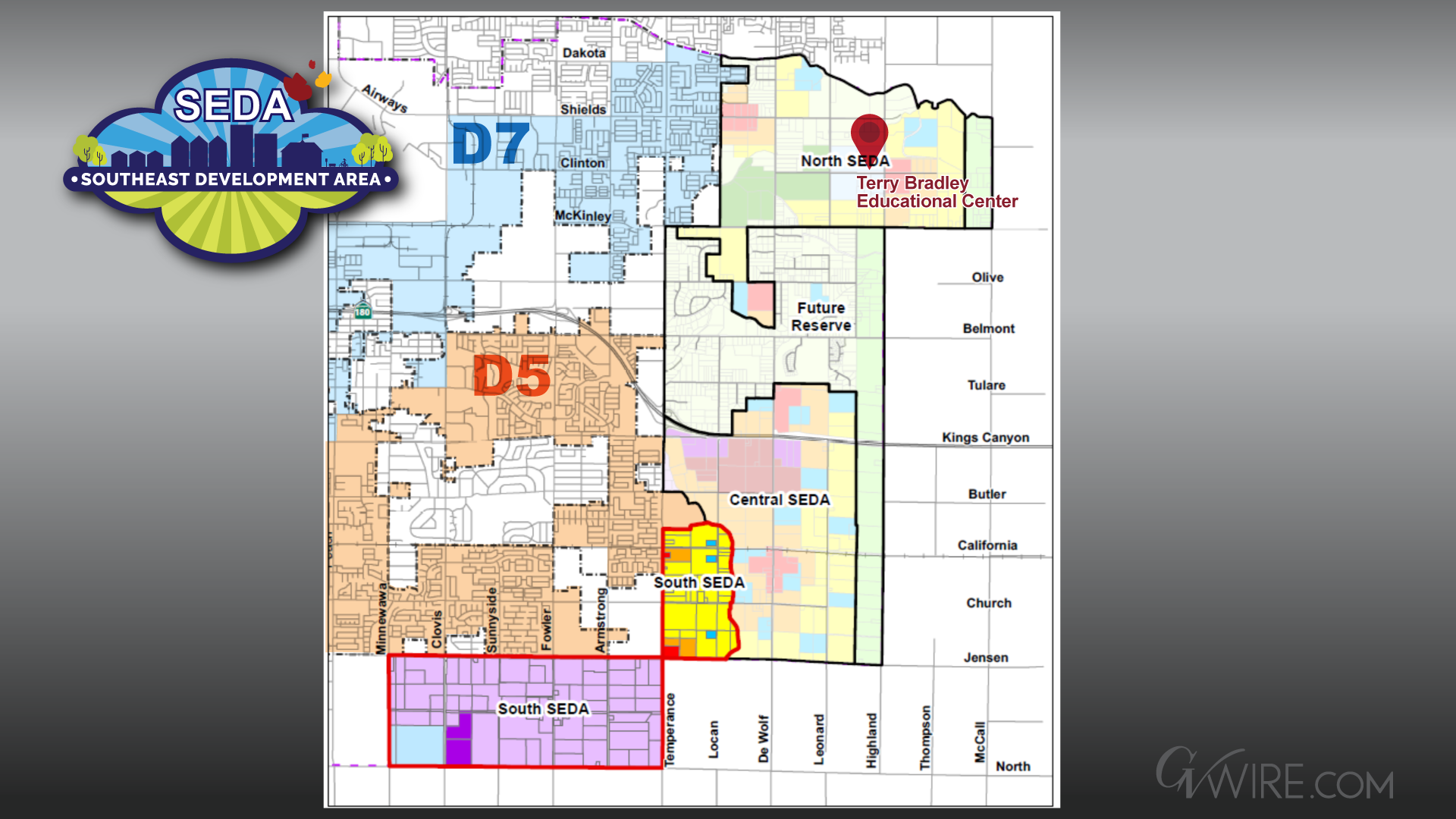
After meeting with SEDA opponents, Dyer said he will recommend to the city council safeguards on SEDA to limit development to only the southern area of the plan and a 500-acre portion caddy corner to the area.
The southern area will mostly be a “flexible research and development” zoning — a new area that Clark likened to the industrial area at Ingram Avenue south of Nees Avenue. The nearby 500 acres will be dedicated to housing.
A commercial real estate broker previously told GV Wire that investment into small industrial areas would likely only come from people living near their businesses.
Dyer said population caps or required voter referendums could limit further expansion into SEDA.
“Before you can move beyond the current boundaries, they would have to reach a certain population density level within the existing area, maybe that’s 70% or even have a voter referendum in place to go beyond the identified growth area at this point. I’m open to any of that,” Dyer said.
Bonilla said without seeing a plan he could not comment on whether it would hurt the district.
The More Restrictions, the Less Competitive Fresno Is: BIA
President and CEO of the Fresno Madera Building Industry Association Darren Rose said builders will do what it takes to have SEDA approved. The same housing market study referenced by Bonilla shows demand throughout the city, so he said the fewer restrictions, the better for homebuyers and affordability.
“The building industry is willing to work with the administration to get a specific plan eventually passed,” Rose said. “However, the more restrictions developers have, the less competitive Fresno will be,” Rose said.