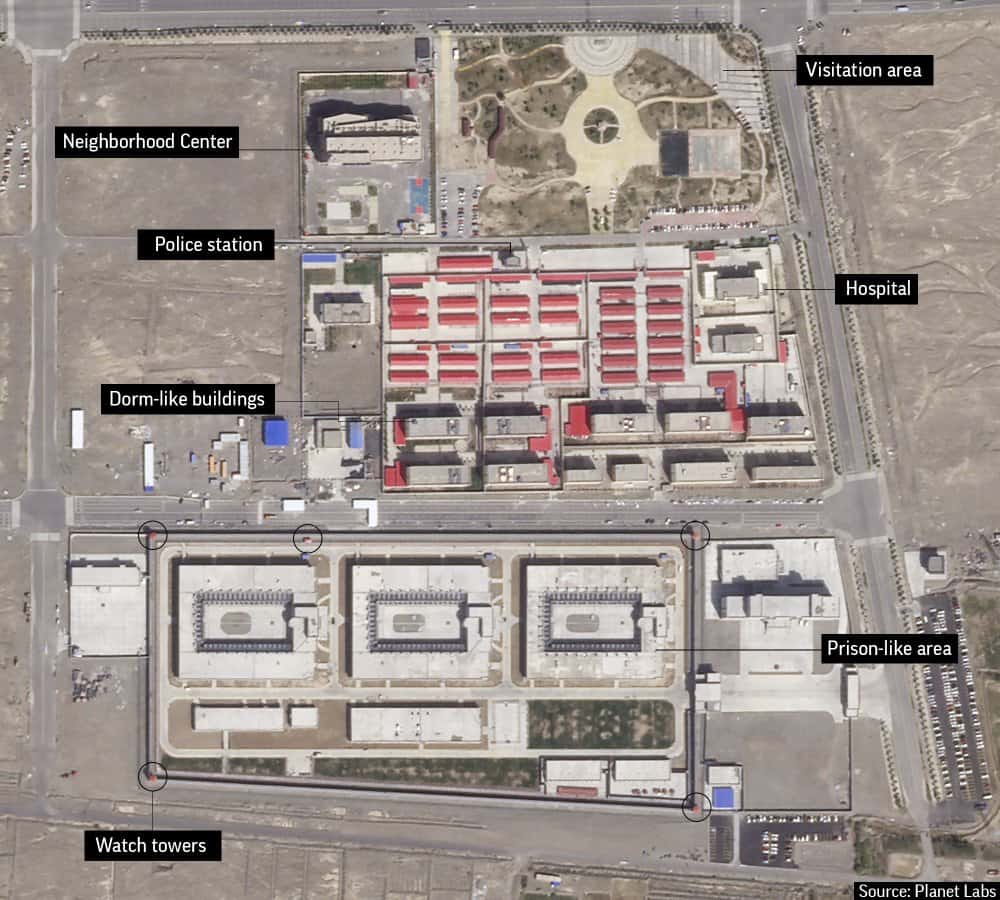
No more denying, no more dodging. The Chinese Communist Party can no longer hide its relentless campaign of mass internment against the ethnic minorities in the northwestern region of Xinjiang, or claim that the effort is an innocuous educational program. What was already widely known, vastly reported and confirmed by firsthand accounts has now been proved beyond doubt by the government’s own records — gigabytes of files, reams of reports, thousands of spreadsheets — some of them classified and highly confidential.
Last weekend, The New York Times disclosed and analyzed the contents of a trove of leaked internal Chinese government documents that outline specific policies for how to repress Xinjiang’s predominantly Muslim minorities — and reveal that President Xi Jinping himself set out the foundation for them.
This Sunday, the contents of two more sets of documents — all of which I have reviewed — are being disclosed. Among the first batch, also leaked, is a confidential telegram signed by Zhu Hailun, Xinjiang’s deputy party secretary, which details how local authorities should manage and operate the “vocational skills training centers” — a euphemism for the internment camps. (All translations here are mine.) The second set of documents, a large cache of files and spreadsheets from local governments, reveals the internment campaign’s devastating economic and social impact on the families and communities it targets. FILE – In this Sep. 17, 2018, file satellite image provided by Planet Labs, buildings are seen around the Kunshan Industrial Park in Artux in western China’s Xinjiang region. This is one of a number of internment camps in the Xinjiang region. Experts say the Chinese government has detained up to 1.8 million Uighurs, ethnic Kazakhs and other Muslim minorities for what it calls voluntary job training. But a classified blueprint leaked to news organizations shows the camps are precisely what former detainees have described: Forced re-education centers. (Planet Labs via AP, File)
To provide the best experiences, we use technologies like cookies to store and/or access device information. Consenting to these technologies will allow us to process data such as browsing behavior or unique IDs on this site. Not consenting or withdrawing consent, may adversely affect certain features and functions.
Functional
Always active
The technical storage or access is strictly necessary for the legitimate purpose of enabling the use of a specific service explicitly requested by the subscriber or user, or for the sole purpose of carrying out the transmission of a communication over an electronic communications network.
Preferences
The technical storage or access is necessary for the legitimate purpose of storing preferences that are not requested by the subscriber or user.
Statistics
The technical storage or access that is used exclusively for statistical purposes.The technical storage or access that is used exclusively for anonymous statistical purposes. Without a subpoena, voluntary compliance on the part of your Internet Service Provider, or additional records from a third party, information stored or retrieved for this purpose alone cannot usually be used to identify you.
Marketing
The technical storage or access is required to create user profiles to send advertising, or to track the user on a website or across several websites for similar marketing purposes.