


|
Getting your Trinity Audio player ready...
|
The US economy grew much faster than initially estimated in the third quarter, while inflation increased further in October, reinforcing expectations that the Federal Reserve will raise interest rates next month and again in early 2027.
The sharp upward revision to gross domestic product last quarter, reported by the Commerce Department on Wednesday, marked the quickest economic growth pace in three years. It reflected upgrades to consumer spending and business investment, mostly related to artificial intelligence.
Robust domestic demand is fueling inflation, with a measure of underlying price pressures in October posting its biggest year-on-year increase since late 2023. The economy has powered ahead despite the ongoing US-Israeli war with Iran.

“It is more urgent than ever that Fed officials step up the pace of interest rate hikes to cool off economic demand,” said Christopher Rupkey, chief economist at FWDBONDS. “It was once thought that import tariffs and energy prices from the Mideast war were one-off factors behind the higher inflation numbers, but increasingly the inflation fires look to be stoked by old-fashioned economic demand pressures.”
GDP increased at a 4.3% annualized rate last quarter, the Commerce Department’s Bureau of Economic Analysis said in its second estimate of third-quarter GDP. It was the fastest pace since the third quarter of 2023. The economy was previously estimated to have grown at a 3.4% pace.
Economists polled by Reuters had expected GDP growth would be revised up to a 3.5% pace. The economy grew at a 2.2% rate in the April-June quarter. Growth in consumer spending, which accounts for more than two-thirds of the economy, was revised up to a 4.2% rate from the previously reported 3.8% pace.
Spending is being driven mostly by higher-income households, whose wealth was boosted by the stock market before the ongoing AI-led selloff. Historically low layoffs and moderate hiring are also helping other households to sustain spending, though wage gains have at times lagged inflation. Households are also saving less and dipping into their nest eggs.
Business spending on equipment increased at a 21.8% rate. That was an upgrade from the 20.9% rate of growth estimated last month. Business investment has posted three straight quarters of double-digit growth, and momentum appeared to have persisted early in the fourth quarter.
A separate report from the Commerce Department’s Census Bureau showed non-defense capital goods orders excluding aircraft, a proxy for business spending, jumped 1.2% in October after rising 0.8% in September. Shipments of these so-called core capital goods, which go into the calculation of the business spending on equipment component in the GDP report, rose 0.6% last month after advancing 1.3% in September.
Growing Questions Over Ai Funding
A cloud is hanging over AI. Broader questions about AI funding, profitability, regulation and public resistance to data center developments have arisen and remain even after the surprise reinstatement of Nvidia CEO Jensen Huang. Tech firms have borrowed huge sums over the past year for AI spending.
AI remains a key pillar of the economy.
Final sales to private domestic purchasers, which exclude inventories, trade and government, accelerated at a 5.8% rate, the fastest pace since the second quarter of 2021, the GDP report showed. This measure of domestic demand, closely watched by policymakers, was previously estimated to have surged at a 4.9% rate.
The Personal Consumption Expenditures Price Index increased 0.3% in October after gaining 0.5% in September, the BEA said in a separate report. In the 12 months through October, PCE inflation increased 3.8% after advancing 3.6% in September. The rise in PCE inflation was in line with economists’ expectations.
Excluding the volatile food and energy components, the PCE Price Index increased 0.3% for the third straight month. The so-called core PCE inflation increased 3.3% on a year-over-year basis in October, the largest advance since November 2023, after climbing 3.1% in September.
The US Fed tracks the PCE price measures for its 2% inflation target. Financial markets have priced in a quarter-percentage-point rate hike at the US central bank’s December 8-9 meeting from the current 3.75%-4.00% range, and expected another increase in January, CME Group’s FedWatch tool showed.
Fed Governor Christopher Waller has signaled he could support a bigger half-percentage-point increase to quell inflation.
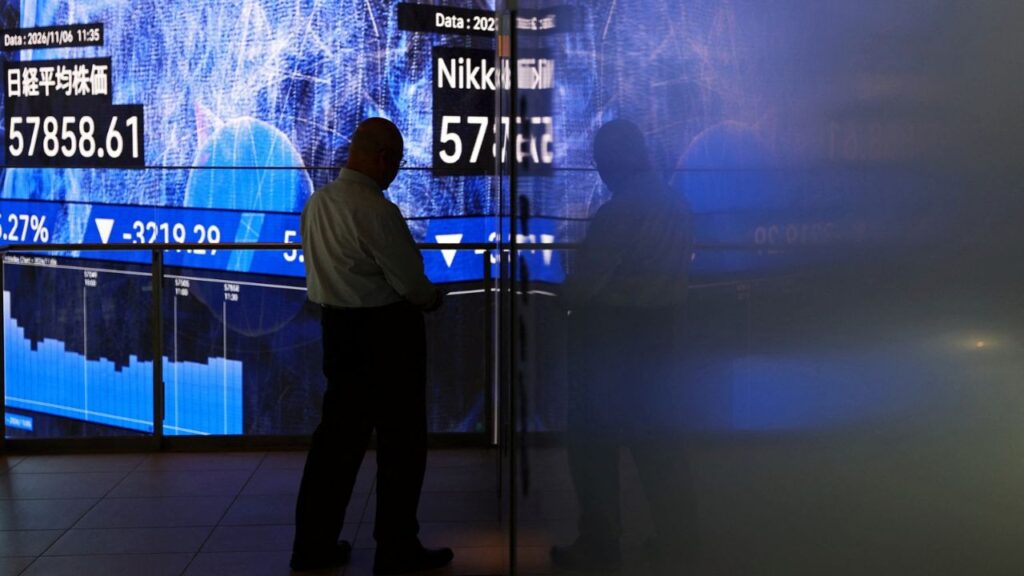
Stocks on Wall Street were trading lower. The dollar rose against a basket of currencies. US Treasury yields fell.
The economy’s resilience was reinforced by a report from the Labor Department showing initial claims for state unemployment benefits dropped 13,000 to a seasonally adjusted 189,000 for the week ended November 21. Claims have been running at very low levels since mid-July.
The number of people receiving unemployment benefits after an initial week of aid, a proxy for hiring, tumbled 95,000 to a seasonally adjusted 1.697 million during the week ended November 14, the claims report showed. The so-called continuing claims covered the period during which the government surveyed households for November’s unemployment rate.
The jobless rate dropped from 4.5% in November last year to 4.1% in October, though part of the decrease has been due to a smaller labor force due to retirements and the Trump administration’s immigration crackdown.
(Reporting by Lucia Mutikani; Editing by Chizu Nomiyama and Paul Simao)