
|
Getting your Trinity Audio player ready...
|
In its glory days, the SS United States was fast, luxurious and all but indestructible. As the ocean liner’s designer, William Francis Gibbs, liked to say, “You can’t set her on fire, you can’t sink her, and you can’t catch her.”
And he was right, up to a point.
On Wednesday, one of the greatest ships to sail the seas made its final journey, 180 feet down to the bottom of the ocean. At 8:59 p.m. Central time, the SS United States — a midcentury monument to postwar American technology and ambition — slipped below the waves, opening its next chapter as an artificial reef and diving destination.

But it turned out to be tough to sink the SS United States. In fact, it took years of planning and preparation to reach this point. And some fighting. A preservationist group filed a last-minute lawsuit to try to block the effort, though a judge dismissed the suit.
So on Wednesday, hundreds gathered about 22 nautical miles off the coast of Destin, Florida, aboard sailboats, speedboats and yachts to watch one of the most unusual intentional sinkings to ever take place. Rarely is a vessel so big sunk in this way.
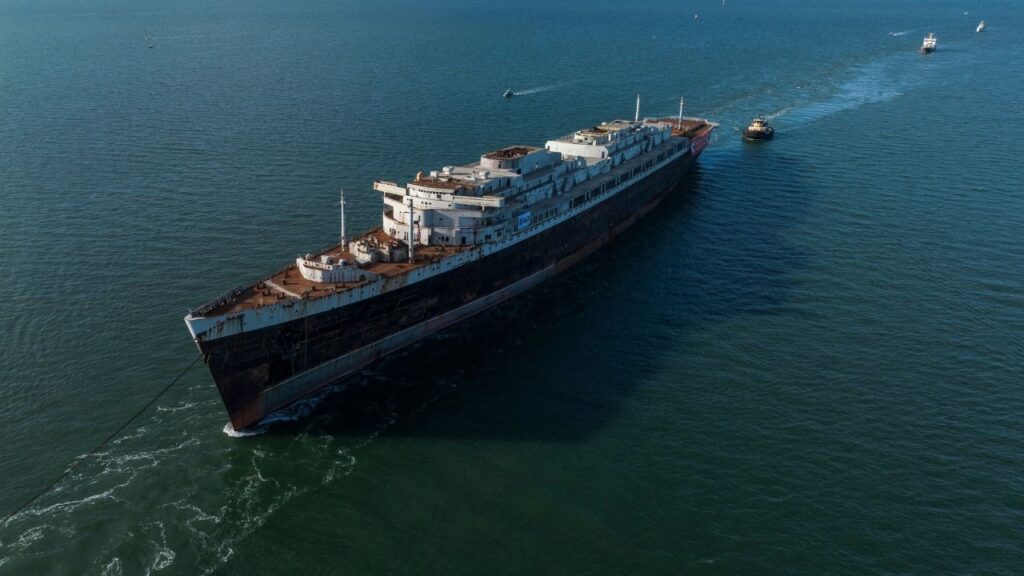
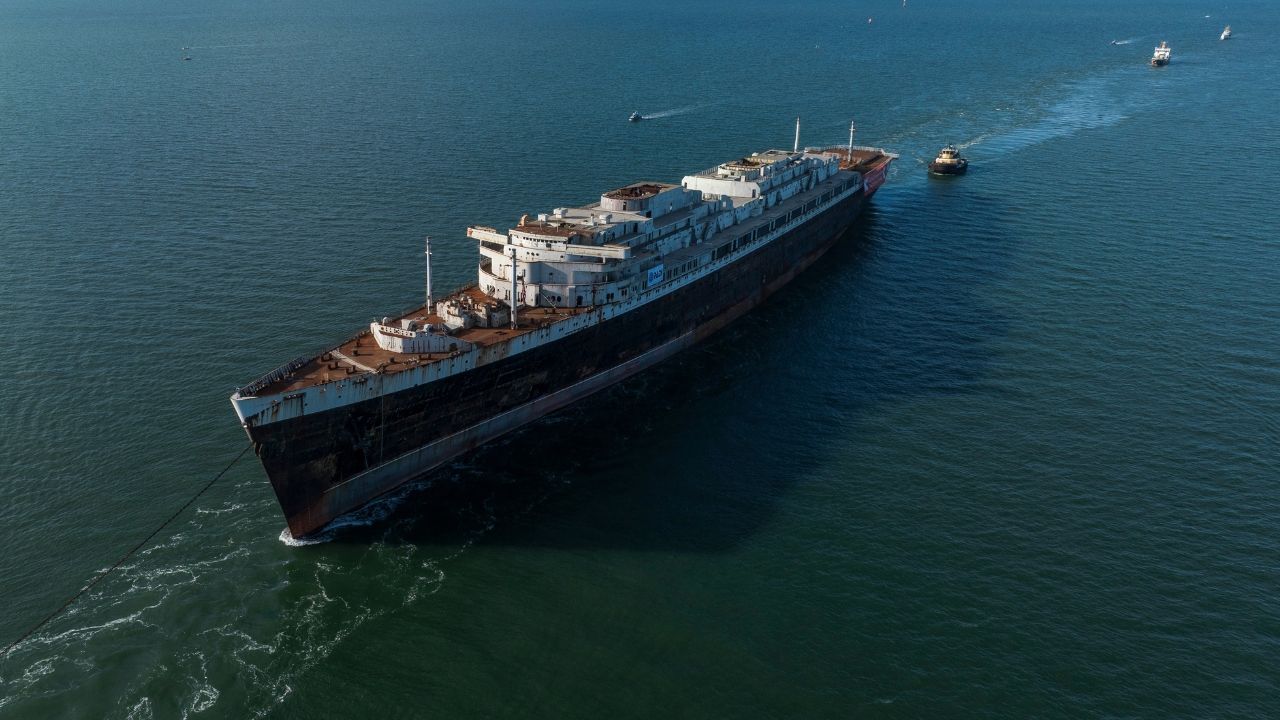
Stripped of its signature red-white-and-blue smokestacks — they were removed for a planned museum nearby — the SS United States cut a somewhat more low and lean profile than it once did. You could say it looked more like a cigarette boat than an ocean liner, if cigarette boats were as long as three football fields.
Still it was a fitting look, because the ship was the fastest ever to cross the Atlantic Ocean.
Gibbs was a giant of 20th-century naval architecture, and the SS United States was his magnum opus. Built in the boom years after World War II, it was an ocean liner so fast, its top speed was a Cold War state secret. On its first trans-Atlantic round trip, in July 1952, it set a speed record that still stands today.
The SS United States spent most of the 1950s and ’60s ferrying people between New York and Europe, its shipboard orchestras and cocktail lounges entertaining countless travelers — presidents, royalty, immigrants and vacationers. Marilyn Monroe sailed on the ship. Walt Disney. Duke Ellington. Princess Grace. But its most famous passenger was probably the Mona Lisa, in 1963, when the painting visited America.
But as jet travel turned ocean liners into relics, passengers dropped away. In 1969, the ship was mothballed. Until relatively recently, it hadn’t budged from its Philadelphia pier for decades.
For the ship to become a reef, its dark, labyrinthine interiors needed to be made safe for divers. Its huge fuel tanks had to be drained of decades-old goop. And for that to happen, the ship had to be towed halfway around the country, to a shipyard in Mobile, Alabama, by a special oceangoing tugboat.
But first, the Coast Guard needed to be persuaded that the ship, which is as long as the Chrysler Building is tall, was safe to move.
The effort to turn the SS United States into an artificial reef was led by Alex Fogg, the natural resources chief of Okaloosa County, Florida, which bought the ship in 2024 for $1 million. The county is assembling a menagerie of sunken ships for divers to explore off the coast of Destin on Florida’s Panhandle.
On Tuesday, Fogg was on hand to help make final preparations for a sinking he’s been working toward for years. Once it’s done, he said, “I really don’t know how I’m going to feel.” He ran through a few possibilities. Relief. Joy. Sadness. Excitement.
“Right now it’s kind of surreal,” he said.
Okaloosa County bought the ship from a nonprofit group, the SS United States Conservancy, which for years had been trying to give it a new life as a hotel, entertainment complex or other development. But the ship’s fate was sealed in 2024 when it was evicted from a dock in Philadelphia by its landlord, the pier’s owner.
The eviction turned nasty. The group even accused the landlord of trying to negotiate a sale of the ship, an asset it didn’t own.
When an urgent search for a new pier failed, the conservancy decided that an artificial reef would be a more dignified end than selling its beloved ship for scrap.
Okaloosa bought it. Then Okaloosa needed to move it. After months of false starts, it finally happened on a freezing February day in 2025.
That morning, Fogg and his team gathered beside the ship in Philadelphia. A half dozen uniformed Coast Guard officials strode up the dock, led by Capt. Kate Higgins-Bloom. She held a piece of paper, and the fate of the ship, in her hands.
Someone whispered: Here comes one of the most powerful officials on the East Coast.
Higgins-Bloom handed Fogg the thing he’d been pursuing for months, a permission slip to pull the ship out into the Delaware River and tow it to Alabama. The Coast Guard was finally satisfied that this could be done safely — basically that the ship wouldn’t sink or cause a disaster somewhere.
The ship was on its way. Down the East Coast, then past Cuba, destined for Alabama. But there was still more than a year of work ahead.
Sinking ships is a business, one that Coleen O’Malley knows well. She and her husband, Tim Mullane, run Coleen Marine, which they estimate has intentionally sunk, or “reefed,” about 140 ships. And the SS United States was one of their best-known customers.
Six months after the ship made it to Alabama, O’Malley was at work, deep inside the vessel. In a tiny room behind a door marked “Relief to Atmosphere,” she explained what was being done.
It was her job to safely send the SS United States to the bottom.
Old deck plans papered the walls. The room vibrated from the thumping of a thick hose in the hallway outside, pumping out oil.
“Every ship is different, but every ship is the same,” O’Malley said. The wiring had to come out, along with ductwork, glass and things that might entangle or injure divers. “Snag hazards,” Mullane said.
There was a need to cut passages strategically throughout the ship, so that divers could easily see pathways to open water and don’t get trapped. It helps sea life, too, by reducing stagnant waters.
And an important one: Making sure the ship, when sunk, sits upright on the bottom. If it lands on its side or flips, it could wobble and be unstable for divers. The secret is to make sure no big air pockets remain inside.
As they worked to prepare the ship last August, the decks were heaped with crumpled ductwork, piles of wires and stacks of mad-scientist control panels with labels like “Shaft Revolution Indicators.” A tanker truck parked out front was slurping out the oil.
It was an especially big week in the ship’s transformation. Its two iconic, teardrop-shaped smokestacks, or funnels, each the height of a six-story building, were ready to be lifted off.
Mullane stood at the top of the ship, conducting an orchestra of cranes, barges and people with cutting torches, and dropping F-bombs.
At 1:06 p.m., “Clear the stack” came across the radio, warning everyone to move away.
At 1:10, Mullane emphasized the point with a touch of profane urgency. “Clear!” he shouted.
“It’s only under 16 tons of tension,” he said to no one in particular.
A series of gut-vibrating booms rumbled through the ship. A man stepped out of a small hatch near the bottom of the forward funnel and made a cutting motion across his neck.
“I’ve got goose bumps,” Fogg said.
More pounding and groaning of metal, and at 1:50 p.m. the funnel swung free in a puff of rust. O’Malley ran up the starboard side toward the bow, where she and her husband shared a kiss.
Which brings us to Wednesday, when years of uncertainty about the ship’s future and then all that preparation — months of cleaning, decontaminating, hoisting and cutting — came down to one big moment off the Florida coast.
By late afternoon, holes were opened in the hull just above the waterline. Water was pumped into the ship, causing it to settle lower and lower, over a period of eight hours until seawater rushed into the holes that were cut in the hull. Mullane was the last person to stand on the ship before transferring to a waiting boat.
And the SS United States made its final journey.
Fogg called the sinking “the most honorable next chapter.” He said he planned to be the first person to dive to the SS United States, once it came to rest on the bottom.
—
This article originally appeared in The New York Times.
By Jesse Pesta/Micah Green
c. 2026 The New York Times Company