

|
Getting your Trinity Audio player ready...
|
Blake Musick’s first Bible, given to him as a child by his parents, was a hardback King James Version with an illustration of Jesus teaching some children on the cover. His second was a large-print edition, acquired as a teenager, with a thick zippered cover to protect it as he carried it to church.
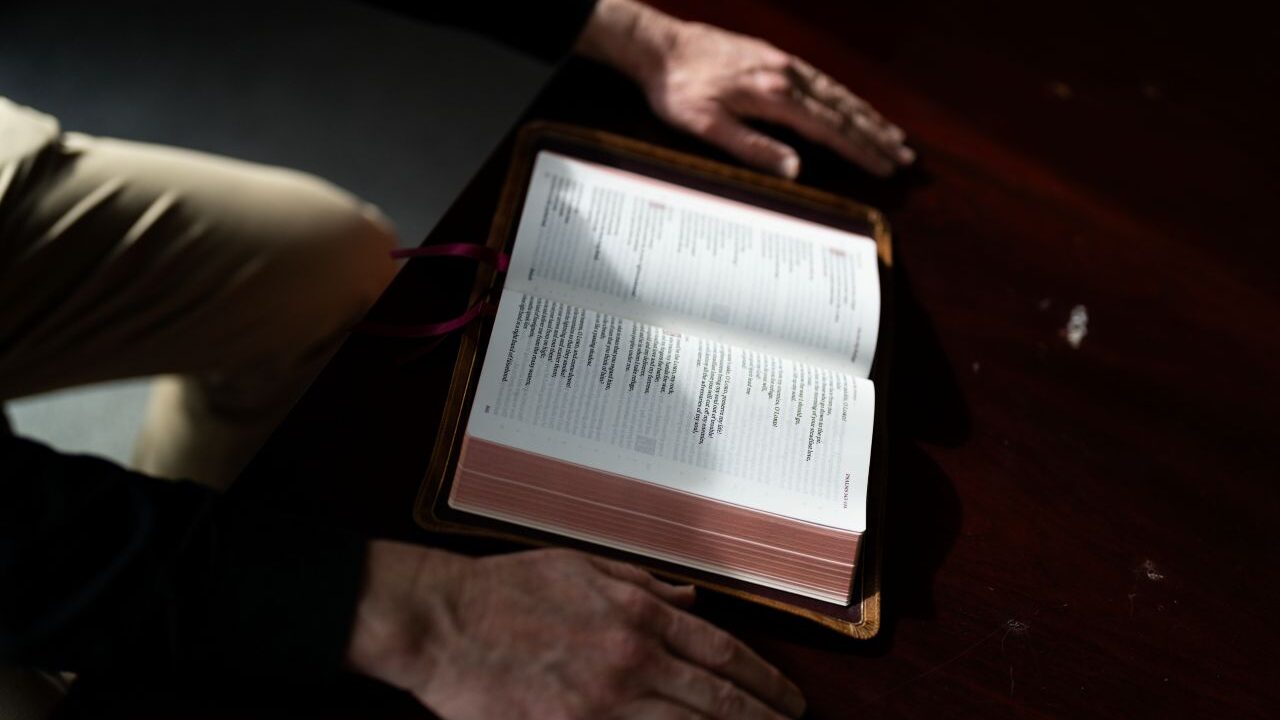
He acquired his 70th Bible, give or take, in February, an English Standard Version bound in soft brown cowhide with a sticker price of $299.99, scooped up for $200 secondhand on Facebook.
“This is actually God’s word,” Musick, 38, said. “If it’s something that important, then why not have a really nice copy of it?”

Musick, a pharmacist in Johnson City, Tennessee, is among a growing number of Americans buying high-end — and high-priced — copies of the Bible. The growing category of premium Bibles includes a wide array of translations assembled with high-quality materials, like genuine leather covers, and in many cases extras like elaborate color illustrations. Musick estimated that about half the Bibles in his collection are in that category.
The retail cost can run up to $400 for a single book, an even more remarkable figure in a category where the core text itself has been in print continuously since the invention of the printing press, and is often handed out for free.
“There’s been a renaissance in the whole field,” said Sky Cline, who has been selling premium Bibles online since the early 2000s, and later began producing his own, sourcing materials like calfskin leather from Italy and paper milled in France. His sales began growing during the coronavirus pandemic and haven’t stopped.
Bible Apps Are Popular, but Collectors Love the Printed Word
Cline attributes his success to a few factors, including a gravitation toward handmade, long-lasting objects, and “a push away from instant, artificial, blue-light culture,” he said. Bible apps like YouVersion, which marked its billionth unique download in November, remain extremely popular. But many collectors of premium Bibles mention how satisfying the books feel and smell, with comparisons to baseball gloves and saddle shops.
Bible sales tend to surge after major geopolitical events, like the invasions of Iran and Ukraine, Cline said. The assassination of Charlie Kirk last year prompted a “huge spike” in premium Bible sales on his website, he said. (Many pastors reported at least temporarily higher church attendance numbers in the wake of Kirk’s death.)
The trend is part of a larger expansion in Bible sales over the last five years, confounding experts and running against broader trends in book publishing. Bible sales have grown steadily since 2021, and have set annual sales records since 2022, according to Circana BookScan, which tracks book sales. Last year, 19 million Bibles were sold in the United States, a 21-year high and double the volume sold in 2019.
So far this year, Bible sales are up 5% over the same time frame a year ago, while print book sales overall are down 3%, according to Circana.
“Whatever happened six years ago with COVID and Bible readership, we’re now starting to see some tangible results of what that looks like,” said Tim Wildsmith, a podcaster and writer who reviews Bibles on his YouTube channel.
Premium Bibles remain a relatively niche product. On March’s list of bestselling Bibles, maintained by the Evangelical Christian Publishers Association, a trade association, the most expensive product is a $79.99 leather-bound Bible with study notes by the California pastor John MacArthur. Most of the Bibles listed cost between $20 and $50.
But higher-priced Bibles have multiplied in recent years. Word on Fire, a Catholic ministry, published its fifth installment of a seven-volume Bible promoted as a “cathedral in print” last year, with each leather-bound volume priced at $99.95. A spokesperson said the series has sold more than 600,000 copies so far, a figure than includes cheaper hardcover and paperback versions.
Lifeway, a publisher associated with the Southern Baptist Convention, now offers “handcrafted” editions. Crossway Books issued an expanded selection of “heirloom” editions of its English Standard Version translation last year, with several versions retailing for $350; a larger “pulpit Bible” is $400. Word on Fire, Lifeway and Crossway are nonprofits, but some other publishers are for-profit entities with a Christian corporate identity. Many of the publishers also support programs that distribute lower-priced Bibles for free.
The ESV, which turns 25 this year, has become the preferred translation for many evangelical Christians. The version uses less gender-inclusive language than some other popular translations, and touts its “essentially literal” approach. Josh Dennis, the company’s chief executive and president, said sales of the ESV in general have more than doubled in the last two years.
For many Christians, buying a copy of the Bible is different from buying a beautiful copy of, say, a favorite novel. Many at least aspire to study from it daily, often annotating and underlining as they read and pray.
25% of Americans Read a Bible Weekly
About a quarter of Americans use a Bible at least weekly, according to a survey last year by the American Bible Society. The group’s annual survey found that 41% of Americans use their Bibles at least three or four times a year, the highest total since 2021.
Depending on the translation, the Old and New Testaments contain about 750,000 words total, making it tempting for publishers to shrink font sizes and cram more words on thinner paper. Many publishers tout an extra attention to page design in their premium editions, emphasizing both beauty and readability.
“People are starting to reason, ‘If you’re going to get a Bible, get a good one,’” said Daniel Arroyo, founder of the premium Bible company Humble Lamb, which is based in Kentucky.
Humble Lamb sold its first Bible in 2018, and did $2.7 million in sales last year. Most Bibles in its catalog are priced between $220 and $250, and feature fore-edge painting — illustrations on the outer edges of the pages that are only revealed when the pages are fanned.
Collectors of premium Bibles tend to share a few characteristics, publishers and experts say: They are typically evangelical Christians who own multiple other Bibles already, and many of them are men. Arroyo estimates that at least 60% of his customers are men. Wildsmith, the Bible reviewer, said his YouTube audience was about three-quarters male. Some recent surveys have detected Bible reading and church attendance stabilizing or even rising after years of decline, shifts fueled in part by young men.
Historically, many households owned one “family Bible” and used it to record milestones like births, deaths, and baptisms, and then passed it down through the generations. Some premium Bible consumers see themselves as returning to that tradition.
In Tennessee, Musick treasures two Bibles in his collection that were each once owned by one of his grandmothers.
“The way I look at it, when I’m having a hard day, I can pick up one of those Bibles and see where my Grandma underlined a verse or made a note,” he said. “It’s like sitting back at her house reading a Bible with her.”
This article originally appeared in The New York Times.
By Ruth Graham/Tierney L. Cross
c.2026 The New York Times Company