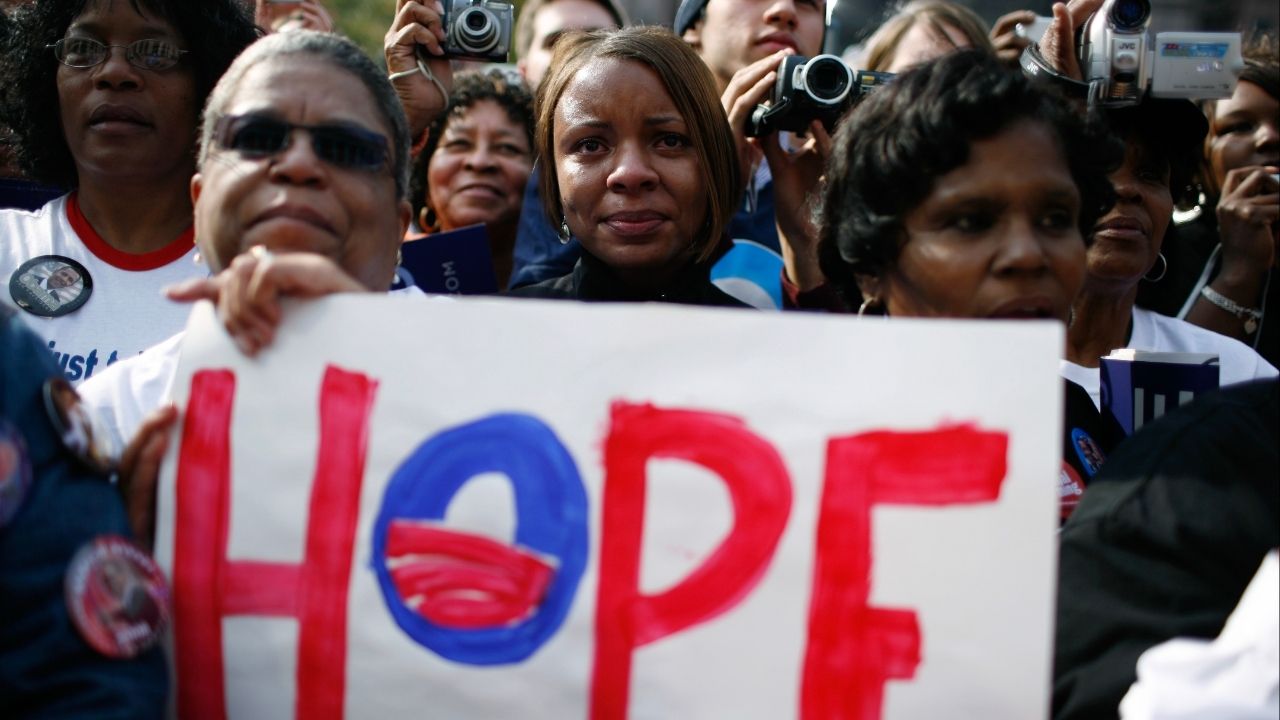
Supporters Sen. Barack Obama (D-Ill.) during his presidential campaign, at the Ohio State Capitol in Columbus, Nov. 2, 2008. Jesse Jackson’s presidential campaigns created a pathway for scores of Black Democrats to run for office. (Damon Winter/The New York Times)

Share
|
Getting your Trinity Audio player ready...
|
WASHINGTON — When Jesse Jackson ran for president in 1984, he was viewed as a protest candidate without the political infrastructure to mount a serious challenge for the Democratic nomination.
By the time he ran again four years later, Jackson wanted to build a serious campaign. He had spent years registering millions of new Black voters and built a fresh kind of multiracial Democratic coalition that included progressive white voters and people of color.
Jackson fell short, finishing second in the 1988 primary race, but his campaign created a pathway for scores of Black Democrats to run for office while demonstrating for the first time that white Americans would vote for a Black presidential candidate.
“Jesse Jackson provided a building block for campaigns and efforts like mine to be successful,” said Carol Moseley Braun, who in 1988 was an Illinois state representative and volunteer for Jackson’s campaign and who four years later, with his support, became the first Black woman elected to the U.S. Senate. “Nobody thought a Black person could get elected to anything but a Black district. Before Jesse, that was true. What he showed is that Black candidates with the right campaign can reach across racial boundaries.”
In 1972, Shirley Chisholm became the first Black candidate for president from a major party, and the Rev. Al Sharpton ran in 2004, but until Barack Obama won the White House in 2008, Jackson’s 1988 campaign was the only one to capture enough delegates to be considered a legitimate contender.
In the aftermath of Jackson’s campaigns, many Black politicians made historic leaps to prominent offices.
In 1989, L. Douglas Wilder was elected the first Black governor of Virginia, and David Dinkins and Norman Rice were elected the first Black mayors of New York and Seattle.
Also in 1989, Ron Brown became the first Black person to lead a major national party when he was elected chair of the Democratic National Committee.
Three years later, Moseley Braun was elected to the Senate, while the number of people of color in the House rose sharply between 1990 and 1992.
And Obama’s path to his 2008 Democratic primary victory would have been far tougher without changes to the Democratic National Committee delegate allocation system that were demanded by Jackson’s allies at the party’s 1988 convention in Atlanta.
The Jackson delegates forced the party to end a winner-take-all distribution of delegates during the presidential nominating contests. Instead, each state would award delegates proportionally, giving underdog candidates an opportunity to build momentum throughout the primary race.
“Without Rev. Jackson, there never would have been Barack Obama,” said Donna Brazile, who was a top organizer of Southern states for the 1984 Jackson campaign and went on to serve as acting DNC chair.
It was not only Black candidates whom Jackson inspired to seek office. The Minnesota state director on his 1988 campaign was a liberal college professor named Paul Wellstone, who in 1990 toppled an incumbent Republican senator. Another supporter, Mayor Bernie Sanders of Burlington, Vermont, was elected the same year to the House — becoming the only democratic socialist in Congress at the time.
And in 1992, Bill Clinton won the presidency with the help of a coalition of Black and Latino voters, many of whom had been mobilized by Jackson’s campaigns.
Obama, Sanders and others who followed Jackson aimed to expand the electorate as he had.
“Jackson showed that if you wanted to win, you should not just depend on statistics from previous elections that show who votes — you go out and find new supporters and get them to vote,” said Gerald Austin, who was Jackson’s campaign manager in 1988. He added that Zohran Mamdani’s successful run for New York City mayor last year was “an extension of what Jackson did in ’88. He won because he involved different races and young people and drew them into a win.”
Austin, in an interview, recalled attending a party fundraising dinner at a Minneapolis hotel in 1987 at which Jackson and other Democratic presidential candidates spoke.
Jackson, he said, spoke last, and when he did, the kitchen staff that had prepared and served the food for the evening emerged into the ballroom to hear Jackson’s remarks.
“They didn’t come out for anybody else,” Austin said. “But this was their first chance to see someone running for president who looked like them.”
Jackson remained deeply involved in Democratic politics long after his presidential campaign ended.
Brazile said that when she was the campaign manager for Vice President Al Gore’s White House bid in 2000, Jackson called her every day at 6 a.m. to receive updates and give advice.
In 2008, he was an early endorser of Obama — though he was at times a distraction for the campaign, such as when he accused Obama of “talking down to Black people.” Jackson subsequently apologized.
Jackson’s best-known speech is the one he delivered to the 1988 Democratic National Convention in Atlanta, which he concluded with a stirring call to “keep hope alive.”
Twenty years later, when Obama ran for president, his campaign’s prevailing image was a poster of the Illinois senator behind one word: Hope.
—
This article originally appeared in The New York Times.
By Reid J. Epstein/Damon Winter
c. 2026 The New York Times Company