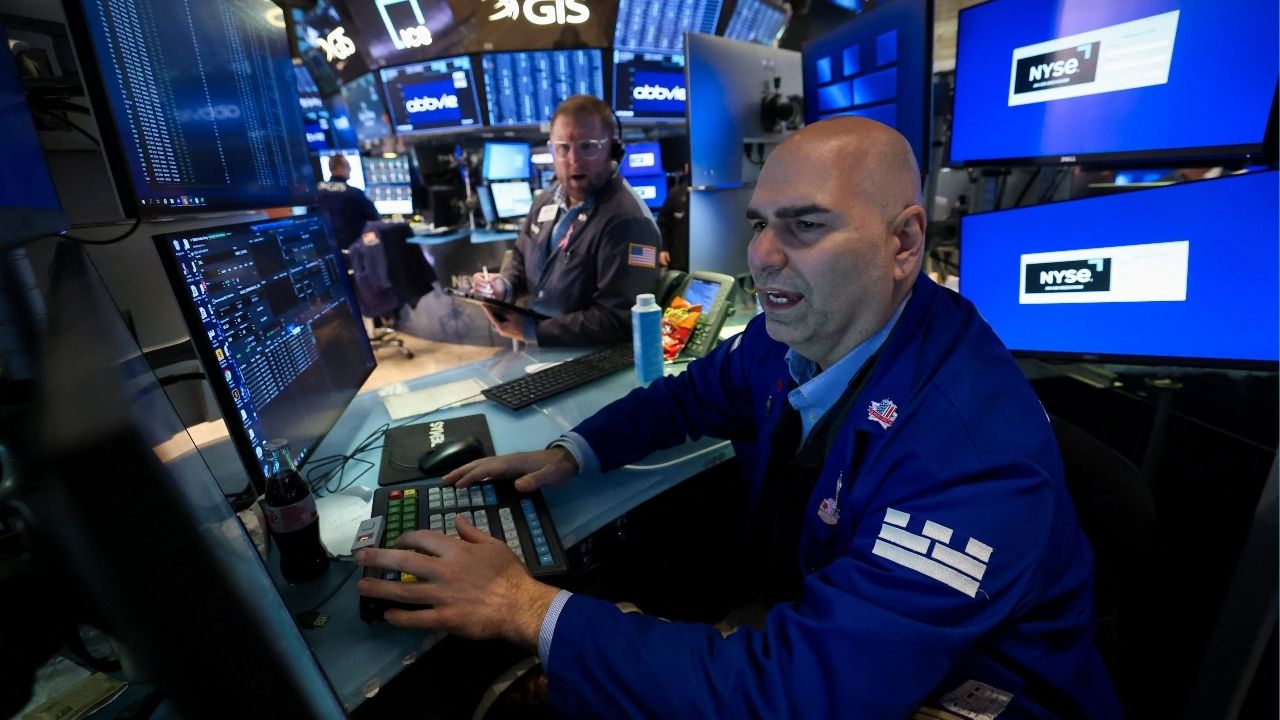
Traders work on the floor at the New York Stock Exchange (NYSE) in New York City, U.S., January 13, 2026. (Reuters/Brendan McDermid)

Share
|
Getting your Trinity Audio player ready...
|
Wall Street’s main indexes dropped in a choppy trading session on Tuesday after a long weekend, with tech heavyweights leading declines as investor concerns over AI-led upheavals across the sector persisted.
Most U.S. technology stocks were lower on the day, with Nvidia losing 1.6% and Microsoft down 1.3%.
Worries that artificial intelligence could disrupt business models had sparked a selloff in software firms, brokerages and trucking companies the previous week, causing Wall Street’s three main indexes to log their steepest weekly decline since mid-November.
Potential risks from Chinese AI players also added to the uncertainty. On Monday, Alibaba unveiled a new AI model, Qwen 3.5, designed to independently execute complex tasks.
Intel lost 2.2% and Advanced Micro Devices was down 5.2% on Tuesday. The Philadelphia SE Semiconductor index fell 2.3%.
“The Alibaba AI product is one of the variables weighing on markets today and that’s a part of a much larger dynamic that’s at play here,” said Stash Graham, managing director and CIO at Graham Capital Wealth Management.
“You are seeing a rebalance… for the markets to take a breather off such a strong year last year; it’s natural.”
Main Markets Fall
At 10:01 a.m. ET the Dow Jones Industrial Average fell 175.80 points, or 0.35%, to 49,326.73, the S&P 500 lost 50.44 points, or 0.75%, to 6,784.64, and the Nasdaq Composite was down 258.44 points, or 1.15%, to 22,288.23.
The S&P 500 financials index was a bright spot, adding 0.8%. Big banks such as Goldman Sachs and JPMorgan Chase were up 0.7% and 1.1%, respectively.
Software stocks remained under pressure, with the broader S&P 500 software index falling 1.8%. CrowdStrike, Adobe and Salesforce were off between 2% and 5%.
The S&P 500’s materials index plunged 2.1% tracking precious metal prices, while the energy index lost 1.8%.
This week, the personal consumption expenditure report – the U.S. Federal Reserve’s preferred inflation gauge – will be in focus for insights into inflation and could impact the central bank’s rate-cut trajectory.
The data follows a cooler-than-expected consumer inflation reading last week that slightly raised bets on interest-rate cuts this year.
Traders are pricing in a 25-basis-point reduction in June, with the odds at 52%, compared with a close-to-49% chance a week ago, according to CME’s FedWatch Tool.
Warner Bros rejected Paramount’s revised takeover bid, giving the studio a week to negotiate a better deal. The companies rose 2.4% and 7.8%, respectively.
In other movers, Norwegian Cruise Line jumped almost 8% after activist investor Elliott said it had built a more than 10% stake in the cruise operator.
Fiserv’s shares gained almost 4.4% after the Wall Street Journal reported activist investor Jana Partners had taken a stake in the payments company.
Masimo surged about 34% after Danaher said it would acquire the pulse-oximeter maker for $9.9 billion, including debt. Danaher lost 3.4%.
Meanwhile, Iran’s foreign minister said the country had reached an understanding with the United States in a second round of nuclear talks in Geneva, but more work needed to be done.
Declining issues outnumbered advancers by a 1.62-to-1 ratio on the NYSE and by a 1.72-to-1 ratio on the Nasdaq.
The S&P 500 posted 35 new 52-week highs and five new lows, while the Nasdaq Composite recorded 42 new highs and 109 new lows.
—
(Reporting by Purvi Agarwal and Twesha Dikshit in Bengaluru; Editing by Pooja Desai)
RELATED TOPICS:
Categories





Dana Eden, Co-Creator of ‘Tehran,’ Found Dead in Hotel Room