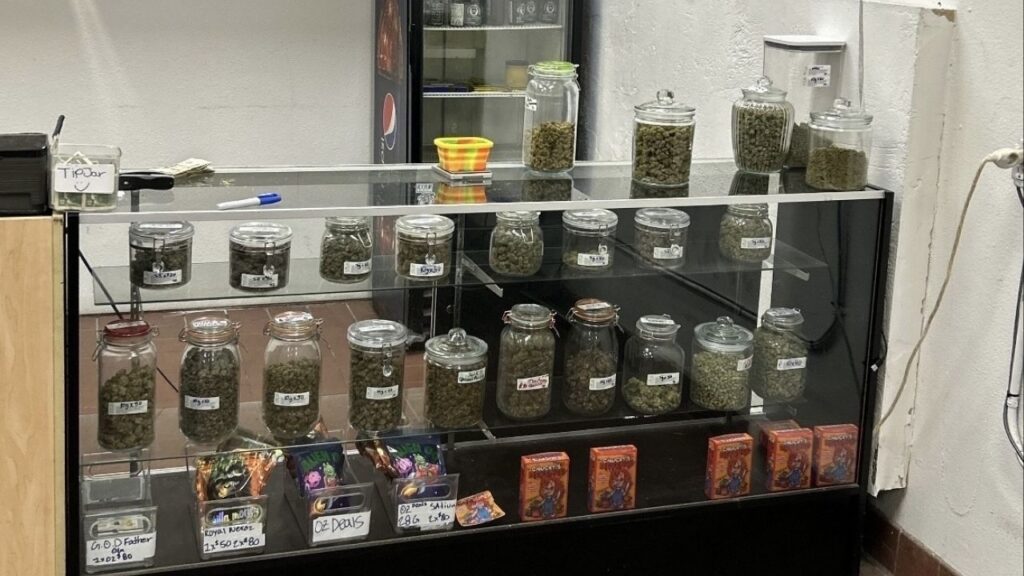
The extensive security camera system at a Mexican goods store in Hillsboro, Ore., where county deputies and local police had a tense encounter with federal immigration agents, Feb. 5, 2026. Far from the national spotlight, smaller towns and exurban communities are dealing with President Donald Trump’s expanding mass deportation effort, and the effects can be acute. (Jordan Gale/ The New York Times)


- ICE’s mass deportation efforts have expanded into small and mid-sized communities, unsettling towns unaccustomed to visible federal immigration operations.
- Local officials say aggressive tactics and limited coordination with police are eroding trust and straining public safety resources.
- Residents and leaders warn that fear of immigration enforcement is discouraging crime victims and witnesses from cooperating with law enforcement.
Share
|
Getting your Trinity Audio player ready...
|
President Donald Trump may be ending the surge of immigration agents in the Twin Cities, but his mass deportation effort has already extended well past large, liberal cities like Minneapolis, to small communities where the national spotlight does not exist but the impact can be at least as acute.
From Big Cities to Small Towns
In places like Cornelius, Oregon; Danbury, Connecticut; Biddeford, Maine; and Coon Rapids, Minnesota; where moderation, not partisanship, might predominate, the arrival of Immigration and Customs Enforcement — and the more aggressive tactics ICE officers often use — has been jarring. In small towns, resources may already stretched, and even a single incident can shatter the tranquility of neighborhoods unaccustomed to turmoil.
ICE is proud of its reach. The agency is using “data-driven intelligence” to deploy its agents, the agency said in an email, declining to identify a spokesperson. It added, “ICE operates everywhere — rural, urban, and suburban.”
Tensions With Local Law Enforcement
In Coon Rapids, an exurb about 15 miles from downtown Minneapolis, Bill Carlson recently watched federal agents as they waited across the street for hours to take away a Vietnamese family he called his neighbors.
“There is a fear here,” he said. “I didn’t think anything like this would happen in America, let alone Coon Rapids.”
Last month, ICE “surge teams” from Philadelphia were sent into West Virginia, hitting the towns of Martinsburg, Moorefield, Morgantown, Beckley, Huntington and Charleston. None of those places have more than 50,000 residents and Moorefield has less than 3,000. Federal officials boasted of arresting more than 650 immigrants living in the country illegally.
At a coffee shop in Hillsboro, Oregon, deputies and local police in Washington County responded in October to multiple 911 calls that reported 10 armed men wearing masks who approached a car filled with high school students with weapons drawn in a crowded drive-thru lane. Only after a tense encounter — and after the armed men got in their van and left — did the local officers understand they’d been in a standoff with federal immigration agents.
“You’ve got people in that parking lot who want us to arrest the ICE agents,” said Sheriff Caprice Massey, adding that she is worried her deputies could wind up in an accidental gunfight with federal officers. “And you’ve got ICE agents who want us to help them or get out of their way.”
Emergency responders have also fielded a rash of 911 calls about abandoned vehicles. “ICE will just take someone and leave their car, windows smashed, in the middle of the road,” Massey said.
ICE officials said they are not responsible for the confusion; federal officers “clearly identify themselves as law enforcement while wearing masks” and notify local agencies when making arrests, the ICE email said.
As for the 911 calls, he said those are “a direct result of sanctuary policies, activist smear campaigns, and dangerous political rhetoric that encourages reporting or recording ICE activity.”
Regardless of who is to blame, the effects are acute.
Shattered Trust in Immigrant Communities
In Cornelius, Oregon, population 14,763, town leaders in late November declared a state of emergency and asked Oregon’s governor, Tina Kotek, for money to pay for more police — specifically so they can have officers monitor ICE.
Community activists said Washington County police and prosecutors have told them there’s nothing they can do even when officers are present for immigration enforcement that turns violent.
“We said, ‘But they’re hurting people,’” said Maria Caballero Rubio, executive director of Centro Cultural, a Cornelius nonprofit that supports the Latino community. “People are being thrown to the ground for no reason, and a police officer is just standing by.”
Washington County is Oregon’s second-most populous and home to the headquarters of Nike and Intel’s largest domestic manufacturing campus, but that tells only half the story. Away from U.S. Highway 26, the communities become more rural and heavily Latino. The county is about 18% Hispanic, higher than the state as a whole. In several small agricultural towns, Hispanics are a majority.
“We’re the town for the farms, the place with the John Deere dealership, the Bobcat store, the U-Haul dealerships,” said Jeffrey Dalin, the mayor of Cornelius, where more than half the 15,000 residents identify as Latino.
Coon Rapids, a city of about 64,000 residents, is similarly in the outer orbit of the Twin Cities, 2 1/2 times less dense than Minneapolis.
Last month, the presence of immigration authorities outside of a Mexican restaurant in Coon Rapids alarmed its employees, most of whom have not returned to work, said Pat Carlson, a City Council member who for years has worked closely with immigrant communities. On a recent Friday, as children prepared for school, at least a dozen federal agents roamed the halls of an apartment complex on University Avenue near 92nd Lane North East, according to the property manager, cellphone footage and residents, many of whom are immigrants.
On Jan. 20, about two dozen residents went before Coon Rapids’ mayor, Jerry Koch, and the City Council, worried about immigration agents roaming the streets where their children play.
As they spoke, Koch grew more and more frustrated.
“We’re not Minneapolis or St Paul; we’re not a sanctuary city; we cooperate,” he said later in an interview.
He also made clear he was frustrated with the reaction of some of his constituents to the growing presence of federal agents.
“I get emails that say, ‘ICE has been spotted three times in town today, here at this house, at this house, that house,’” he said. “It’s like, ‘Oh, come on, get off whatever tracking site you’re on and put the whistles away.’”
There are also questions of shattered trust between immigrant communities and law enforcement, a worry echoed by mayors of towns big and small across the country.
In Oregon, Massey’s office provides police service for Cornelius, and local law enforcement officials said they have worked hard, particularly after George Floyd’s murder in 2020, to build trust with a population that has often felt ignored or outright abused by prosecutors and police.
They have hired Spanish-speaking officers, held forums and town halls, and worked closely with nonprofits and social service agencies that serve immigrant and Latino populations. The Washington County Sheriff’s Office recently began using body-camera technology for real-time translation.
All of that would be for nothing if Hispanic residents stop cooperating out of fear for ICE.
“Right now we are seeing — not anecdotally, but repeatedly — people who are victims or witnesses of crimes and reluctant to come forward,” said Kevin Barton, Washington County’s district attorney.
That’s bad for everyone, he added.
“If your loved one was a victim of a violent crime and the only witness was undocumented, wouldn’t you want them to call 911?” he asked. “Wouldn’t you want them to come testify in court?”
Local leaders still said the immigration surge here has not made their communities safer.
Massey said she and other law enforcement leaders have met with regional and national officials from the Department of Homeland Security to ask for what they consider basic changes in how ICE operates — including wearing visible badges identifying themselves as federal officers and notifying local police before making arrests in public places.
“We’ve talked a lot,” she said. “Nothing has changed.”
—
This article originally appeared in The New York Times.
By Anna Griffin and Chelsia Rose Marcius/ Jordan Gale
c.2026 The New York Times Company
RELATED TOPICS:
Categories




Hey Ilia, America Is Still Proud of You.