

|
Getting your Trinity Audio player ready...
|
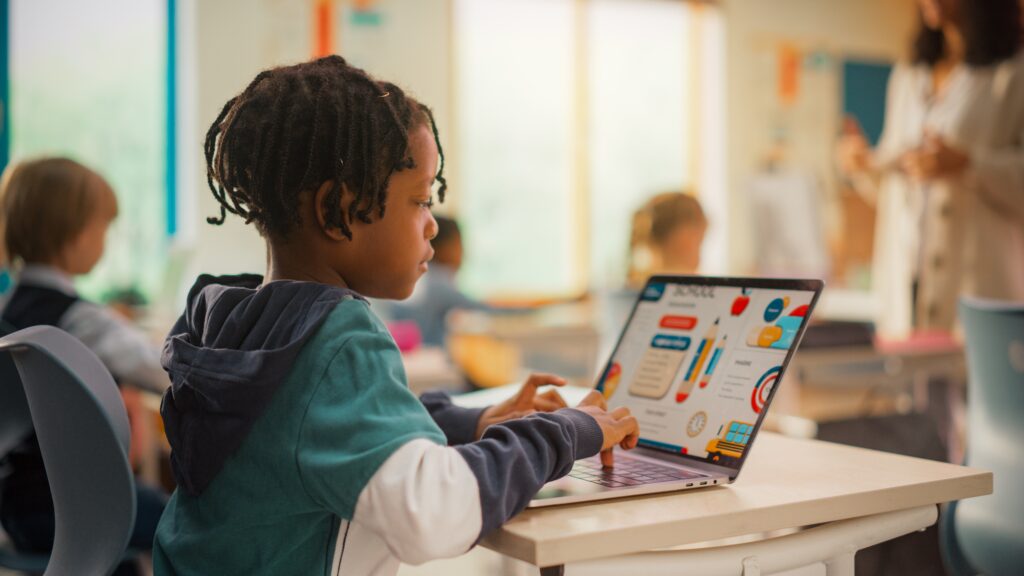
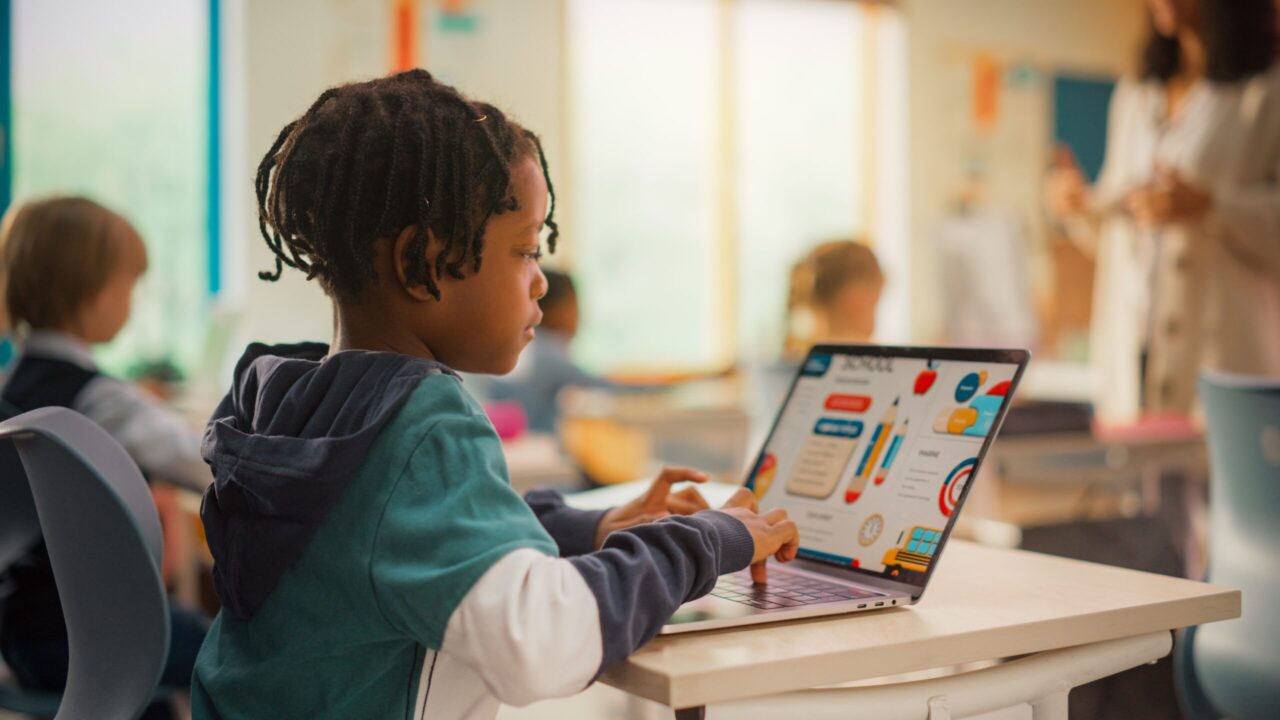
No longer will every student in the Fresno Unified School District have a laptop for use at home.

For almost six years, the school district provided every student with a device, part of a nationwide push to give students equal access to technology during the coronavirus pandemic, which closed schools and initially sent students online for learning.
Through June, Fresno Unified’s 40,000 elementary students must turn in their laptops. Going forward, they will use them at school.
The reversal is, in part, to reduce spending on fixing or replacing laptops each year. There’s also a shift in thinking about the educational value of laptops for students in grades K-6. Keeping devices at school means students can start their work immediately, rather than wasting time in class figuring out whose computer is working, broken, or forgotten, teachers say.
“It’s really about supporting students in the classroom,” said Tami Lundberg, the district’s chief technology officer. “Let’s increase the instructional time.”
This story was originally published by EdSource. Sign up for their daily newsletter.
Still, there are concerns that removing laptops from households could limit access to educational resources that engage students and families.
It’s unclear whether other large districts in California are scaling back on sending laptops home as Fresno Unified is doing. Some smaller districts appear to be doing the opposite. This month, for example, 30 students in the Madera Unified School District received laptops through donations from United Way Fresno and Madera Counties.
The Cost of Replacing, Repairing Devices
Across the country, cost has been a common issue for student devices, according to Adam Phyall, director of professional learning and leadership at All4Ed, a national advocacy organization focused on access to equitable educational opportunities. The more students move a device from home to school, the higher the likelihood of damage occurring, Phyall said.
“With them now going home and in those spaces, schools are having to replace and repair various machines,” he said. “School districts (are) making budget decisions and saying, ‘Well, maybe if we keep them in our buildings, they can last longer.’ ”
That’s the case in Fresno Unified. Despite providing students and families with guidance to take care of the devices, the district experienced high rates of broken or lost devices over the last five years — up to 30% of devices damaged or lost each school year, costing Fresno Unified about $4 million annually or over $2 million over the technology budget.
Returning to classroom laptops will cost the district $8 million in one-time funds and will nearly eliminate the ongoing costs to replace and repair devices in a couple of years, Lundberg said.
Teachers and Parents Have Mixed Responses
Computer keys broke, and screens cracked. Laptops are left at home right before a lesson or a test. Those are some of the reasons Kirk Elementary second grade teacher Ivana Ford-Neal supports keeping computers at school. Her students were expected to complete several lessons and assignments via online learning platforms from home.
“They were not fulfilling that,” Ford-Neal said.
Instead, with the laptops back in the classroom, student work previously assigned as homework will be completed there, she said.
But Greenberg Elementary School teacher Jacquilla Burris, who runs one of the school’s after-school programs for grades K-4, said she is worried about students who have already returned the laptops, especially those struggling to read. Students read books on their devices until the district began recalling the laptops.
Since returning their laptops, students have been less engaged in the reading program, Burris said. The after-school program doesn’t have enough devices for all students.
The after-school program, run through the Office of Advancing Academic Acceleration & Achievement, also offers workshops for parents to help their students with reading. Burris said that at the beginning of the school year, parents logged in to the sessions with their students’ devices. Without the devices, parent engagement has declined because access to technology to help students is gone.
This is one of the risks of returning laptops to schools, said Phyall of All4Ed. When families lack access to online resources, students can fall further behind, he said.
“If we’re no longer sending them home, then we run the risk of widening those gaps,’’ he said. “It is going to start creating this inequity of the haves and have-nots when devices stop going home with our students.”
Though not the intent, some families also used the devices to find ways to improve their lives. A father may use a laptop to fill out job applications, said Burris of Greenberg Elementary, where nearly 96% of students are socioeconomically disadvantaged. “It does cause a hardship for families who are already low-income and struggling.”
Renewing the Purpose of a District-Provided Device
But leaving devices in the classroom will restore accountability for how students use them, some teachers and parents say.
Because parents had not purchased the devices, there was no ownership or responsibility for the computers, teachers told EdSource. Parents were required to pay $40 for a damaged laptop and $100 for a lost device.
Computer replacement was a free service at technology centers across the district, but many parents wouldn’t use it, they said. Some struggled to reinforce what the devices were intended for.
Even though devices at home were meant to help students with their academics, Adriana Ramirez, a mother of two elementary students and one middle schooler, admittedly did not see that happening. When her now middle schooler was in elementary school, he often got in trouble for using his laptop to watch YouTube and chat with other students. In 2024, Fresno Unified disabled the student-to-student chat function.
“Growing up, any technology that we had, we had it at school,” Ramirez said, “so I don’t see it negatively. When it’s at home, they don’t use it for school.”
Ford-Neal, the Kirk Elementary teacher, said that with the new practice, teachers will reassert the proper use of the devices.
“We can control the narrative — how they’re using the computer, if they’re getting their work done, what they’re doing on the computer, all of that — because we’re in a class setting,” she said. “When it’s at home, we can’t control that.”
About the Reporter
Lasherica Thornton covers education in California’s Central Valley. Follow her on X @LashericaT