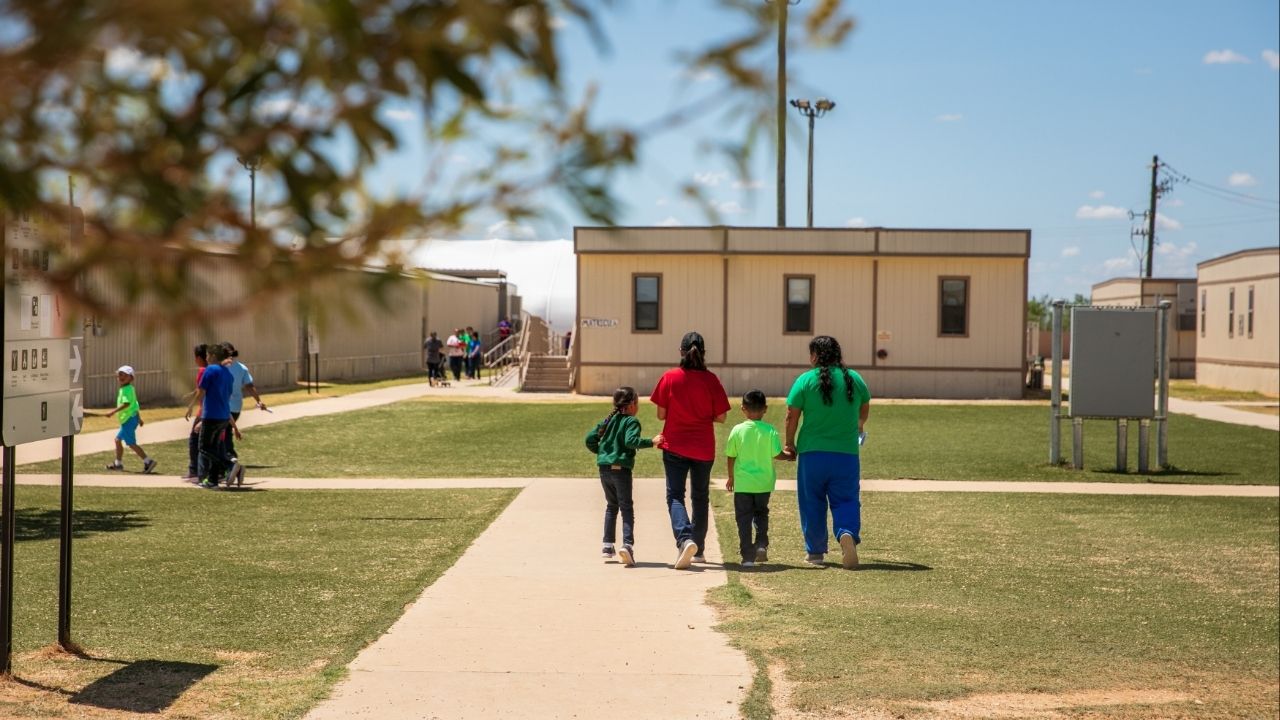
The South Texas Family Residential Center, later known as the Dilley Immigration Processing Center, in Dilley, Texas, on Aug. 23, 2019. About 3,500 adults and children have been detained at the facility since it reopened in 2025. (Ilana Panich-Linsman/The New York Times)

Share
|
Getting your Trinity Audio player ready...
|
A 7-year-old in Oregon was seeking treatment for a nosebleed last month when immigration agents detained her and her parents outside a hospital emergency room. They were taken to a federal detention center in Texas for three weeks.
In Chicago, a 5-year-old was at a laundromat with her mother last fall when they were surrounded by agents and flown to Texas.
And a teenager who had been living in the United States for a decade was getting ready for school one morning last year when police showed up at his family’s door. He, too, ended up confined in Texas with his mother, even though she had begged for him to be allowed to stay with family members who are American citizens, according to court records.
The number of children in federal custody has climbed sharply since President Donald Trump revived the practice of detaining families last year, as part of his promise to deport immigrants who are in the country illegally. The most prominent example came last month, when 5-year-old Liam Conejo Ramos, still wearing his Spider-Man backpack, was detained along with his father on their way home from school in suburban Minneapolis.
Under the Trump administration’s mass deportation campaign, hundreds of children have been detained, usually with a parent. Nearly all pass through one place: a sprawling detention center in Dilley, Texas, that is a jumble of trailers and soft-sided tents in a desolate expanse about 70 miles south of San Antonio.
Known as the Dilley Immigration Processing Center — or just Dilley — it has been the main site for family detentions since it was built in 2014 during the Obama administration, which at one point held more than 1,000 children there during a surge of migrants fleeing Central America.
The Biden administration stopped using the facility to detain families in 2021 and closed it in 2024. The Trump administration reopened it last year.
In the past, Dilley was used mainly to hold women and children who had just crossed the border. But now, many of the children sent there had been living in the United States and attending American schools, sometimes for years.
“There are many, many Liams,” said Elora Mukherjee, a professor at Columbia Law School who runs the school’s immigration clinic.
The children who end up at Dilley are generally immigrants themselves, brought to the United States by a parent. It is unclear if any American citizens, such as babies born recently to immigrant parents, have been detained there.
All told, about 3,500 adults and children have passed through Dilley since it reopened, according to lawyers and legal aid organizations that represent families. Some are held for only a few days, others for months. Some are deported, voluntarily or not. Accounts of their stays come from court affidavits written by parents and children, recent interviews with families and reports from lawyers and members of Congress who have spoken with them.
The Biden administration allowed hundreds of thousands of migrants to enter the country seeking asylum. Trump officials have said that migrants took advantage of a system where asylum cases could take years to be decided.
The Trump administration says that migrant families can avoid confinement by voluntarily leaving the country.
“Being in detention is a choice,” the Department of Homeland Security said in a statement, adding that the administration was offering $2,600 and a free flight to people who leave voluntarily.
Many families have refused that offer. They may have pending cases in immigration court, giving them hope that they might be allowed to stay. Some have built lives in the United States, and some fear returning to their home countries.
Federal officials say parents can choose whether to be detained with their children. However, it’s unknown how many parents have been allowed to leave their children with another adult caregiver.
Many families say immigration agents have given them no choice but to bring their children with them.
Taken from Learning
Until two months ago, Edison, a 13-year-old Guatemalan boy, was a thriving seventh grader in Chicago. He excelled at math, his favorite subject, played on his school’s soccer team and translated for his immigrant parents.
Today, Edison is being held with his mother in Dilley, where his schooling has been reduced to an hour a day.
His father, Ricardo, who spoke on the condition that he and his family be identified only by their first names, said that he came to the United States first, and that Edison and his mother arrived in 2023 and applied for asylum together.
In December, he said, Edison’s mother complied with instructions to visit an Immigration and Customs Enforcement office for their case and was told to bring the boy back with her the next day. The two were taken into custody while Ricardo was waiting outside, a moment that has left him in agony, he said.
He said that his wife was not given the option to leave their child behind.
On average, about 175 children a day were held in ICE detention last year, up from about 25 children a day at the end of the Biden administration, according to data from the Deportation Data Project, which is current as of October. (Under President Joe Biden, families taken into custody after entering the United States were sometimes kept temporarily in hold rooms or other facilities for processing.)
As of mid-January, there were about 1,400 people at Dilley, including about 500 children and 450 parents, according to RAICES, a nonprofit organization that provides legal services to families inside Dilley. (About 450 single women are being held there in a separate part of the facility.)
A promotional video by CoreCivic, a private prison company that runs Dilley, depicts a dormlike setting, with bunk beds, an outdoor playground, a volleyball court, a no-frills library and a pantry with animal crackers and other snacks.
Families describe a different reality: inadequate medical care, lights kept on all night, scant drinking water and little education.
The detention center is surrounded by barbed wire, and most families sleep in rooms shared with other families. Children often lose weight and get sick. Recently, there were two confirmed cases of measles. Some children have become suicidal and had panic attacks, families and lawyers say.
“There is a lot of desperation,” said Javier Hidalgo, a legal director with RAICES, who has visited the facility many times.
Christian Rubi, 16, said in a phone interview from Dilley that he has “a lot of anxiety attacks.”
“I start crying, shaking,” said Christian, who arrived in the United States from Mexico when he was 7 and had been living in San Antonio, where he was detained with his mother during a check-in with ICE. They have been held for more than four months. “I just want to get out of here,” he said. “It’s hell.”
A mother seeking asylum from Colombia who spent two months at Dilley this fall wrote that her daughter, 6, had previously been an engaged first grader in New York City. Art was her favorite subject. But she regressed at Dilley.
“She has started to wet her pants again since coming here,” the mother, Kelly Vargas, wrote in an affidavit in October. “She is also asking at night to drink milk from my breasts. She hasn’t had breast milk in four years.”
The Department of Homeland Security said, “Detainees are provided with three meals a day, clean water, clothing, bedding, showers, soap and toiletries.”
“Children have access to teachers, classrooms and curriculum booklets for math, reading, and spelling,” the agency added. “All of this is generously funded by the U.S. taxpayer.”
‘Not Really Education At All’
At Dilley, children of different ages and grades are grouped together for one-hour classes, which often consist of basic worksheets or coloring. After several weeks, the lessons are repeated, according to families and lawyers.
“In high school, I was taking chemistry, geometry, history and English,” said Christian, the 16-year-old who had been living in San Antonio. At Dilley, he said, “they don’t teach you anything.”
Christian said that high school students were handed a sheet to color in the American flag and another to search for the 50 states. He has quit attending class.
Sometimes, children are turned away, because the class size is limited to 12 to 15 students.
Leecia Welch, who is chief legal counsel at Children’s Rights and represents detained children in a class-action legal case, said that the offerings at Dilley were “not really education at all.”
As more children have been detained, their U.S. schools often must piece together where they have gone.
In Columbia Heights, Minnesota, a suburb of Minneapolis, several children were taken to Dilley, including 5-year-old Liam, whose release was ordered by a judge. Two brothers were sent there with their mother and later released. While there, school officials said, the brothers recognized another child in the cafeteria: a fifth-grade girl, who had been missing from their school for weeks.
ICE has sporadically released families, sometimes without explanation. In late January, several dozen families were allowed to go free.
Hundreds remain. Edison, the 13-year-old, has now been at Dilley for 58 days. He has been having recurring episodes during which he feels despondent, his father said. He crawls under a bunk bed and weeps uncontrollably.
“You can make all sorts of improvements to Dilley, but it’s still going to be a prison,” said Welch, who regularly visits Dilley to assess conditions.
“You can improve education, and they should,” she added, but “it will still be a place with sick, sad children.”
—
This article originally appeared in The New York Times.
By Miriam Jordan, Sarah Mervosh and Allison McCann/Ilana Panich-Linsman
c. 2026 The New York Times Company
RELATED TOPICS:
Categories




Trump’s DOJ Antitrust Head Steps down after Turbulent Tenure