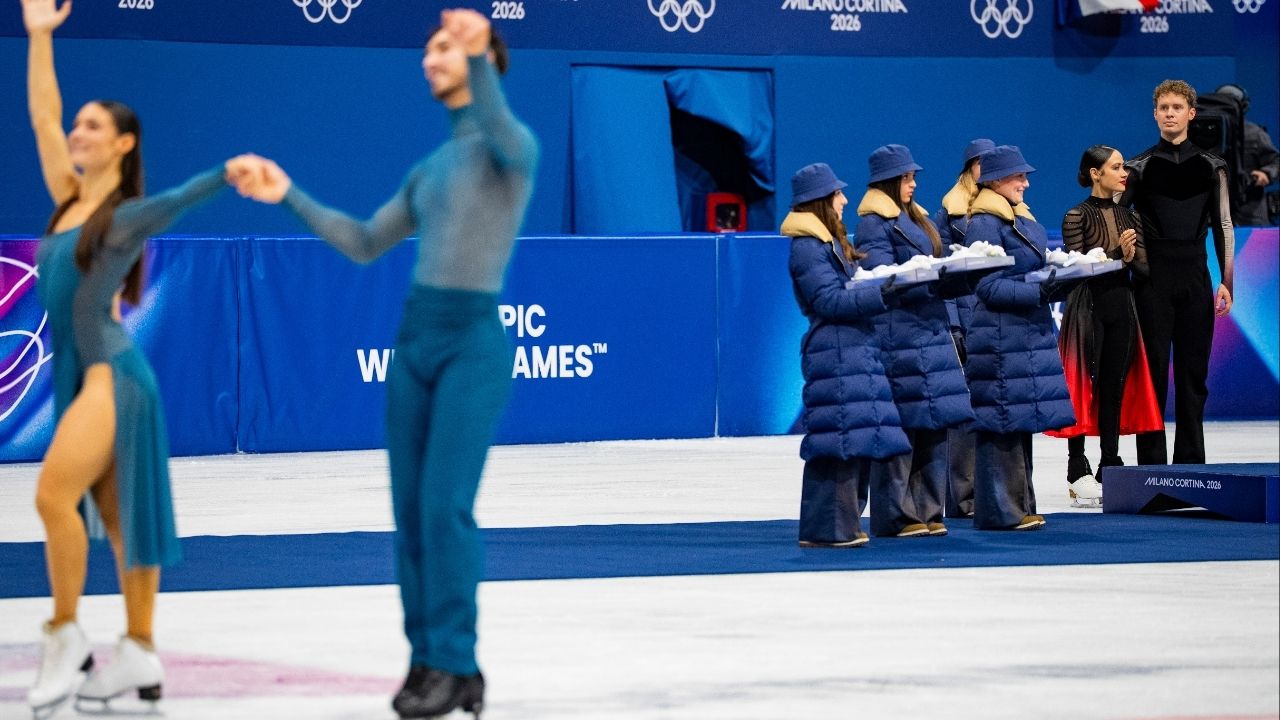
Evan Bates and Madison Chock, right, of the U.S., who won silver, look on as Laurence Fournier Beaudry and Guillaume Cizeron of France greet the crowd after winning gold in the final of the figure skating ice dance free dance during the 2026 Milan Cortina Winter Olympics at the MSK-Competition Rink in Milan, on Wednesday, Feb. 11, 2026. (Vincent Alban/The New York Times)

Share
|
Getting your Trinity Audio player ready...
|
MILAN — The Canadian ice dancing pair had the crowd going from the moment that the first bars of 1990s-themed pop music started blasting from the speakers. Getting spectators excited by the right song choice was a big part of their planning, said Zachary Lagha, who, with his partner, Marjorie Lajoie, enjoyed one of the biggest fan reactions of the night.
What most of those in attendance at the Milano Ice Skating Arena on Monday didn’t know was that the thumping beats they enjoyed were the result of a sudden change the duo had been forced to make to the routine that they had originally practiced for this month’s Winter Olympics in Italy.
Just weeks earlier, Lagha and Lajoie learned that they were at risk of breaching copyright law because of their use of a musical composition featuring hits by Australian rockers AC/DC that they had not been cleared to use. So they pivoted.
The intricacies of intellectual property law have been the talk of the figure skating competition in Milan unlike at any previous Games. Several athletes have found themselves caught up in copyright controversies before and during one of the biggest competitions of their careers, illustrating the complex and error-prone process skaters must navigate to gain permission to use others’ music in their routines.
Athletes, coaches and experts say that international broadcast rights, social media and new music tracking tools are placing more attention on skating performances at major competitions such as the Olympics, drawing the attention of copyright owners.
Just ask Amber Glenn, the American figure skater who unexpectedly found herself at the center of an online dispute over music licensing Sunday night, only hours after she had helped the United States win the team competition.
‘Without Permission’
A Canadian musician, Seb McKinnon, posted on social media that Glenn had used his song “The Return” in her routine “without permission.”
“Is that usual practice for the Olympics?” he wrote.
The controversy was soon over, with McKinnon and Glenn posting Tuesday that they had smoothed things out.
“The issue of music rights can be complex and confusing, seems like there was a hiccup in that whole process,” Glenn wrote in a statement, though she did not explain how they had resolved the dispute. “I’m glad we cleared things up with Seb and I look forward to collaborating with him.”
The day after winning the gold, Danny O’Shea, Glenn’s U.S. teammate, said that he and his pairs skating partner, Ellie Kam, had obtained licensing rights for their competition songs — “Everybody Wants to Rule the World” by Tears for Fears; “Sweet Dreams (Are Made of This)” by the Eurythmics; and “Eleanor Rigby” by the Beatles — well before the Games.
“Our choreographer told us unless you come with the licensing for it, you can’t use it. And we’ve got to do it ourselves,” O’Shea said.
They can be considered fortunate given what happened to Russian figure skater Petr Gumennik, whose music plans were upended just two days before competition for the same reason. Gumennik, performing as a neutral athlete in Milan because Russia remains banned from Olympic competition, found out he did not have permission to use music from the 2006 film “Perfume: The Story of a Murderer,” so he had to switch to a piece of classical music.
For years, only instrumental music was permitted in most Olympic figure skating competition, with the exception of ice dancing, which has long allowed music with lyrics. That rule was changed after the 2014 Winter Olympics, in part to allow more skaters to incorporate songs that could make the sport more appealing to audiences.
One early sign of trouble came after the 2022 Beijing Games, when a musical duo sued an American skating pair, Alexa Knierim and Brandon Frazier, along with NBCUniversal, which broadcast the competition in the United States, accusing the pair of having used their music without permission. The case was settled a few months later.
In the run-up to the Milan Cortina Games, the governing body for the sport, the International Skating Union, wrote to national skating federations and held meetings with coaches to emphasize the importance of having the correct paperwork. The national federations have sought to guide athletes, including by directing them to searchable databases for music licenses. But obtaining licenses is not always easy.
Chantal Epp, founder of ClicknClear, a British-based company that helps advise skaters and others on music licensing rights, said that some songs could require the permission of multiple people.
On Thursday, Epp’s company announced a deal with Universal Music Group that allows athletes to gain access to most of Universal’s giant catalog.
For athletes, the wait for permission to use music can be almost as anxiety-inducing as waiting for a judge’s scores.
Olivia Smart and her ice dancing partner, Tim Dieck, who compete for Spain, traveled to Italy unsure that the clearance for their song of choice — from the soundtrack to the recent “Dune” movie — would come in time, even though they had requested it months earlier.
“Tim was like, ‘Maybe I’ll message Hans Zimmer myself,’” Smart said, referring to the film’s composer of the soundtrack. The permission came through just before the competition.
Then there is the question of cost. Most figure skaters are amateurs and cannot afford royalties for the music of their choice. But some can, and that can create a competitive imbalance.
The International Olympic Committee, which generates billions of dollars from television rights for the Games, does not contribute to the cost of the music that skaters use in competition. “We understand the playing field is not totally level,”said Mark Adams, an IOC spokesperson.
Pascal Denis, a Canadian who coaches multiple skaters at the Games, said the costs associated with using a piece of music can range from a few dollars to as much as several thousand per year. That is simply too expensive for some competitors, he said, adding that some ice dancing pairs have “had to change their music already two or three times this season.”
A Spanish figure skater, Tomàs-Llorenç Guarino Sabaté, became a cause célèbre on the eve of the Games after using social media in an attempt to persuade the rights holders to let him use music from the “Minions” animated franchise at the Olympics.
Going to social media was a last-ditch effort, said Epp, who said she had been working with Sabaté for months to get the correct authorization. The clearance arrived days before his performance — “probably because it blew up in the media,” she said.
Sabaté’s coach, Edoardo De Bernardis, said that had the permission not come, he would have been without a routine.
“Imagine you have been working with that choreography and that routine for months, every day, and then when you finally can go to this competition, which is one of the biggest dream for the athletes, you cannot do that anymore,” he said. “We didn’t have any other music that was already bought, and we didn’t have a program so we didn’t know what to do.”
But the permission came with a stipulation, De Bernardis said: It can be used only during the Olympics. After that, Sabaté will likely need to find new music — and a new routine.
—
This article originally appeared in The New York Times.
By Tariq Panja/Vincent Alban
c. 2026 The New York Times Company