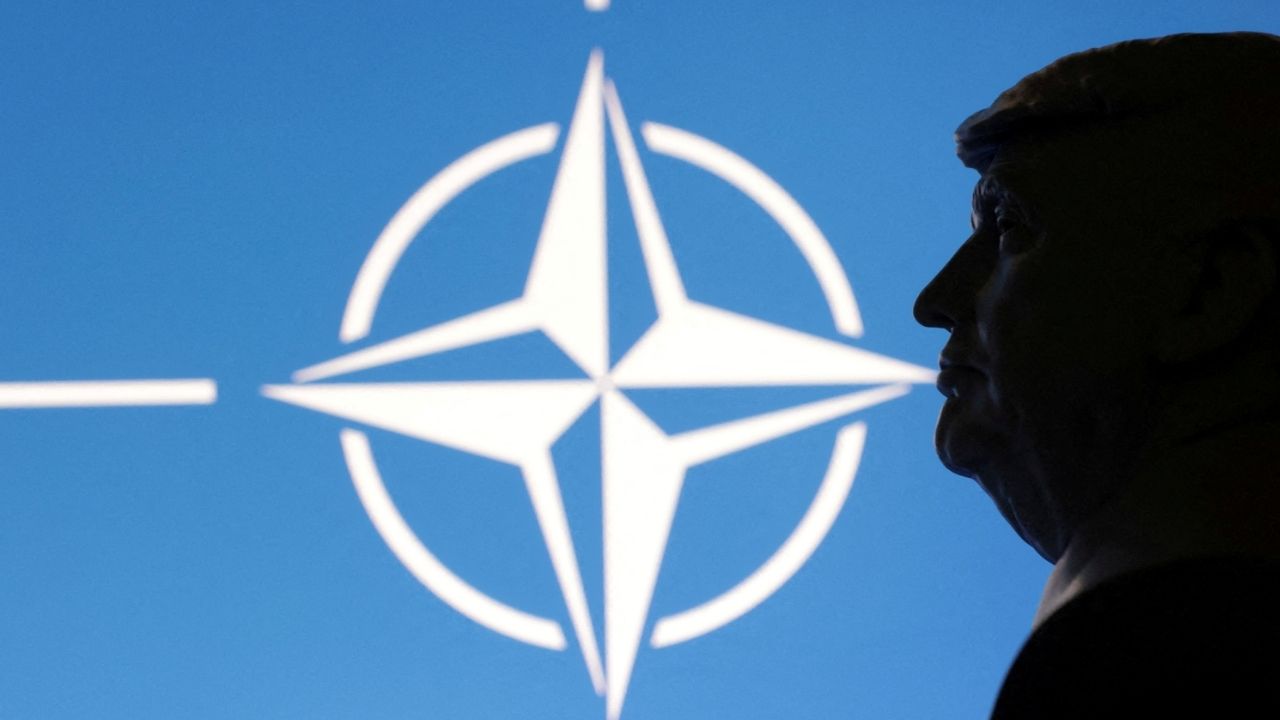
A 3D-printed miniature model of U.S. President Donald Trump with the NATO logo in the background is seen in this illustration taken April 23, 2025. (Reuters File)


- NATO has launched a new mission, Arctic Sentry, to bolster its military presence in the High North amid increased Russian activity and growing Chinese interest in the region.
- Officials say Russia’s expanding Arctic operations pose rising risks to Europe and North America.
- The initiative follows pressure from President Donald Trump to strengthen Arctic defenses, including renewed focus on Greenland’s strategic importance.
Share
|
Getting your Trinity Audio player ready...
|
Bombers, fighter jets, missiles and nuclear-capable submarines. Over the past year alone, analysts have documented dozens of times Russia has displayed these machines of military might in the Arctic.
Now, NATO forces are combining their own ongoing operations in the Arctic to more quickly track and, if necessary, stop what officials on Wednesday called an aggressive Russia and an increased Chinese presence.
“The Arctic and the High North are increasingly important for our collective security,” Mark Rutte, the NATO secretary-general, said Wednesday in Brussels. He added, “In the face of Russia’s increased military activity and China’s growing interest in the High North, it was crucial that we do more.”
The new mission, called Arctic Sentry, is similar to NATO deterrence operations in the Baltic Sea and Eastern Europe. It is not expected to be dramatically different from what Nordic allies have been doing for years to prepare themselves for Russian incursions in the region.
But as warming waters have opened up new shipping lanes and Moscow tests NATO’s patience, officials said the trans-Atlantic military alliance can no longer afford to overlook the Arctic.
A Push From Trump
Rutte called Arctic Sentry “a clear result” of talks to assure President Donald Trump that NATO is doing more to protect the Arctic.
Trump’s demands last month that the United States take control of Greenland, as an early line of missile defense, threatened to divide NATO. On Wednesday, Rutte said talks on that issue between the United States, Denmark and its semiautonomous territory of Greenland, were ongoing.
“The Arctic wasn’t really on NATO’s agenda for a long time, but that was because the Arctic allies wanted it so,” said Minna Alander, an Arctic and defense expert at the Stockholm Center for Eastern European Studies.
She said NATO had been increasing exercises in the European Arctic for a while but added, “I don’t think that there would have been any other particular reason right now to do the Arctic Sentry if it wasn’t for Trump’s push for Greenland.”
Threats From the Arctic
Since the start of January 2025, Russia has conducted at least 33 military maneuvers in the Arctic, about half of them training exercises, according to the Center for Strategic and International Studies, an analysis group in Washington.
Much of Russia’s military activity on the European part of the Arctic is based in the Kola Peninsula, where Moscow keeps submarines that can carry nuclear warheads. Russia protects the submarines with coastal, naval and air patrols. That includes those at the headquarters of Russia’s Northern Fleet in Murmansk, on the Barents Sea, where warmer currents from the Atlantic Ocean keep the waters from freezing over.
A main concern among NATO military officials is that Russia could sail a nuclear-capable submarine through the Norwegian Sea and then through waterways between Greenland, Iceland and the United Kingdom, called the GIUK Gap, to reach the broader Atlantic.
“Then it’s game over,” Alander said. “It’s really hard to find a submarine in the Atlantic Ocean.”
Russia also engages in what NATO officials have described as “cat-and-mouse games” to smuggle illicit oil and sabotage critical energy pipelines and communication cables on the seabed.
Then there is the matter of Greenland. The shortest path for Russia or China to launch missiles against the United States is over the North Pole, Alander said. Trump has said he wants to base missile interceptors in Greenland. But experts are divided over whether that would significantly add to the current U.S. missile defense plans.
China’s military generally does not sail near Greenland, although some of its commercial ships do.
NATO Gears Up
Most significantly, officials said Arctic Sentry will build up the number of troops in the so-called Cap of the North that includes parts of Norway, Sweden and Finland within the Arctic Circle. Those countries will most likely lead the new Arctic Sentry initiative, based on their vast experience in the region, Alander said.
On Wednesday, Britain’s defense secretary, John Healey, said the United Kingdom will double its troops deploying to Norway’s Arctic region to 2,000 over the next three years.
Sweden is leading a new land force, based in Finland, of at least 4,000 troops, that will be fully operational in coming months. Britain, Denmark, France, Norway, Iceland and Italy are also contributing to that effort.
NATO has already increased maritime patrols in the Norwegian Sea and into the GIUK Gap, where alliance military officers said Russian submarines and ships put Europe and North America at the most risk. That may also be a testing ground for NATO’s newly developed surveillance drones to see how well they can withstand harsh weather conditions.
And a Nordic air force — with pilots from Norway, Sweden, Finland and Denmark — works together on a weekly basis, Alander said.
NATO trains in the Arctic regularly, including exercises in mid-March that will deploy about 25,000 troops and personnel to Norway, Finland and the surrounding seas and airspace.
Training exercises accounted for about two-thirds of allies’ 33 Arctic operations last year, according to the Center for Strategic and International Studies.
—
This article originally appeared in The New York Times.
By Lara Jakes
c.2026 The New York Times Company
RELATED TOPICS:
Categories


Morgan Stanley CEO Ted Pick’s Pay Rises 32% to $45 Million