

|
Getting your Trinity Audio player ready...
|
As the Trump administration stymies hundreds of commercial solar and wind projects nationwide, legislators in 24 states want to literally put the power in the hands of the people by allowing modest solar energy systems on balconies, porches and backyards.
A Grassroots Solar Movement
Last year, in an unanimous vote, Utah became the first state in the nation to pass a law allowing residents to plug small solar systems straight into a wall socket. These systems, which retail for around $2,000, produce enough electricity to power a laptop or small refrigerator.
In just a matter of months, legislators in 23 other states have announced similar bills, including California and New York. If passed, the legislation would eliminate one of the technology’s biggest barriers in the United States: homeowners or renters could install plug-in panel systems, in most cases up to 1200 watts, without approval from their local utility.

Proponents also hope the bills speed the development of a set of safety standards that could open the floodgates to wider adoption.
For politicians, the bills offer a rare legislative opportunity: the cost to the government is zero while the appeal of lowering electricity costs at a time of rising utility bills is great. The plug-in panels don’t require complicated installation or the services of an electrician and are far cheaper than traditional rooftop systems, which cost an average of $20,000.
“It’s certainly one of, if not the fastest-growing legislative initiatives that I have worked on nationally,” said Justin Flagg, director of communications and environmental policy for New York state Sen. Liz Kreuger, a Democrat.
Utah state Rep. Raymond Ward, a Republican, was inspired to propose his state’s bill by the growing popularity of balcony solar units in Germany. There, balkonkraftwerke, or “balcony power plants,” have been registered by more than a million homes and apartments. Costs have fallen as the technology has gained popularity, and some models now start at a few hundred euros and can be purchased online through Ikea.
Inspired by Europe’s ‘Balcony Power Plants’
“The momentum is coming from the fact this is so easy to understand,” Ward said. “People are like, oh, I can just buy that and plug it in? Oh yes, I want one of those. And then they’re turning to their representatives to say, why can’t I have it here? What needs to change?”
Iowa state Rep. Sean Bagniewski, a Democrat, who sponsored plug-in solar legislation in Des Moines, said the concept
In New York, Krueger had been interested in plug-in solar for over a year when she learned about Utah’s legislation. Her office got in touch with Bright Saver, a nonprofit group that promotes plug-in solar, as well as the renewable energy advocacy group Permit Power, and Craftstrom, which sells plug-in solar panels. Krueger introduced legislation in September.
“It’s kind of a great legislative combination of something that’s super popular, in the public mind right now, and doesn’t have a lot of natural opposition,” Flagg said.
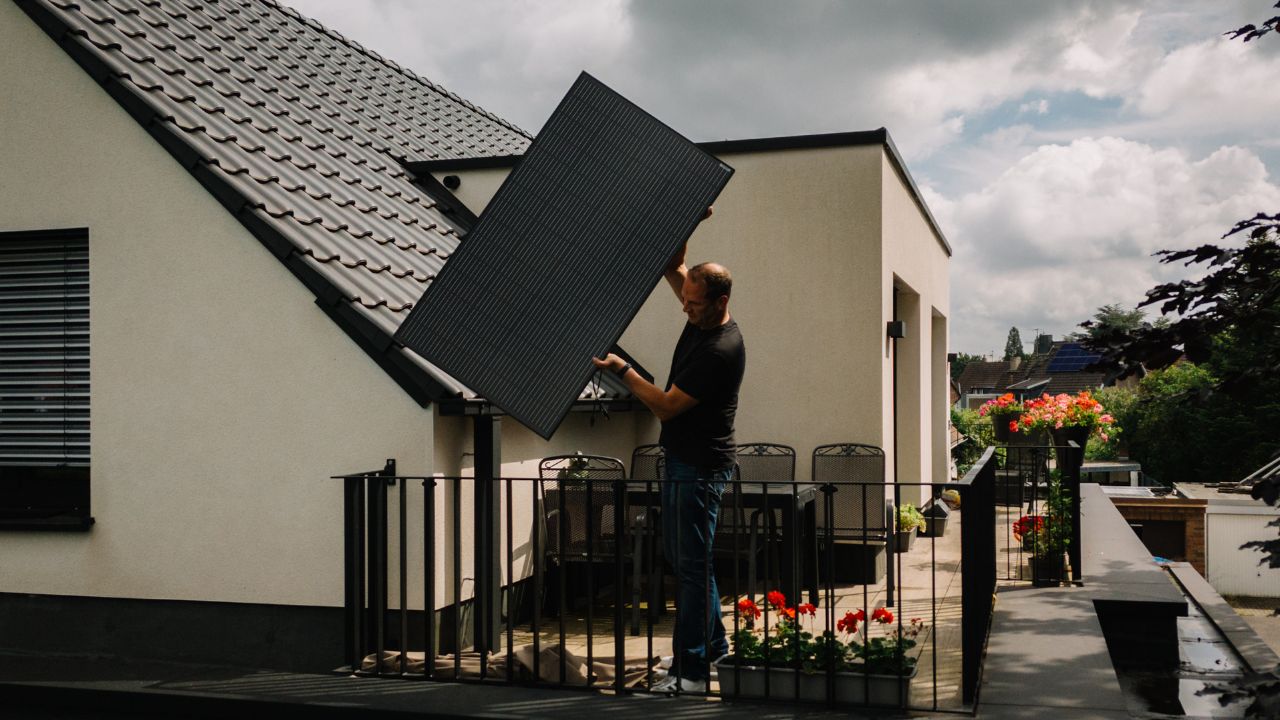
The solar panels, which typically measure 3 to 5 feet on each side, capture sunlight that is converted by an inverter into AC power and is fed through a plug into a standard wall outlet, reducing the amount of electricity that a household draws from the utility.
So far, there has been little significant opposition to the flurry of bills.
Safety Standards and Industry Pushback
In Washington state, a labor union representing electrical workers and the Association of Washington Business, a regional business group, testified against the state’s plug-in solar bill. Neither responded to questions about their position.
Spokeswomen for Puget Sound Energy and Avista Corp., two Washington state utilities that testified against the bill, said their companies had safety concerns about plug-in solar technology and were waiting to see how the issues are addressed.
New York’s Con Edison did not respond to request for comment.
It’s unlikely that the legislation introduced in all 24 states will become law. But for plug-in proponents, momentum is important. They’re hoping the excitement speeds the rollout of a safety certification that plug-in solar products must obtain before entering the market in most states.
The state plug-in solar bills typically include a requirement that systems be certified by Underwriters Laboratories (UL), a private company that develops product safety standards, or an equivalent nationally recognized testing laboratory.
Until recently, UL had not weighed in on plug-in solar systems. But in December, a for-profit affiliate, UL Solutions, released a set of preliminary certification criteria. A group of independent experts will eventually settle on the final safety standards.
Some of UL Solutions’ certification criteria could slow growth of the nascent industry if they are echoed in the final standards. For example, the company would like to see an electrician do some additional work to protect buildings’ wiring systems from potential fires or shock, said Ken Boyce, vice president at UL Solutions.
“We want to keep people safe,” Boyce said. “That’s first and foremost in our minds at all times.”
Not everyone is happy with UL’s proposals. “As a preliminary standard, it’s almost a list of their grievances against the product,” Ward said.
“There’s a lot of thinking out there that this can be made safe without electrician installations and without inspections and costly compliance, and we agree that it can be done,” said Jeremy Friedman, campaign strategist at Third Act, a nonprofit group of Americans over 60 that has been organizing in support of plug-in solar legislation.
For now, companies can apply for product certification under UL Solutions’ criteria. UL Solutions is “actively evaluating” plug-in solar products, said spokesperson Steven Brewster.
—
This article originally appeared in The New York Times.
By Claire Brown/ Patrick Junker
c.2026 The New York Times Company