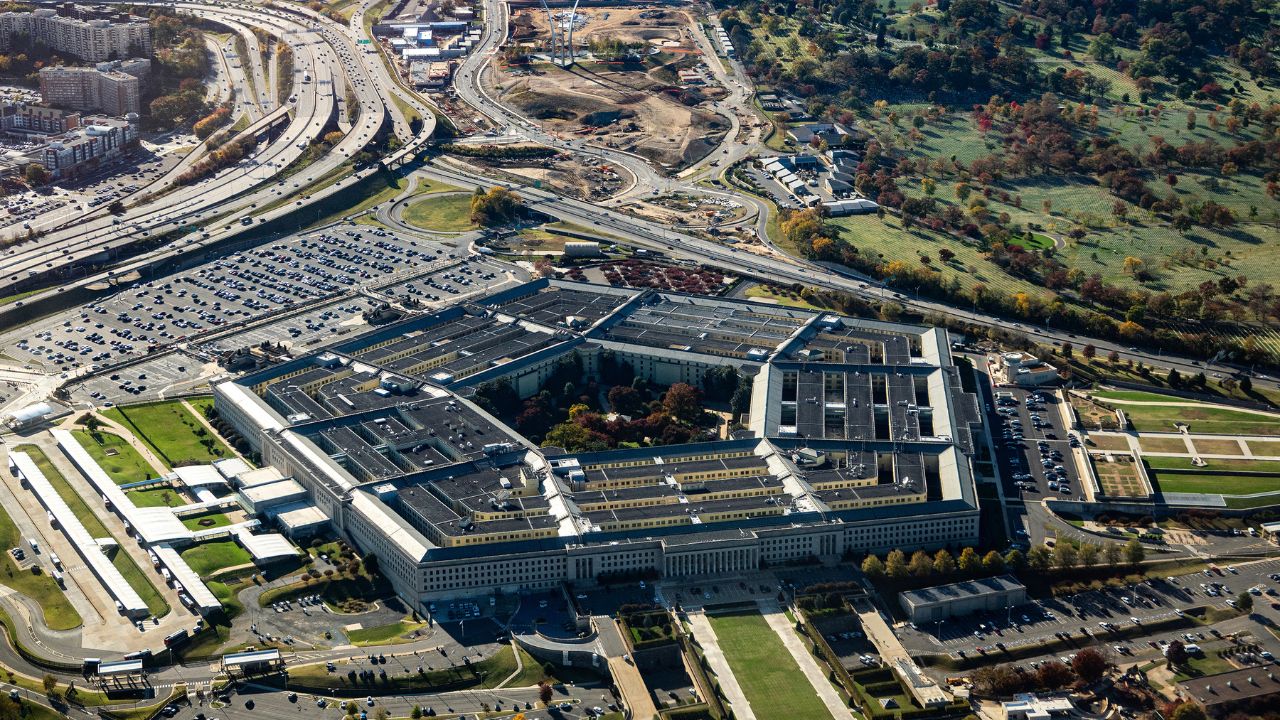
An arial view of the Pentagon in Arlington, Va., Oct. 31,2025. The Pentagon is sending about 200 troops to Nigeria in the coming weeks to help train its military to fight Islamist militants, weeks after President Donald Trump criticized the country for failing to shield Christians from terrorist attacks, a U.S official said on Tuesday, Feb. 10, 2026. (Kenny Holston/The New York Times)


- The Pentagon will deploy about 200 additional U.S. troops to Nigeria to train local forces fighting Islamic militants, U.S. officials said.
- The move follows President Donald Trump’s sharp criticism of Nigeria over attacks on Christians and a U.S. missile strike last December.
- The expanded U.S. role reflects a rapid shift in policy driven by security concerns, religious activism and closer military coordination with Nigeria.
Share
|
Getting your Trinity Audio player ready...
|
The Pentagon is sending about 200 troops to Nigeria in the coming weeks to help train its military to fight Islamic militants, weeks after President Donald Trump criticized the country for failing to shield Christians from terrorist attacks, a U.S. official said Tuesday.
U.S. Expands Military Role in Nigeria
The troops will augment a small team of U.S. forces who have been in the West African nation for weeks assisting local soldiers with identifying potential terrorist targets for strikes using U.S. and Nigerian intelligence, said the official, who spoke on the condition of anonymity to discuss operational matters.
The new troops, whose impending deployment was reported earlier by The Wall Street Journal, will be assigned to locations across the country to provide troop training and technical expertise, the official said. The U.S. troops will not be involved in combat operations, the official added.
From Rhetoric to Missile Strikes
Relations between Nigeria and the United States took a startling turn after Trump late last year threatened to enter Nigeria “guns-a-blazing” to avenge what he has called a “Christian genocide.” Weeks later, on Christmas Day, Navy warships aided by Nigerian intelligence launched 16 Tomahawk missiles at what Trump said was the “terrorist scum” responsible for killing Nigerian Christians.
The strike was the explosive outcome of an intense, yearslong push led by Christian activists, Republican lawmakers and American celebrities seeking U.S. intervention in a long-simmering security crisis in Nigeria.
Activists and a Policy Shift
Thousands of Muslims and Christians alike have been killed as part of a campaign of violence and land disputes. The violence involves battles over land, kidnappings for ransom, sectarian tensions and terrorism, but the activists wanted Trump to see the conflict through a single lens: the persecution of Christians.
The activists have seized on his support to orchestrate a rapid shift in U.S. foreign policy toward Nigeria, with major consequences for the country, including the threat of more bombings.
U.S. military leaders who for years have complained about prickly relations with the Nigerian military say the shift has opened the door to increased intelligence sharing and military planning, and now additional training. U.S. surveillance planes from Ghana regularly fly over contested Nigerian territory and relay data to teams of U.S. and Nigerian military analysts drawing up potential terrorist targets for strikes.
Gen. Dagvin R.M. Anderson, the head of the military’s Africa Command, met with senior Nigerian officials this month. His deputy, Lt. Gen. John Brennan, was in Nigeria’s capital last month to announce a closer military partnership between the two nations.
Just how effective the increased U.S. involvement in Nigeria has been or will be is an open question.
Effectiveness and Risks Remain Unclear
The Tomahawk missiles fired Dec. 25, valued at about $32 million, hit northwest Nigeria, an overwhelmingly Muslim area. U.S. military officials are still assessing the damage, but they said more than three dozen Islamic State-affiliated terrorists were flushed out and later arrested by Nigerian authorities.
Residents have said the missiles hit empty fields and vacant militant hideouts.
Africa Command said it was helping Nigeria in its campaign against several extremist groups, including Boko Haram and another known as Islamic State’s West Africa Province.
“Africa Command is working with our Nigerian and regional partners to increase counterterrorism cooperation efforts related to ongoing violence and threats against innocent lives,” Anderson said in a statement after the December strikes. “Our goal is to protect Americans and disrupt violent extremist organizations wherever they are.”
—
This article originally appeared in The New York Times.
By Eric Schmitt/ Kenny Holston
c.2026 The New York Times Company
RELATED TOPICS:

Pentagon to Send 200 Troops to Nigeria