


|
Getting your Trinity Audio player ready...
|
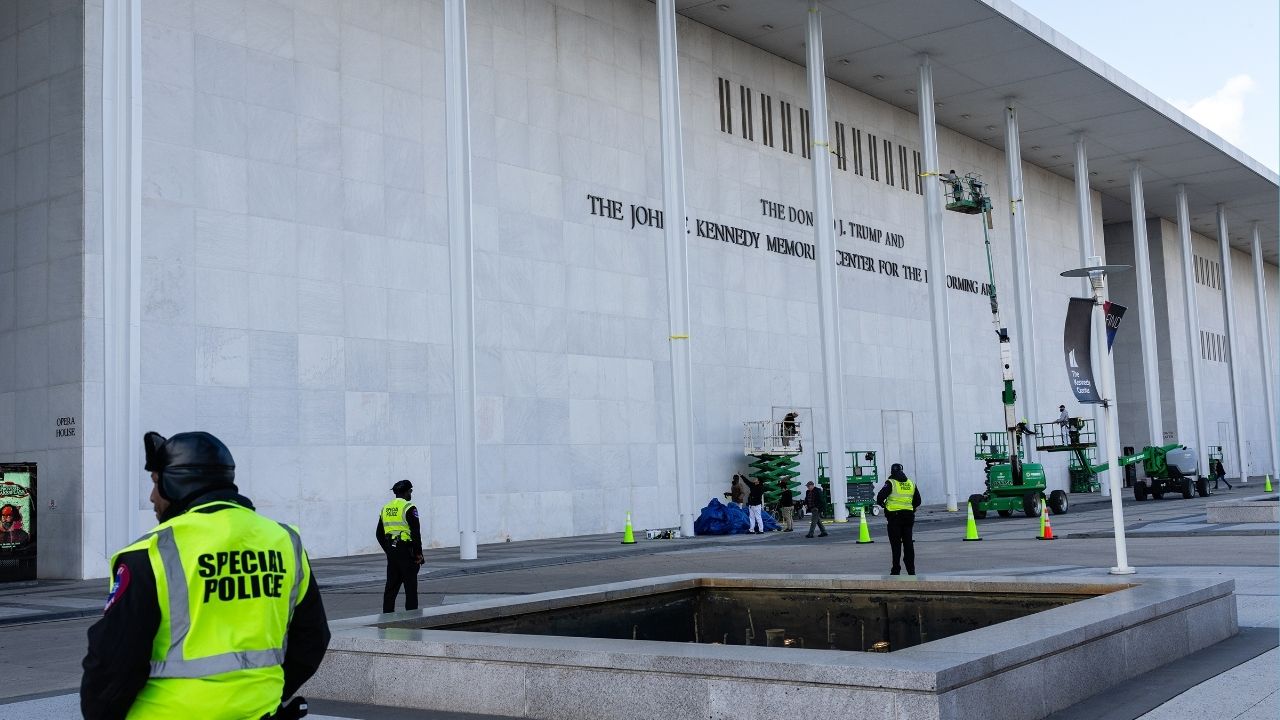
The John F. Kennedy Center for the Performing Arts is set to close this summer for an extensive two-year renovation, the latest step in President Donald Trump’s campaign to remake one of America’s top cultural institutions in his image.
For more than half a century, the Kennedy Center has been Washington’s premier venue for music, dance, theater and opera. It has hosted performances by singer Aretha Franklin, conductor Leonard Bernstein and many other celebrated artists.
But Trump has said that he believes the center’s programming is too “woke” and anti-American, and that its physical infrastructure lies in a state of disrepair he considers unacceptable.

In his second term, Trump has purged the center’s board and made himself its chair. On Sunday, he announced a plan to close the building on July 4 to build a “new and spectacular” entertainment complex over the next two years.
Here’s what to know about the Kennedy Center and Trump’s plans to remake it:
Construction of the Center Was Delayed for Years
The center was imagined as a grand performing arts hub in the capital, and Congress designated it as the National Cultural Center in 1958. But construction was delayed for years, partly because some lawmakers in Washington were reluctant to fund it.
In 1962, President John F. Kennedy and the first lady, Jacqueline, led a fundraising drive for the center. The next year, he signed legislation extending the fundraising deadline.
Kennedy was assassinated in November 1963. Within months, Congress voted to turn the center into a living memorial for the slain president. In December 1964, work finally began on the complex, renamed the John F. Kennedy Center for the Performing Arts.
The center opened in 1971 with a performance of Bernstein’s “Mass,” a piece commissioned by Kennedy’s widow for the occasion. A New York Times article from the opening night called the center “the first proper opera house ever built in the capital of the richest nation on earth.”
The Center Received Millions of Visitors a Year
The Kennedy Center, designed by architect Edward Durell Stone and perched on the bank of the Potomac, was one of Washington’s busiest landmarks.
Until last year, it received around 2 million annual visitors. It has featured performances by the Washington National Opera and the National Symphony Orchestra, and its current exhibits include one on Kennedy’s legacy and another on the history of hip hop.
It also hosts the annual Kennedy Center Honors, which are awarded for outstanding cultural contributions. Past honorees have included actors Fred Astaire and Cary Grant; musicians Ray Charles and Dave Brubeck; and the members of the rock band Led Zeppelin.
Trump Has Thrown the Center Into Turmoil
Within weeks of returning to the Oval Office, Trump made it clear that he intended to dramatically reshape the Kennedy Center. He dismissed the board and installed himself as its chair, naming a loyalist, Richard Grenell, as the interim president.
Trump also said that the center was in a state of disrepair and criticized what he described as ideologically driven programming. Grenell also said that the center’s finances were in disarray, though prior leaders have disputed claims of financial mismanagement.
After those moves, ticket sales fell, and there were boycotts by performers and contributors.
The backlash intensified in December after the board voted to change the center’s name to the Trump-Kennedy Center. Democrats challenged the change and said it disrespects Kennedy’s legacy. Some have argued that only Congress has the authority to change the center’s name.
More organizations and artists, including acclaimed composer Philip Glass, canceled events at the center. And the Washington National Opera decided last month to find another home, abandoning the hall where it had played since 1971.
Announcing the closure Sunday, Trump did not offer any details about the kind of reconstruction he had in mind, other than to say it would involve “Construction, Revitalization, and Complete Rebuilding.”
—
This article originally appeared in The New York Times.
By Qasim Nauman/Eric Lee
c. 2026 The New York Times Company