

|
Getting your Trinity Audio player ready...
|
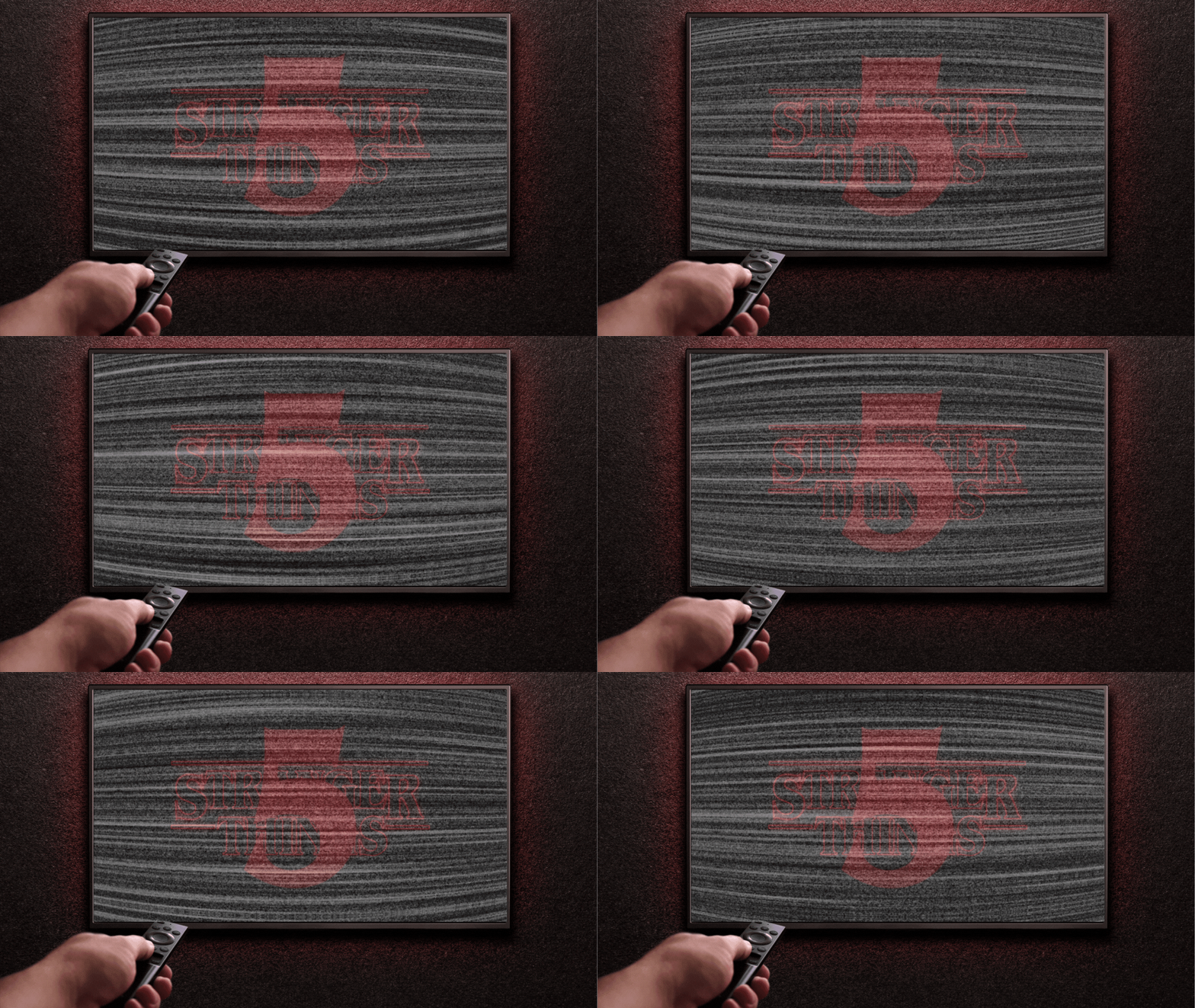
Now don’t get me wrong. I am so glad Steve Harrington (Joe Keery) didn’t die. I would have flipped a table, turned off Netflix, and pretended this show ended in Season 4 if they took him out for shock value alone. That said, I am also not entirely sure we don’t owe Game of Thrones a very quiet apology.

Anthony W. Haddad
The Millennial View
No, the Game of Thrones ending was still worse. That’s not up for debate. But there was a moment during the Stranger Things finale, actually several moments, where I had to shut off the TV because every character suddenly seemed to act just to move the plot along, like ‘let’s go do this’ was their only motivation. Logic, fear, and real emotion all took a backseat to the story’s need to keep moving.

The Rollout
And that’s when I realized the biggest problem wasn’t just the ending. It was how we got there.
Netflix split the final season into chunks: the first four episodes on November 26, the next three on Christmas, and the finale on New Year’s Eve. At first, I was mad because I wanted to binge it all at once. Now I’m mad because I didn’t. The space between episodes gave us time to sit with everything, and sitting with it exposed the cracks.
There were more exciting fan theories popping out on Reddit than the show’s actual writing. This is where the show hurt itself.

Instead of being swept along emotionally, we had time to ask questions, to rewatch scenes, and to notice when something didn’t land. Nowhere was that more obvious than the moment that should have been one of the most powerful in the entire series: Will Byers (Noah Schnapp) finally finding his truth.
On paper, that moment is huge. In the 1980s, being openly gay was dangerous, isolating, and often devastating. Framed correctly, it could have been heartbreaking. But it came while Holly was literally fighting for her life, and somehow everyone dropped everything to emotionally circle Will. The issue wasn’t the moment, it was the framing. In today’s world, where representation has evolved even if imperfectly, the emotional impact wasn’t what the show thought it was. We’ve moved from “this is a reveal” to yelling at the TV, “Girl, we know.”
The Finale
There was an overdependence on action, so much action that it started to feel like noise. In the supposed brain-melting showdown, Vecna is getting absolutely worked. And I kept waiting for anything. No demogorgons. No swarm. No last-ditch unleash-everything moment. If I had that many powers and my body was getting wrecked, I would be emptying the arsenal. Instead, Vecna just took it. In that moment, he stopped being terrifying and became disappointing.
This brings me to the biggest letdown of all: a wasted villain with a wasted plan.
Vecna, or Henry Creel (Jamie Campbell Bower), had potential. There was even a whole prequel play explaining his backstory, Stranger Things: The First Shadow. But most people didn’t see it. If your main villain’s emotional weight depends on supplemental material, that’s not world-building, that’s homework.
We did get some answers. We learned the truth about the Upside Down, though it felt less like a revelation and more like a way to quietly tape over plot holes. There were moments that genuinely worked. Delightful Derek (Jake Connelly) was the reason I kept watching at points. The scene where Vecna invades Jim Hopper’s (David Harbour) mind, making him believe he killed Eleven (Millie Bobby Brown)? That was good. That was scary. That was earned. This was the type of shock and awe I believe us fans wanted the whole entire season.
But so much of the rest felt thrown in.
The performances didn’t help. This hurts to say, because we’ve seen what this cast can do. Seasons 1 through 4 gave us raw, emotional, sometimes devastating performances. Here, it felt like the actors themselves were tired. The emotions were predictable. The beats felt rehearsed instead of lived-in. It was as if everyone knew this was the end, and not in a good, intentional way.
Then There’s Eleven
I’m not saying killing a character automatically makes a finale great. It doesn’t. But when Mike Wheeler (Finn Wolfhard) talks about Eleven, maybe alive, maybe watching over the “three waterfalls,” and we get glimpses of what the other characters’ futures could be, that was some of the best dialogue in the entire finale. It was quiet, vulnerable, and it trusted the audience in a way the rest of the finale didn’t. For a moment, I thought, finally, they’re letting the story breathe with only a few minutes remaining.
On the-other-hand, what a cop-out. The entire weight of Eleven’s “death” is now suspended in limbo. She’s out of the characters’ lives, for now potentially, giving them time to grieve, sure. But it feels less like storytelling and more like the cast lobbying to keep their characters alive. “What if we throw in some even more powerful magic we’ve never hinted at before, and she doesn’t actually have to die?” Problem solved.
This also sets the stage for countless spin-offs to pop up on Netflix, cashing in on the Stranger Things brand. But unless they actually find a new magical threat that makes sense as the big bad, I’m not interested. I don’t need a show about Steve coaching a bunch of kids or Nancy Wheeler (Natalia Dyer) chasing stories for the local paper. That’s not drama. That’s just life, and that’s not why we tuned in for five seasons of monsters, psychic powers, and the Upside Down. If the next chapter can’t give us stakes, mystery, or danger that actually matters, I’ll pass.
It’s infuriating because the show spent years throwing us, the fans, around emotionally. We’ve been gaslit by cliffhangers, fake-outs like when they teased Steve’s death, and horror for the sake of tension. And now, at the very end, the writers do the same thing to the characters themselves. We’re meant to feel closure and grief, but the rug is pulled out again. It’s like being shaken around for emotional effect, only to realize we were never supposed to land anywhere meaningful.
Eleven surviving in this magical, convenient way undercuts the stakes. It’s not clever. It’s not brave. It’s just another twist designed to keep the audience dangling while the show pats itself on the back for making us care.
The Real Tragedy
The bigger the budget got (rumored to near half a billion dollars), the worse the storytelling became with Season 5 being the lowest rated season. The show didn’t fail because it lacked spectacle. It failed because it stopped believing that emotion, restraint, and character were enough. Stranger Things didn’t need to be louder. It needed to be braver.
I don’t hate the ending. I’m just disappointed by it. And maybe that’s worse.
This was a show that taught us how powerful friendship, fear, and love could be in a small town with big monsters. In the end, it chose scale over soul. For a series that once thrived on quiet bike rides and whispered secrets, that feels like the strangest upside down of all.
—
Connect with Anthony W. Haddad on social media. Got a tip? Send an email.