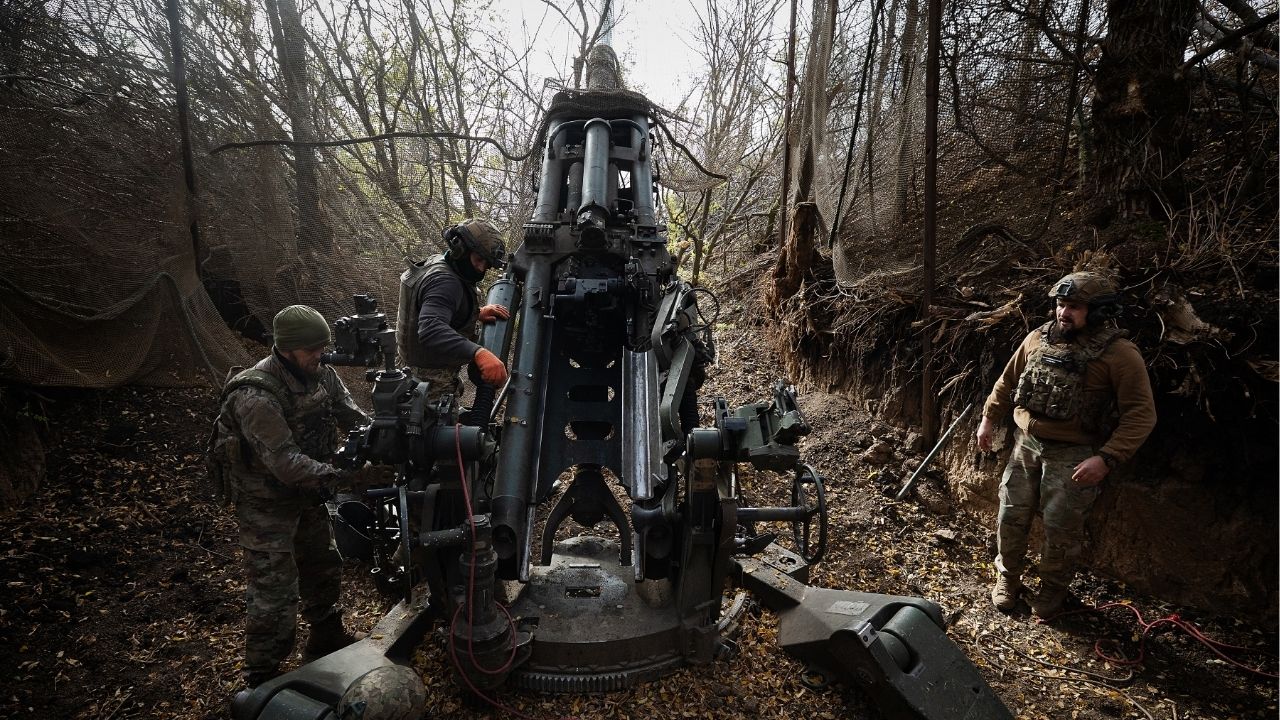
The 148th Artillery Brigade fires at Russian targets in the Zaporizhzhia region of eastern Ukraine, Oct. 14, 2025. The Zaporizhzhia plant, occupied by Russia, would be crucial to powering Ukraine’s postwar recovery. (Tyler Hicks/The New York Times)

Share
|
Getting your Trinity Audio player ready...
|
KYIV, Ukraine — President Volodymyr Zelenskyy has said that Ukraine and the United States are 90% of the way toward an agreement to end the war with Russia. Within the 10% still in dispute is who will control Europe’s largest nuclear power plant.
The plant, in the Zaporizhzhia region of southern Ukraine, has been under Russian military occupation since the early days of the war. All six of its reactors are shut down, and nuclear experts say that restarting its electricity-generating operations while the fighting continues is too dangerous.
Both Russia and Ukraine want to restart the plant after the war, and both want control of its operations. They view it as a vital energy asset because of its enormous generation capacity — 6 gigawatts, enough to power a medium-sized country like Portugal.
The United States has also shown interest, seeing the facility as an opportunity to advance American economic interests in a peace deal. U.S. negotiators, Zelenskyy said, have proposed that the United States, Russia and Ukraine jointly operate the plant, an idea that Kyiv opposes.
Here’s what you should know about the plant and the negotiations surrounding it.
What Is the Status of the Plant Today?
Russia’s seizure of the plant early in the war was widely condemned by the international community. It sits on the front line in Zaporizhzhia, a precarious situation that has raised fears of a nuclear disaster.
Nearby fighting has repeatedly knocked the idled plant off the high-voltage electricity lines needed to power cooling systems that keep nuclear fuel from melting down. During those times, the site has had to rely on backup diesel generators to cool the reactors. Limited localized ceasefires, including one this week, have been arranged to let crews repair the power lines and reconnect the plant.
In 2023, an explosion at a dam drained the plant’s primary source of cooling water, forcing it to rely on a smaller cooling pond and wells, and elevating worries about the risk of a meltdown.
Why Is the Plant so Important for Russia, Ukraine and the US?
Russia has made clear it will not relinquish control of the plant. The facility sits in a region, Zaporizhzhia, that Russia has formally annexed despite not controlling it entirely.
Moscow has outlined plans to restart the reactors and feed electricity into its own power grid. Energy experts say the plant might be used to supply energy to parts of southern and eastern Ukraine under Russian occupation. Last year, a Greenpeace report showed that Russia was building power lines in occupied southern Ukraine to link the plant to its own grid.
“They occupied it, and they believe that we cannot do much to prevent them from resuming its operation,” Zelenskyy told reporters last week. “They will link the operation of this plant to humanitarian considerations — to the fact that there are people in the temporarily occupied territories who have no water and no electricity.”
For Ukraine, regaining control of the plant is not just about undoing an illegal seizure. It is central to the country’s postwar energy independence. Before the war, the plant supplied roughly a quarter of the country’s electricity needs. Its generation capacity would be vital for powering reconstruction efforts, energy experts say.
Talks about U.S. involvement in the plant emerged early last year, as Kyiv and Washington negotiated a deal giving the United States preferential access to mineral extraction in Ukraine. Ukrainian officials told their U.S. counterparts that processing the minerals would require enormous power and would be viable only if the Zaporizhzhia plant returned to Ukrainian control.
The plant could also supply power to energy-intensive facilities such as data centers. The recent peace plan drafted by Ukraine and the U.S. mentions the development of such centers as part of Ukraine’s postwar recovery.
Who Would Control the Plant Under the Current Peace Proposals?
A plan drafted in November by Russia and the United States initially suggested restarting the plant under the supervision of the International Atomic Energy Agency, the United Nations’ nuclear watchdog, with electricity production shared between Russia and Ukraine.
The most recent U.S. proposal calls for the plant to be jointly operated by the United States, Russia and Ukraine, “with the Americans acting as the chief manager,” Zelenskyy told reporters last week.
He rejected that idea. “How can there be joint commercial activity with the Russians after everything that has happened?” Zelenskyy said.
Instead, Ukraine has proposed operating the plant as a joint venture with the United States. “Fifty percent of the electricity produced would go to Ukraine, and as for the remaining 50%, the United States would independently determine its allocation,” Zelenskyy said.
With that statement, Zelenskyy hinted that the U.S. share could be entirely or partly redirected to Russia. Moscow, however, is unlikely to completely relinquish control of the facility.
Zelenskyy said he and his team had discussed the plant’s fate for roughly 15 hours in recent days. “These are all very complex matters,” he said.
—
This article originally appeared in The New York Times.
By Constant Méheut/Tyler Hicks
c. 2025 The New York Times Company
RELATED TOPICS:
Categories



US Supreme Court Declines to Hear Friant Water Rights Case