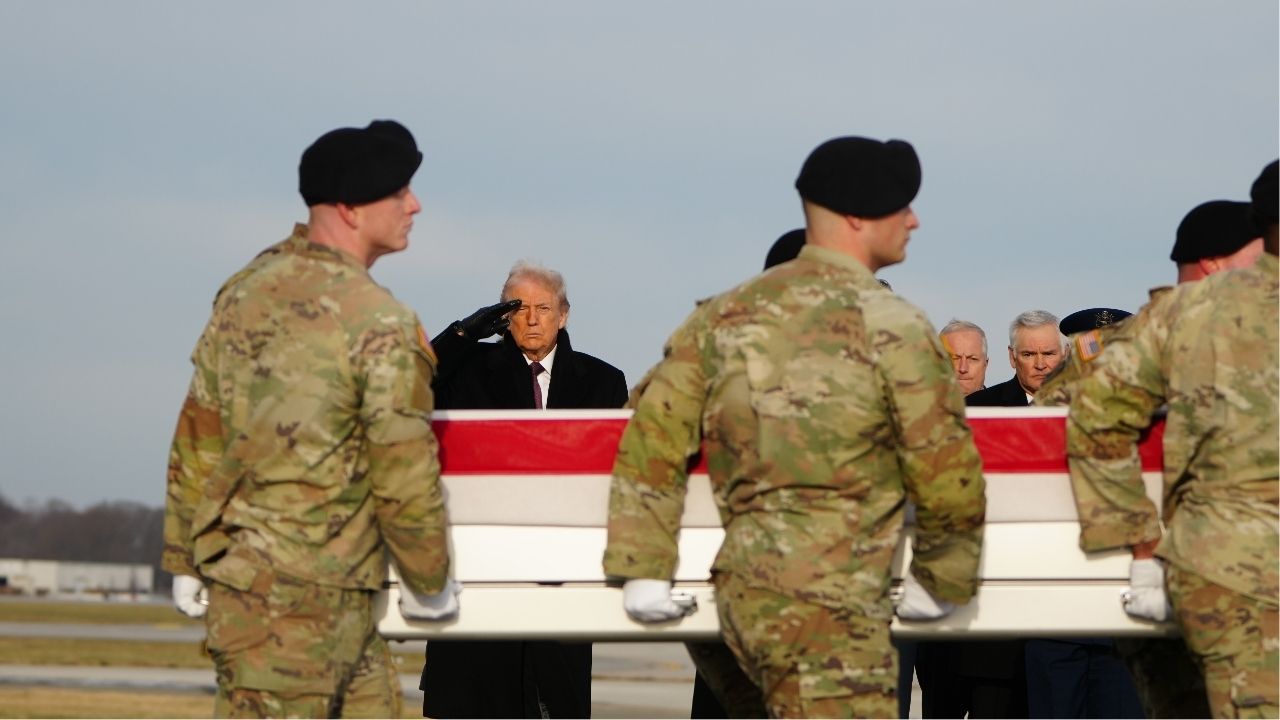
President Donald Trump salutes during a dignified transfer of remains service for two Iowa National Guard members who were killed in Syria, at Dover Air Force Base in Delaware, on Wednesday, Dec. 17, 2025. American fighter jets, attack helicopters and artillery salvos struck dozens of suspected Islamic State sites in a “massive attack” across central Syria on Friday night, according to a U.S. official speaking on condition of anonymity. (Tierney L. Cross/The New York Times)

Share
|
Getting your Trinity Audio player ready...
|
WASHINGTON — The United States began major airstrikes against the Islamic State group in Syria on Friday, fulfilling President Donald Trump’s vow to avenge the deaths of two U.S. Army soldiers and a civilian U.S. interpreter killed in a terrorist attack in the central part of the country last Saturday.
U.S. fighter jets, attack helicopters and artillery salvos struck dozens of suspected Islamic State sites at several locations across central Syria, including weapons storage areas and other buildings to support operations, according to a U.S. official, who spoke on the condition of anonymity to discuss operational matters.
The U.S. air and artillery attacks were expected to last several hours, deep into early Saturday morning in Syria, in what the U.S. official said would be “a massive attack.”
Social media accounts in Syria reported explosions across wide swaths of the country.
The soldiers slain last Saturday were the first American casualties in the country since the fall of dictator Bashar Assad last year. They were supporting counterterrorism operations against the Islamic State group in Palmyra, a city in central Syria, when they came under fire from a lone gunman, U.S. and Syrian officials said.
The U.S. strikes Friday, and the likelihood of more counterterrorism operations in the coming days, signal a sharp military escalation in Syria at a time when the United States has reduced its presence there to about 1,000 troops, half of what it started with at the beginning of the year. The decision to draw down forces had reflected the shifting security environment in Syria after Assad’s government collapsed.
But the assault last weekend was a stark reminder of the danger in the region and the quandary of whether to keep U.S. forces there at all.
No group has claimed responsibility for the attack, though initial assessments suggest that it was most likely carried out by the Islamic State group, according to the Pentagon and U.S. intelligence officials.
Top U.S. intelligence officials told Congress this year that the Islamic State group would try to exploit the end of the Assad government to free 9,000 to 10,000 of the militant group’s fighters and about 26,000 of their family members now detained in northeastern Syria, and revive its ability to plot and carry out attacks.
Although it no longer holds much territory, the Islamic State group is still spreading its radical ideology through clandestine cells and regional affiliates outside Syria and online. Last year, the group was behind major attacks in Iran, Russia and Pakistan.
The deadly attacks against the U.S. soldiers also highlighted the challenges for the nascent Syrian government, led by President Ahmad al-Sharaa, as it steers a deeply fractured country emerging from nearly 14 years of civil war.
Since his rebel coalition toppled the Assad government, al-Sharaa has had to contend with threats from the Islamic State group and various other armed groups, while simultaneously building a new national military.
In the months immediately after al-Sharaa took power, the United States conducted scores of airstrikes on Islamic State redoubts in the Syrian desert, which appeared to tamp down the immediate threat. But in the past month, particularly after al-Sharaa publicly embraced an international campaign to combat the group, attacks have increased, analysts said.
The attack in Palmyra marked the first U.S. casualties in Syria since Assad was ousted from power a year ago, and underscored how the Islamic State group has exploited security gaps to target civilians and al-Sharaa’s forces.
—
This article originally appeared in The New York Times.
By Eric Schmitt/Tierney L. Cross
c. 2025 The New York Times Company
RELATED TOPICS:
Categories