

|
Getting your Trinity Audio player ready...
|
In recent weeks, the North Dakota Supreme Court reinstated a near-total ban on abortions. Texas enacted a law that lets private citizens sue out-of-state doctors who mail abortion medications into the state.
And California approved legislation to protect those very same doctors, allowing abortion pills to be sent into Texas and other states without the name of the patient or prescriber on the prescription label.
The U.S. Supreme Court in 2022 overturned the landmark abortion decision Roe v. Wade, granting state governments far more control over regulating abortions than they had had for nearly 50 years.
Women Continue to Get Abortion Care
In the three years since, the divide between states that allow abortions and those that severely limit or ban them has only continued to deepen. In some cases, states are battling each other as they try to enforce their restrictions or protect access across state lines.
“The U.S. is becoming a tale of two countries in terms of abortion access and abortion policy,” said Ushma Upadhyay, a professor and a public health scientist at the University of California, San Francisco. But, she added, “All of this legislation will never take away from the fact that women will continue to need abortion care and continue to get abortion care.”
Despite red states passing a spate of laws restricting abortion access in recent years, research shows that the number of abortions nationwide has climbed every year since 2022, when the Supreme Court’s decision in Dobbs v. Jackson Women’s Health Organization ended a woman’s constitutional right to an abortion.
That’s largely because doctors in states that permit abortions are providing more abortions to women living in states where the procedure is banned or highly restricted.
Since 2022, the proportion of patients who travel out of state for abortions has increased substantially, studies have found. Carbondale, a small city in southern Illinois, illustrates this trend: Three clinics there, within driving distance from 10 states that ban abortion, provided 11,000 abortions last year, nearly all to out-of-state residents.
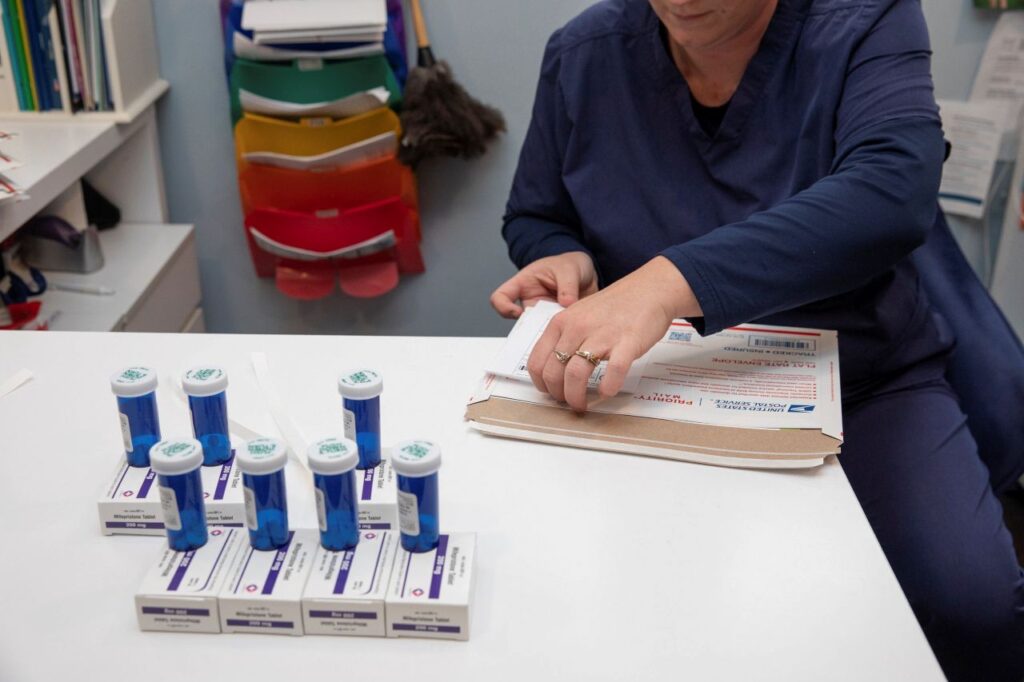
And while more patients are traveling out of state for the procedure, experts say it is telehealth, in which doctors mail abortion medications so that pregnancies can be ended at home, that is driving much of the increase.
Last year, 1 out of 4 abortions nationwide was provided via telehealth, compared with 5% before 2022, according to WeCount, a study led by the Society of Family Planning. And in states where abortion was banned, 99% of abortions were provided by telehealth.
“The reality is people are getting abortions, people are providing abortions, and the post-Dobbs environment is not stopping them,” said David Cohen, a law professor at Drexel University who co-wrote the book “After Dobbs.”
North Dakota Ruling Likely to Have Little Impact
Cohen pointed out that the recent North Dakota court decision to ban abortion would likely have little impact on the ground because the state’s climate had been so hostile to abortion for years. There aren’t any providers left in the state to push out.
And in Missouri, where anti-abortion advocates are trying to roll back access with a ballot measure, women have become accustomed to leaving the state or getting telehealth abortions because the abortion landscape has fluctuated so much in recent years, experts say.
“Individual state borders no longer had the same meaning they once had,” said Carole Joffe, a professor at the University of California, San Francisco, who co-authored the book with Cohen. “What we can conclude from the post-Dobbs era is that the abortion-providing community and women themselves have developed very creative modes of resistance.”
Telehealth Is Latest Frontier in Abortion Legislation
The popularity of telehealth, particularly in states where abortion is banned, has made it the latest frontier for abortion legislation in both red and blue states.
Last week, Texas enacted a law that aims to stop doctors from other states from mailing abortion pills to Texas.
Texas, where abortion is banned in almost all circumstances, is one of 20 states that now ban abortion or restrict the procedure earlier in pregnancy than the standard set by Roe v. Wade. But roughly 35,800 people got abortions in Texas last year, virtually all through a telehealth provider, according to the WeCount data.
The new Texas law, known as HB 7, allows private citizens to file lawsuits for at least $100,000 against anyone who prescribes or mails abortion medication to Texas residents. It is the most ambitious effort yet to halt abortions through the telehealth process.
“What anti-abortion lawmakers and advocates are trying to do is disrupt the new realities of abortion care in 2025,” said Kelly Baden, vice president for public policy at the Guttmacher Institute, a research organization that supports abortion rights. “This was never just about overturning Roe v. Wade — this is about really trying to stop all abortions anywhere, any way they can.”
Those who oppose telehealth abortions say that doctors have overstepped by providing abortions for women who live in states where the procedure is not allowed. Texas Right to Life, an anti-abortion group, heralded the law for targeting “the underground abortion industry,” led by activists “hiding in liberal states.”
So far, medical providers have said the law won’t stop them from providing abortion medication to people in Texas.
Blue States Like California Strengthen Laws to Protect Providers
Blue states this year have strengthened their shield laws, which protect abortion providers from out-of-state prosecutions and are intended to allow them to keep prescribing medicines for people out-of-state. In at least eight states, including California and Massachusetts, officials are prevented from obeying subpoenas, extradition requests and other legal actions that states with bans take against abortion providers — a stark departure from typical interstate practices of cooperating in legal matters.
This summer, Republican attorneys general wrote to congressional leaders saying they were “asking Congress to assess the constitutional authority it may have to preempt shield laws.” The letter described the laws as “blatant attempts to interfere with states’ ability to enforce criminal laws within their borders and disrupt our constitutional structure.”
Instead, Democratic lawmakers in states including New York, Washington and Colorado this year added safeguards that allow doctors to remove their full names from abortion medication prescriptions for privacy.
California went even further. In Colorado, for example, providers still must put the practice’s name, if not the individual doctor’s, on the prescription label. But California’s new law allows providers to dispense abortion drugs without including the name of the doctor, pharmacist or patient on the label.
“California stands for a woman’s right to choose,” Gov. Gavin Newsom said in a statement when he signed the law in September.
This article originally appeared in The New York Times.
By Soumya Karlamangla/Julia Rendleman/Jackie Molloy)
c.2025 The New York Times Company