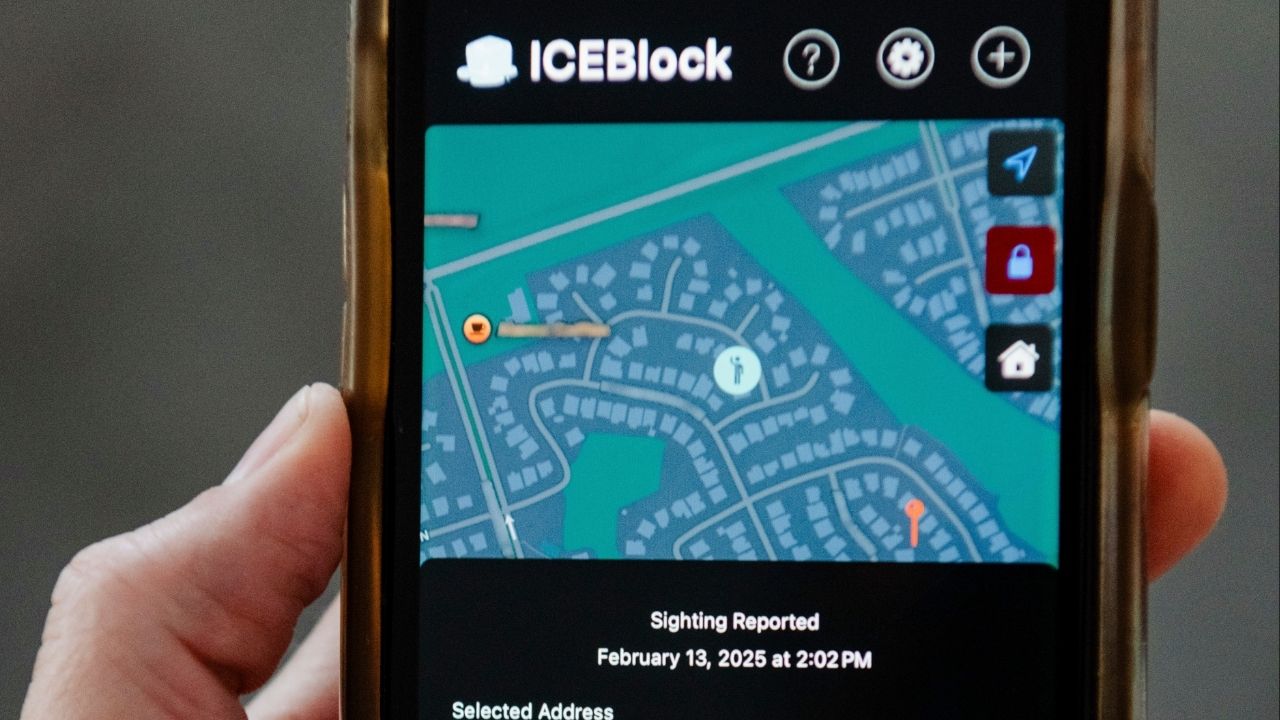
A phone displays a demonstration screenshot of the app ICEBlock, Dec. 6, 2025. On Monday, Dec. 8, the app’s developer, Joshua Aaron, sued top Trump administration officials, accusing them of pressuring Apple to stifle his free speech and his right to create, distribute and promote the app that allowed users to alert people when they saw ICE agents. (Carter Johnston/The New York Times)

Share
|
Getting your Trinity Audio player ready...
|
SAN FRANCISCO — For six months, Apple distributed an app called ICEBlock that allowed users to alert people when they saw Immigration and Customs Enforcement agents. But after the Trump administration complained that the app endangered officers, Apple removed it.
On Monday, the app’s developer, Joshua Aaron, sued top Trump administration officials, accusing them of pressuring Apple to stifle his free speech and his right to create, distribute and promote ICEBlock.
The suit, which was filed in the U.S. District Court for the District of Columbia, claimed that Attorney General Pam Bondi abused the government’s power when the Justice Department contacted Apple and demanded it remove the app, which she said she had done in a statement to Fox News in October. She said Apple removed the app after her request.
The legal action could reveal more about Apple’s decision-making and compliance with edicts from the Trump administration. According to Apple’s own public reports, it has removed apps at the request of authoritarian governments like China and Russia, but not from the U.S. government.
The removal of ICEBlock came as tech companies took down other immigration-related apps and services. Apple removed an app called DeICER, which helped users report immigration action. Google removed a similar app called Red Dot. And Meta, Facebook’s parent company, removed the Facebook group ICE Sighting-Chicagoland for violating its policies “against coordinated harm.”
Representatives for Bondi and the Trump administration didn’t immediately respond to requests for comment. Apple declined to comment.
The suit is the latest example of a partisan legal battle over how Republicans and Democrats have used control over the White House to influence the digital economy. In 2022, Republican attorneys general sued the Biden administration, accusing it of forcing social media companies to stifle skepticism about COVID-19 and vaccines. The Supreme Court ruled in the administration’s favor, saying the government could contact social media platforms about misinformation.
Trump Administration Condemns Apps
The Trump administration has condemned ICEBlock and other apps that were critical of its immigration policies. Kristi Noem, the secretary of homeland security, said the app obstructed justice. White House press secretary Karoline Leavitt said it incited violence against law enforcement.
A representative for Noem didn’t immediately respond to a request for comment.
The administration’s pressure preceded the removal of ICEBlock and the other apps. Late last month, the Electronic Frontier Foundation, a digital rights group, filed a lawsuit against the Justice Department and Department of Homeland Security to try to unearth information about any communications between the government and tech companies that might reveal coercion to restrict protected speech. Aaron followed with his own suit Monday.
“A lesson we should all take from this is when we see our government is doing something wrong, it is our duty to stand up,” Aaron said in an interview.
Apple’s removal of ICEBlock is consistent with how it has handled requests from governments around the world, but out of step with its approach in the United States.
In 2016, the company refused to comply with a request from the FBI that it unlock the phone of a terrorist who killed 14 people in San Bernardino, California. It said that doing so would endanger the privacy and security of all its customers. The government eventually gained access to the phone through a separate route.
Apple has removed thousands of apps in China over the years, including news providers and encrypted messaging apps. In 2019, it removed an app protesters were using in Hong Kong to track police. Supporters of the app said it helped residents avoid clashes between police and protesters, but authorities said protesters used it for those attacks.
Aaron said Apple’s decision to remove ICEBlock showed that it was “in bed with this administration or under threat from it.” He and his legal team hope the court will rule that the government can’t make threats against private companies, and Apple will return the app to its store.
—
This article originally appeared in The New York Times.
By Tripp Mickle/Carter Johnston
c. 2025 The New York Times Company
RELATED TOPICS:
Categories


Israel to Join Trump’s ‘Board of Peace’, Netanyahu Says
Instagram’s Top Exec Grilled over Safety Decisions at Trial