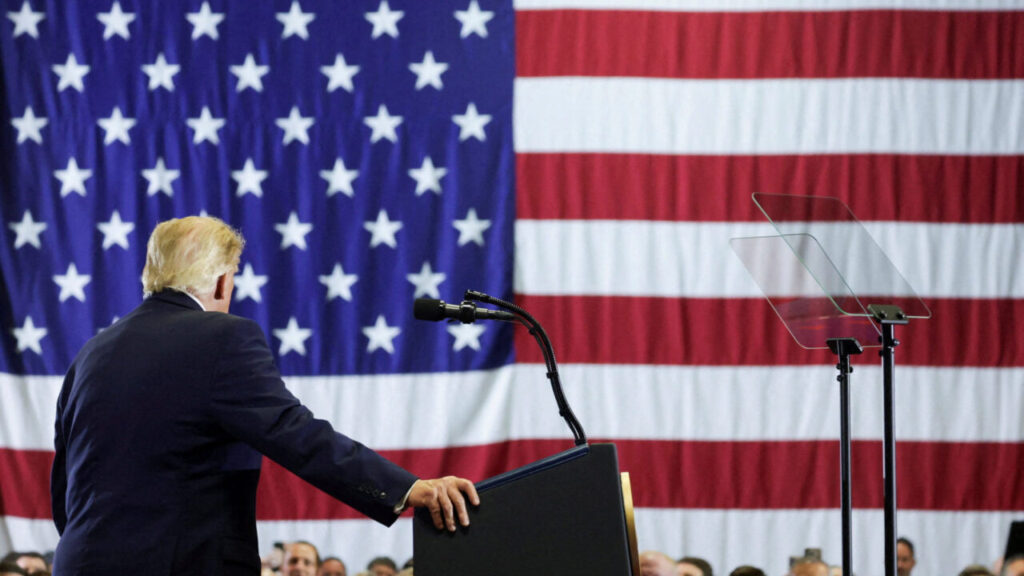




An overwhelming majority of Americans said that it is inappropriate to use taxpayer funds for TV ads featuring the president around an election, in a Reuters/Ipsos poll conducted as spots with President Donald Trump air ahead of November’s midterms.
The six-day poll, which concluded Monday, found that 86% of Americans — and four out of five Republicans — think it is inappropriate to use taxpayer money to pay for election-related TV ads featuring the president or his cabinet.
Ethics experts and lawmakers from both parties have criticized three nationally broadcast ads that celebrate a “golden age of America” airing weeks before the Nov. 3 midterm elections. Lawmakers have questioned whether public funds are being used to promote Trump politically, while other critics say the spots may violate longstanding restrictions on government propaganda and political activity.

Trump Claims They Are Public Service Ads
Trump and his aides have said the ads are educational, patriotic and not intended to promote any politician’s candidacy.
“These public service announcements are about reminding Americans to love their country and understand what makes it worth defending, at home, at our borders, and abroad,” said a White House spokesperson who declined to be named. Trump said late on Monday that he would pay for ads himself or with money raised from the MAGA political committee.
One ad features Trump declaring that “America will never be a communist country” while a chorus repeats “love me.” Another combines images of Mount Rushmore with footage of Trump praising a “golden age of America.” A third describes a “final battle” against the “deep state” and closely resembles one of Trump’s 2024 campaign advertisements.
Each ad ends with a disclaimer that it was paid for by the U.S. government.
Democratic lawmakers have sought independent investigations and said that the White House transferred $20 million in Homeland Security Department funds to air the ads.
Pressure on Republicans Ahead of Elections
Republicans seeking reelection face growing pressure as the president’s approval rating sits at record lows.
Trump has taken a series of unusual steps in recent months promoting his brand and accomplishments, including a sweeping makeover of Washington.
A Trump-appointed board shut down the capital’s landmark John F. Kennedy Center for the Performing Arts after courts rejected two plans to put the president’s name on the building.
Some 71% of respondents oppose renaming the Kennedy Center to include Trump’s name, the poll showed. Just a quarter of Republicans supported that idea.
“For me to get involved and to take that on long term and to carry it or to raise money to carry it, I think that the Trump administration should certainly have recognition,” Trump said last month.
A Media Ban at the White House
In September, Trump banned CNN, MS NOW and Politico from the White House before a judge ordered the administration to restore their access.
Republicans were more supportive of keeping some reporters out of the White House, with 57% backing the practice. Democrats and independents were overwhelmingly opposed. Overall, 68% of respondents said the practice was inappropriate.
The Justice Department has accused the outlets of threatening national security with their coverage, citing stories about US missile stockpiles, construction of Trump’s White House ballroom and turnout at the recent Republican midterm convention.
The Reuters/Ipsos poll, which was conducted online and nationwide, gathered responses from 4,506 U.S. adults and had a margin of error of about 2 percentage points.
—
(Reporting by Trevor Hunnicutt and Jason Lange in Washington; editing by Scott Malone and Rosalba O’Brien)