



|
Getting your Trinity Audio player ready...
|
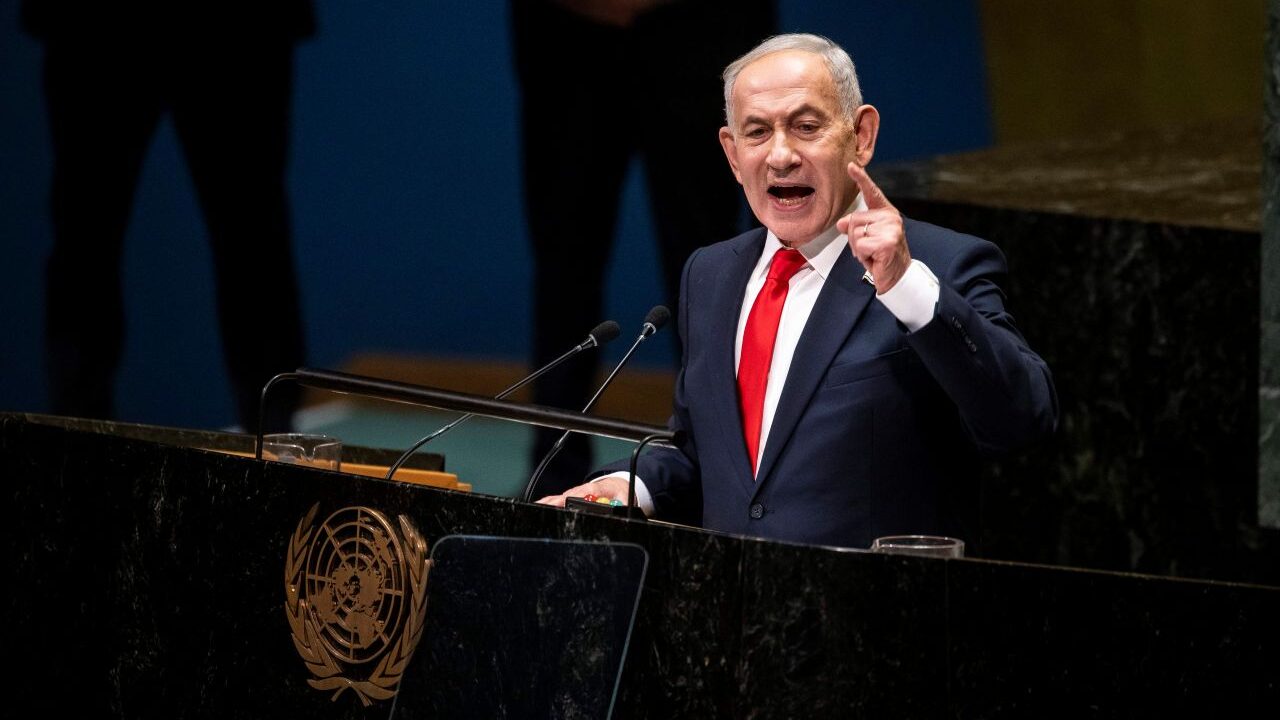
UNITED NATIONS — Prime Minister Benjamin Netanyahu of Israel delivered a fiery speech to the U.N. General Assembly on Thursday as protesters rallied against him in the streets of New York and many diplomats in the hall walked out, as they did last year. A group of supporters countered the display of opposition in the chamber with applause and chants of “Am Yisrael Chai,” a popular refrain meaning “the nation of Israel lives.”
Netanyahu cast his war in the Gaza Strip and the joint U.S.-Israeli strikes against Iran as a “battle against barbarians” and said he had “no greater partner than President Trump.” He struck a tone of intense defiance, vowing that Israel would continue fighting Hamas and Iran “because we have no other choice.”
Netanyahu arrived in New York amid street protests against him. The city’s mayor, Zohran Mamdani, had called for Netanyahu to be arrested under an International Criminal Court warrant, though he later acknowledged his own lack of power to order Netanyahu’s arrest. In his speech, Netanyahu accused Mamdani of being an “antisemite.”

Abbas Describes Israel’s Actions as a ‘Colonial Scheme’
His address Thursday came hours after the Palestinian leader, Mahmoud Abbas, portrayed Israeli actions in Gaza and the West Bank as “a malicious colonial scheme” aimed at forcing Palestinians to leave their homeland. But Abbas said he still hoped for “a democratic Palestinian state that respects the rule of law and human rights.”
Abbas addressed the gathering virtually for the second year in a row because the Trump administration refused to grant him a visa. He argued in his recorded speech for a two-state solution, as he has done for decades. He was also sharply critical of Israel, saying that the state was prosecuting “a genocidal war that has created an unprecedented humanitarian catastrophe.”
Netanyahu, for his part, batted away those accusations while avoiding the topic of Gaza’s destruction. Rather than committing a genocide, he said, Israel had “prevented a genocide” against its own people by Hamas. He called claims of genocide against Israel “the greatest lie of the century.”
UN: Israel Committed Genocide in Gaza
In September, the U.N.’s Independent International Commission of Inquiry on the Occupied Palestinian Territory issued a report saying that Israel had committed genocide in Gaza and that the perpetrators must be held accountable.
Netanyahu is also facing a tough election at home, and his political future is uncertain. His address at the U.N., analysts said, was largely directed at the audience back home and not at the international community, from which Israel is more isolated than ever.
This article originally appeared in The New York Times.
By Max Bearak, Farnaz Fassihi and Isabel Kershner/Dave Sanders
c.2026 The New York Times Company