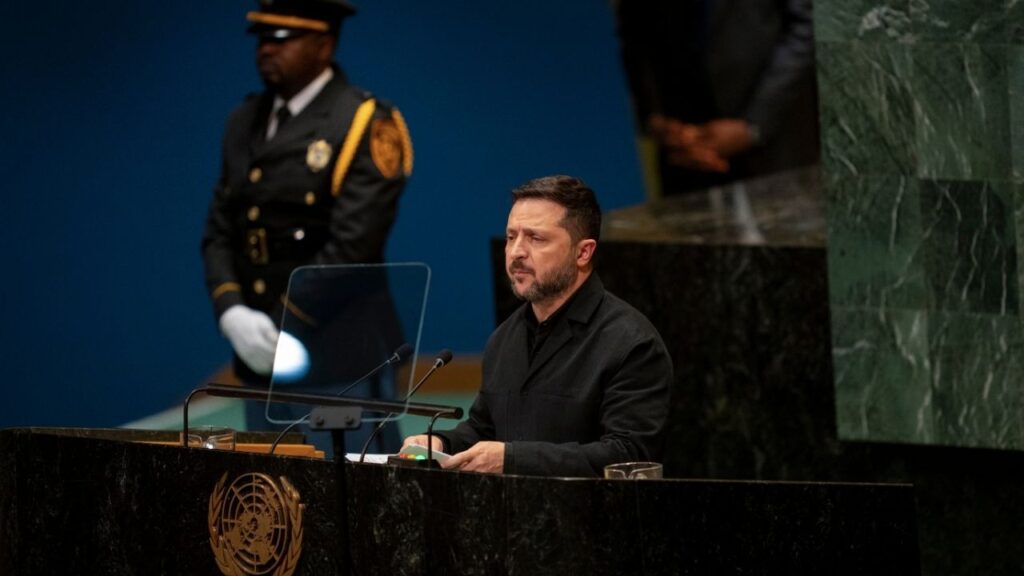
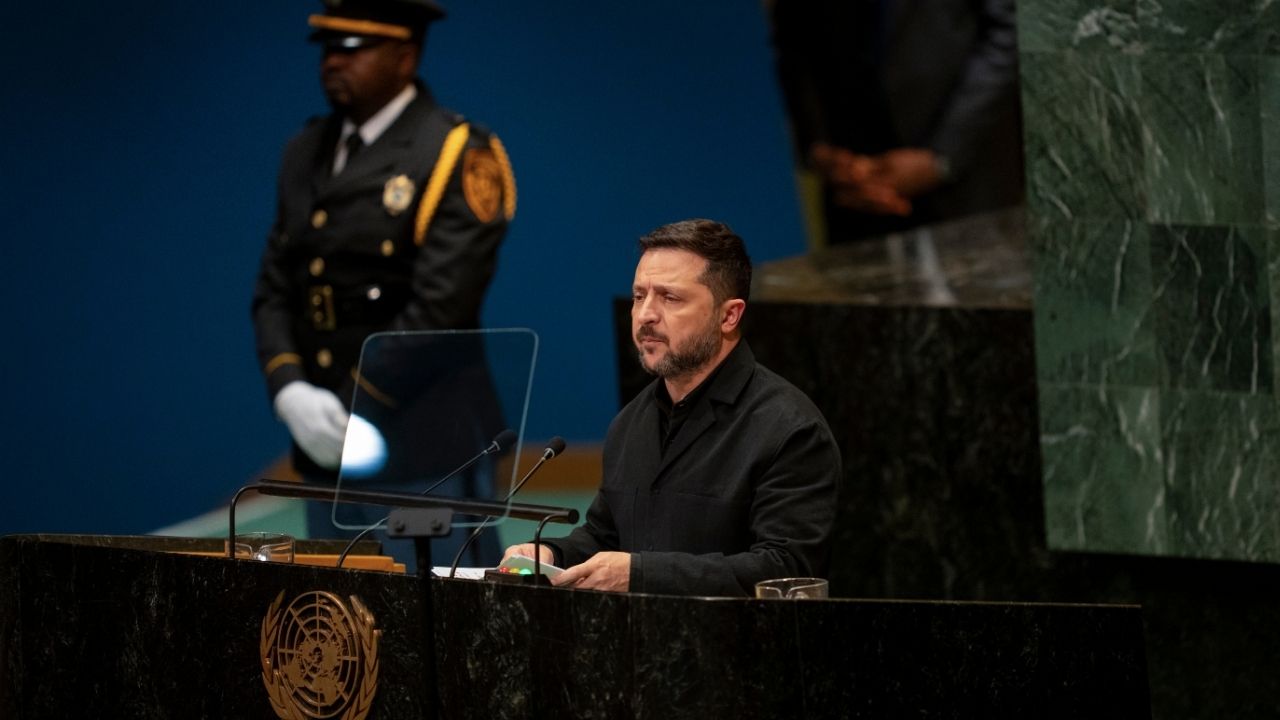

UNITED NATIONS — President Volodymyr Zelenskyy of Ukraine on Wednesday warned that Russia’s “ridiculous and never-ending war” on his country could soon spread to other parts of Europe and called for increased economic pressure on Moscow to force a peace agreement before the fighting enters another deadly winter.
Diplomatic impasses and the global economic fallout from armed conflicts have dominated discussions during the annual gathering of world leaders at the U.N. General Assembly. In his speech to the body, which he delivered in English, Zelenskyy offered reminders of the wide-ranging effects of Russia’s war, from grain shortages to fuel prices to the frenzied race to create ever-more deadly drone technology.
And he predicted how artificial intelligence, which has catapulted to the top of the General Assembly’s agenda, might find some of its darkest uses. “As early as next year, there is a real possibility that AI, not only people, will decide what happens on the battlefield,” Zelenskyy said. “We need peace before we reach that point.”

Zelenskyy said that Ukraine had taken prisoners of war of 47 nationalities and that they had been fighting for Russia as a result of “deception and tricks.” Over the past eight months, Russia has suffered more than 248,000 battlefield casualties, Zelenskyy said, adding that Ukraine possessed “video confirmation for every one of these losses.”
Earlier Wednesday, Iran’s president, Masoud Pezeshkian, delivered a defiant speech to the General Assembly, brandishing pictures of people killed by U.S. and Israeli airstrikes while standing at the same lectern where a day earlier President Donald Trump had threatened to “annihilate” Iran.
Pezeshkian vowed that Iran could “not be made to surrender” and said it would never accept limits on its nuclear program, which he claimed was for peaceful purposes. He accused the United States and Israel of violating international law by targeting civilian infrastructure in its strikes on Iran.
“Yes they did hit us,” he said, “but we did not bend the knee.”
Here Is What Else Is Happening:
— Iran talks: U.S. and Iranian representatives held talks Tuesday through mediators for the first time since a peace agreement fell apart in July. Iran’s foreign minister, Abbas Araghchi, communicated through Qatari mediators with U.S. special envoy Steve Witkoff and Jared Kushner, a son-in-law of Trump’s, on the sidelines of the General Assembly.
— Walkouts: The lone U.S. diplomat in the General Assembly hall left his seat as Pezeshkian spoke. Leaving the chamber in protest has a long history in the U.N. In recent years, it has become something of a tradition.
— Security Council: At a meeting of the U.N. Security Council focused on Ukraine, Russia blamed Europe and its prewar support for Ukraine for its full-scale invasion in 2022. The Russian foreign minister said that European leaders had sought to “whip up an anti-Russia campaign” and that, as a result, Russia “had to” start what it calls its “special military operation” against Ukraine.
— AI: The Security Council will convene a session of foreign ministers on the threat posed by AI, specifically the use of AI weapons in conflicts. The event has gained more urgency after recent warnings by some AI developers that without significant oversight, the technology could pose a threat to humanity.
—
This article originally appeared in The New York Times.
By Max Bearak, Farnaz Fassihi and Pranav Baskar/Lexi Parra
c. 2026 The New York Times Company