


|
Getting your Trinity Audio player ready...
|
A new era of college admissions is unfolding after years of turmoil.
Standardized testing requirements are being revived, or are under consideration, from coast to coast. Admissions officers at both big public schools, like the University of Georgia, and top-tier private institutions, like Washington University in St. Louis, are shedding some application essays. Administrators everywhere are fretting about what role artificial intelligence may play in applications.
The COVID-19 pandemic led many schools to loosen their processes and, in many cases, rely more on components such as essays. But AI’s rise, questions about student preparation, the end of affirmative action and the Trump administration’s campaign to prioritize “merit” in admissions are driving a swing back.

College applications were up during the last admissions cycle, after a more diverse pool of students applied and students applied to more schools on average. But demographic shifts are expected to send enrollments diving in the coming years. At the same time, higher education is wrestling with public mistrust and concerns about the value of college, especially as AI starts to reshape the workforce.
As schools prepare for a future with fewer students and more AI, approaches that make applying to college simpler — and more attractive to families — could help them cushion the impact.
Extra Essays Are Out
The personal essay is still central to many college applications. But supplementary essays are falling out of favor.
Tulane University, for instance, paused its requirement for applicants to write about why they want to attend the school. Concerns about potential AI-generated essays “were definitely a factor” in the decision, said Michael Strecker, a university spokesperson.
Some admissions officers said they don’t use AI detection systems, which are not always accurate.
Georgia, Cornell University, the University of Virginia and Texas Christian University have recently pared back essay requirements. Washington University dropped an optional essay that many applicants apparently did not consider truly optional.
Reducing the number of required essays makes applying easier, which tends to raise a school’s application numbers. By attracting more applicants, a school lowers its acceptance rate, which can make it appear more exclusive — though many colleges do not want to be seen as intentionally pumping up rejection notices.
Strecker said by email that “reducing our admit rate to appear more selective was, in no way, a reason” for pausing a supplemental essay. The “Why Tulane?” essay had just not factored heavily into the school’s selection decisions in recent years, he said.
Tulane still requires that applicants write a personal essay, and the school makes admission decisions largely based on an “applicants’ academic record, testing profile, impact and involvement outside the classroom, letters of recommendation” and the personal essay, Strecker said.
David Graves, executive director of undergraduate admissions at Georgia, said he figures “every admissions office has concerns about essays being written by AI.” While Georgia’s decision to drop a supplemental essay was more about simplifying the process for applicants, other experts said the possibility that students are using AI to help with essays is a rising concern.
“AI has hastened the realization that the written word in this context isn’t necessarily an accurate representation of how somebody thinks and how somebody writes,” said Christoph Guttentag, who retired in 2025 as dean of undergraduate admissions at Duke University after having read student applications for 42 years.
The University of Pennsylvania has lately tried to tell applicants what they can — and cannot do — with AI. Talking through an idea with a parent or teacher or asking that person to proofread is fine. So is using AI to sort through ideas or double-check grammar, the university says.
But Penn, which acknowledges using AI for administrative but not evaluative purposes in admissions, also tells applicants if “you couldn’t explain, in an interview or conversation, how you arrived at what you wrote, or speak to it in your own words, it isn’t ready to submit.”
In St. Louis, where Washington University has long worked to carve out a spot among the nation’s most respected schools, officials some years ago added an “optional” essay for students to showcase more of themselves, said Ronné Turner, vice provost for enrollment management. The school is now phasing it out after deciding much of the information students shared was redundant.
The team also heard from high school guidance counselors that students often believed that skipping the essay would reflect poorly on them.
The school will still require a personal essay and another on what the student might want to study.
“We’re asking them just for the information we need to make good admission decisions,” she said.
Politics Has Entered the Admissions Office
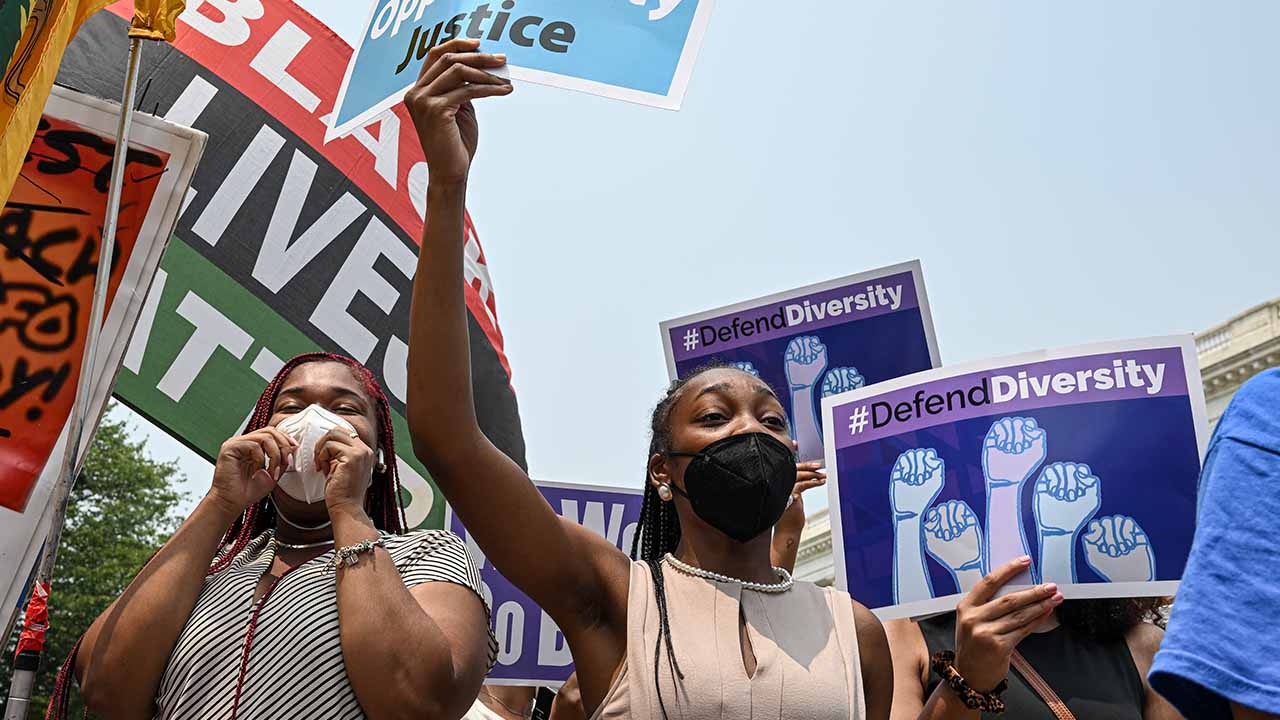
What data universities need remains a significant flashpoint. The 2023 Supreme Court decision striking down race-conscious admissions programs lurks in many internal deliberations about requirements and processes. In that ruling, Chief Justice John Roberts wrote that an applicant “must be treated based on his or her experiences as an individual — not on the basis of race.”
He also said the court’s opinion should not be “construed as prohibiting universities from considering an applicant’s discussion of how race affected his or her life, be it through discrimination, inspiration or otherwise.”
The Trump administration has argued that the court’s opinion should be interpreted to banish any consideration of race in admissions. Many university leaders and lawyers privately contest the White House’s view, but a series of Justice Department inquiries into admissions practices across the country has left them unnerved and searching for ways to avoid scrutiny.
Tests Are Back In
Many figures inside the Trump administration want schools to rely on measures they see as more merit-based, such as test scores and grades. For a variety of reasons, many schools that relaxed their testing mandates during the pandemic are bringing them back. In June, for instance, Columbia University became the last Ivy League institution to announce plans to once again require scores from prospective undergraduate students.
The testing debate is erupting anew in the nation’s most populous state, where the 10-campus University of California system is considering a resurrection of its standardized testing mandate. Given the public system’s prestige and size — it has about 238,000 undergraduate students — a change could reverberate across the national landscape.
The system has drawn plenty of skepticism from the Trump administration, but much of the agitation is coming from faculty members, who say that fewer students appeared ready for UC’s rigors after the system moved in 2020 to do away with standardized testing.
“Starting around 2022, 2023, I noticed that students were struggling to complete even the homework assignments — the same assignments that I’ve been giving for 15 years,” Pradeep Sen, an engineering professor at the University of California, Santa Barbara, told regents in July. “This means I need to spend class time teaching students stuff they’re supposed to know already, which is really impacting the ability to cover the stuff that I need to cover.”
Sen said he was sensitive to the possibility that students of various demographics might perform differently than others on standardized tests. “The answer,” he said during the regents’ meeting, “is not to get rid of the one metric that ensures students have a proper foundation to succeed in college.”
In the same meeting, Jessie Ryan, the president of the California-based Campaign for College Opportunity, warned that reinstating the SAT was “absolutely the wrong solution to an undefined problem.”
Retention and graduation rates had stayed stable or increased since the university system eliminated standardized tests, she said.
“If, in fact, we want to address college preparation, we should be looking not at becoming more selective, but being more supportive to students,” she said.
Maria Anguiano, the chair of the Board of Regents, said that public debates about college readiness had focused “too narrowly” on admissions and standardized testing. Anguiano said the university’s academic senate would conduct a review of standardized testing, among other topics, and submit a recommendation by the end of the academic year.
—
This article originally appeared in The New York Times.
By: Alan Blinder and Mark Arsenault/Kenny Holston
c.2026 The New York Times Company