
|
Getting your Trinity Audio player ready...
|
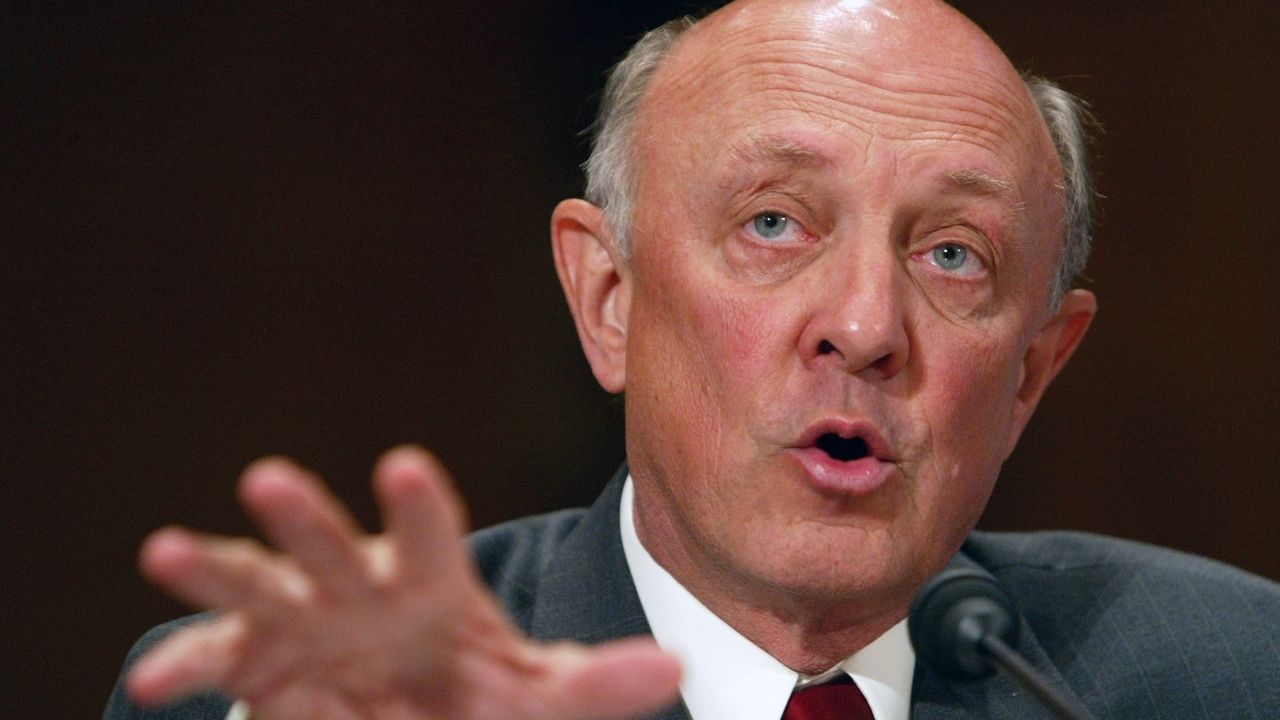
R. James Woolsey, a lawyer and arms control negotiator who had a brief, embattled tenure as director of central intelligence under President Bill Clinton and whose rightward political drift later led him to support the U.S.-led invasion of Iraq and Donald Trump’s presidential candidacy, died Tuesday at his home in Washington. He was 84.
The cause was a stroke, his wife, Conchita Sarnoff Woolsey, said.
An Oklahoma-born conservative Democrat with impeccable academic credentials — Stanford University, Rhodes scholar at the University of Oxford, Yale Law School — Woolsey had the background and intellect to carry him to increasingly prestigious positions over a long career in Washington.

The phrase “Defense Democrat” seemed to have been coined for him. He was a high-powered Washington lawyer but was known for public service under both political parties, including a stint as under secretary of the Navy during President Jimmy Carter’s term and work on arms control for the Reagan administration. From 1989 to 1991, under President George H.W. Bush, Woolsey was America’s ambassador to talks on a treaty limiting conventional forces in Europe.
In 1993, Clinton delivered what should have been a career-defining assignment, naming Woolsey director of central intelligence, but the two never built a close rapport.
At the time, it seemed that a president without deep foreign policy or national security experience had chosen a director of central intelligence whose hawkish credentials would go a long way toward satisfying Republicans. Woolsey was also expected to help mollify career national security professionals entering an uncertain post-Cold War world — and facing post-Cold War budget cuts.
His rocky tenure at the CIA covered challenging times, including the first World Trade Center bombing in 1993; a terrorist shooting that year near the agency’s entrance that killed two people and wounded three; and the so-called peace dividend that followed the collapse of the Soviet Union, a period that saw veteran Kremlinologists retiring or reassigned, effectively blinding the U.S. to the rise of a hostile Russia under Vladimir Putin.
And, of course, there was the 1994 arrest of CIA case officer Aldrich Ames, a turncoat who had delivered invaluable secrets to Moscow for nine years and is regularly described as the most damaging double agent in American history. Though there had long been evidence of catastrophic leaks at the agency, an intensive investigation into Ames only began in 1993.
Although Woolsey, after the arrest, called it a “systemic failure” that Ames had not been pinpointed sooner, he decided that nobody at the agency would be dismissed or demoted, opting to send letters of reprimand to 11 former and current CIA officials whom he believed had overlooked early signs of the mole.
None of his tenure’s challenges could be blamed directly or fully on Woolsey, but the accumulation of so many significant problems — combined with his lack of backing from the White House and his failure to establish a productive working relationship with Congress — left him little support across official Washington.
Woolsey resigned in late December 1994. John Deutch was confirmed as his successor.
Woolsey was embittered by the experience of resigning under pressure. “He was obsessed by it,” James Risen, a former New York Times reporter and a co-author of “The Main Enemy: The Inside Story of the CIA’s Final Showdown with the KGB,” said in an interview.
“It made him much more conservative over time,” Risen added. “His bitterness led him to be anti-Clinton. And then that led him to become more Republican in the late ’90s. And then Iraq brought him completely into the Bush, Cheney, neocon orbit, and he became a real pro-Iraq War hawk.”
Before the 2003 invasion of Iraq, Woolsey told the public television program “Frontline”: “I don’t know how many pieces of evidence one needs in the case of someone like Saddam Hussein. We know Saddam is working hard on weapons of mass destruction.”
That assessment turned out to be wholly wrong, but was widely shared across the Bush administration, which ordered the invasion of Iraq only to find that Saddam had no weapons of mass destruction. The war ended up lasting nearly nine years, with more than 4,000 U.S. deaths and more than 100,000 Iraqi casualties amid a grinding insurgency.
Like others who supported the invasion, Woolsey came to acknowledge the failure of intelligence that had pointed to a robust program for weapons of mass destruction under the Saddam regime. But, like so many others, he continued to maintain that the invasion was justified to oust a dictator and give Iraqis a chance at democracy.
In 2016, Woolsey joined Trump’s presidential campaign as a senior adviser, and he slammed the Obama administration and the tenure of its secretary of state, Hillary Clinton, Trump’s opponent. After Trump won, Woolsey was said to be under consideration for a national security post, but nothing came of it.
Robert James Woolsey Jr., an only child, was born Sept. 21, 1941, in Tulsa, Oklahoma. His father was a lawyer, and his mother, Clyde (Kirby) Woolsey, managed the home.
He received a bachelor’s degree from Stanford in 1963 and a master’s in 1965 from Oxford, which he attended as a Rhodes scholar. At Yale Law School, he was in the Reserve Officers Training Corps but was also involved in protests against the Vietnam War. After graduating in 1968, he spent two years in the Army and rose to the rank of captain, serving as a program analyst for the secretary of defense and the National Security Council, and as an adviser to the U.S. delegation to the Strategic Arms Limitation Talks in Helsinki and Vienna.
Following his service, he spent three years as general counsel to the Senate Armed Services Committee. Starting in 1983, he did a three-year tour as delegate at large to the Strategic Arms Reduction Talks with the Soviet Union.
He was a partner at the Washington law firm Shea & Gardner for 22 years. He also served as a vice president in the global strategic security division at the consulting firm Booz Allen Hamilton.
His first marriage, to Suzanne Haley, ended in divorce after 48 years in 2013. The next year, he married Nancye Miller, who died of cancer in 2019.
Besides his third wife, a human rights activist whom he married in 2020, he is survived by three sons from his first marriage, Robert, Daniel and Benjamin; two stepchildren, Cristina and Nicholas Sarnoff; and 10 grandchildren.
—
This article originally appeared in The New York Times.
By Thom Shanker/Matthew Cavanaugh
c. 2026 The New York Times Company