
|
Getting your Trinity Audio player ready...
|
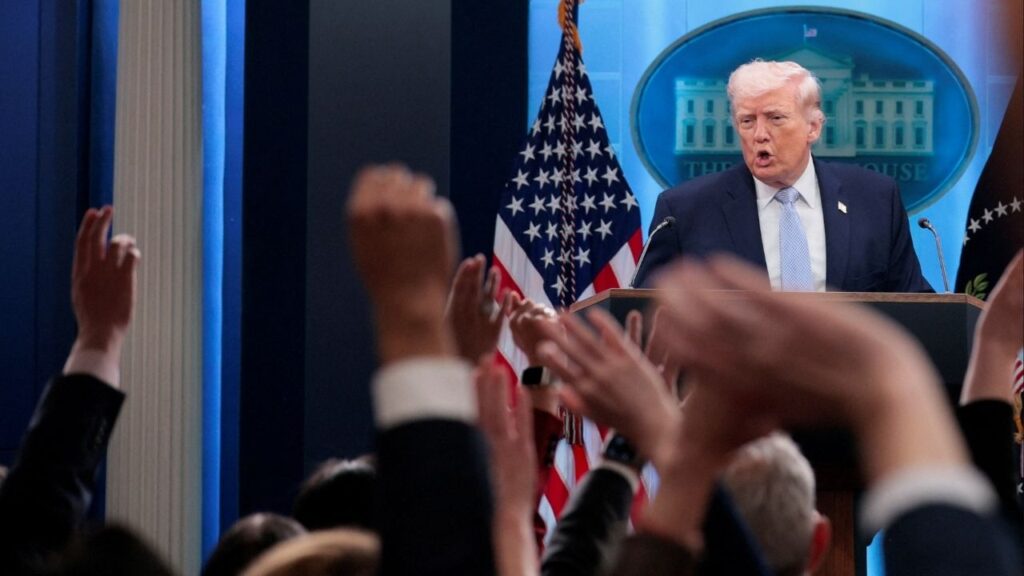
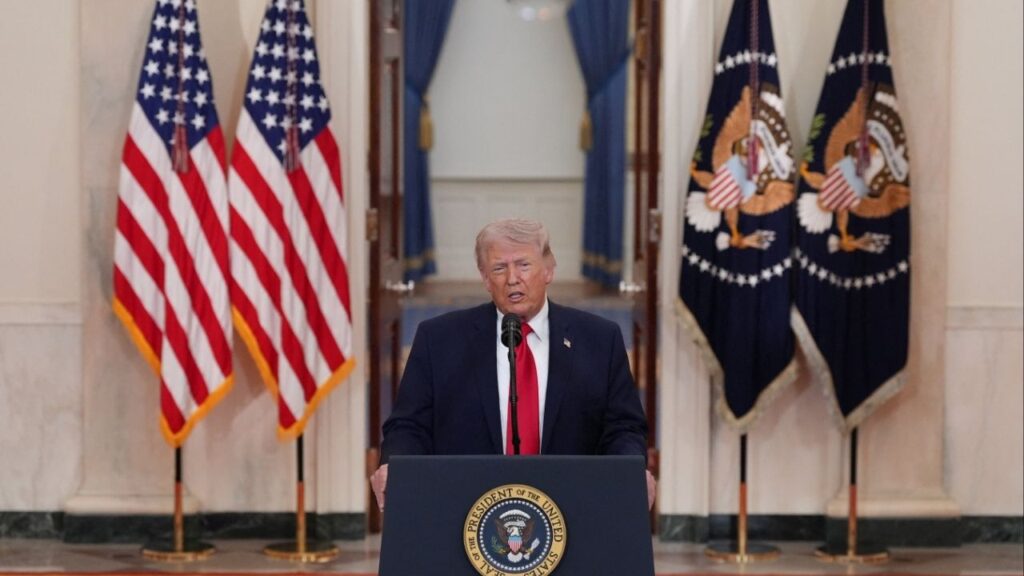
President Donald Trump said on Wednesday that imports from countries supplying Iran with military weapons will face immediate 50% tariffs with no exemptions, announcing the threatened duty in a social media post just hours after agreeing to a two-week ceasefire with Tehran.
Trump’s Truth Social post did not specify which legal authority he would invoke to impose such tariffs, as the Supreme Court in February struck down his use of the International Emergency Economic Powers Act to impose broad global tariffs, prompting a lower court to order refunds of some $166 billion collected over the course of a year.
The 1977 IEEPA law has been used extensively for decades to back financial sanctions against Iran, Russia and North Korea, but the court ruled that Trump overstepped his authority in using it to impose trade tariffs.

“A Country supplying Military Weapons to Iran will be immediately tariffed, on any and all goods sold to the United States of America, 50%, effective immediately, There will be no exclusions or exemptions! President DJT,” Trump wrote.
He did not name any countries that could face punitive tariffs. China and Russia have helped Iran build military capacity to counter U.S. and Israeli pressure, supplying missiles, air-defense systems and technology intended to bolster deterrence.
But that support appeared capped during the U.S.-Israeli attacks on Iran. Both Beijing and Moscow have denied supplying any weapons recently, although allegations against Moscow have persisted.
Reuters reported in February, prior to the first U.S. and Israeli strikes on Iran, that Tehran was considering a purchase of supersonic anti-ship cruise missiles from China. Reuters also reported in March that China’s top semiconductor maker, SMIC , has sent chipmaking tools to Iran’s military, according to two senior Trump administration officials.
Alternative Tariff Tools
Trump does have active “Section 301” unfair trade practices tariffs on Chinese goods from his first term to which he may be able to add duties and similar pending cases related to excess industrial capacity and China’s compliance with a 2020 trade deal. But these would require a public notice period before they could take effect.
Trump also may be able to invoke Section 232 of the Cold War-era Trade Expansion Act of 1962, which allows sector-specific tariffs to protect strategic domestic industries on national security grounds, but using this law would require a new months-long investigation and public comments.
Any new tariffs on Chinese goods would inflame tensions with Beijing as Trump prepares for a planned trip to Beijing to meet with Chinese President Xi Jinping to firm up a delicate trade truce between the world’s two largest economies.
On Tuesday, U.S. Trade Representative Jamieson Greer said that Trump would seek to maintain the current stability in the U.S.-China relationship, to preserve U.S. access to Chinese-produced rare-earth minerals and magnets while maintaining prior tariff levels.
“What we are not looking for is massive confrontation or anything like that” with China, Greer said of the planned meeting between Trump and Xi.
Russia has been another source of arms technology for Iran, but U.S. imports of Russian goods have fallen sharply since the invasion of Ukraine in 2022 and the wave of financial sanctions imposed on Moscow as a result.
U.S. imports from Russia, one of the only countries not subject to Trump’s now-cancelled “reciprocal” tariffs, jumped 26.1% to $3.8 billion in 2025. These are dominated by palladium used in automotive catalytic converters, fertilizers and their ingredients, and enriched uranium for nuclear reactors. The Commerce Department is already moving to impose punitive tariffs on Russian palladium after an anti-dumping investigation.
—
(Reporting by Susan Heavey and David Lawder in Washington; Editing by Sharon Singleton and Matthew Lewis)