

|
Getting your Trinity Audio player ready...
|
Remember Mussel Slough!

By Joe Mathews
Opinion
Most of you can’t remember the massacre that birthed modern California. Because you never learned about it in the first place.
Maybe Mussel Slough has been forgotten because the powers-that-be want it that way.

They don’t want us remembering Mussel Slough, because it would teach us that the U.S. government’s attacks against Californians are not some Trump-era anomaly. They don’t want us to remember that the feds always take the side of a powerful industry against the citizenry. And never stop trying to blame regular people for the government’s own violence.
The Shooout 30 Miles South of Fresno
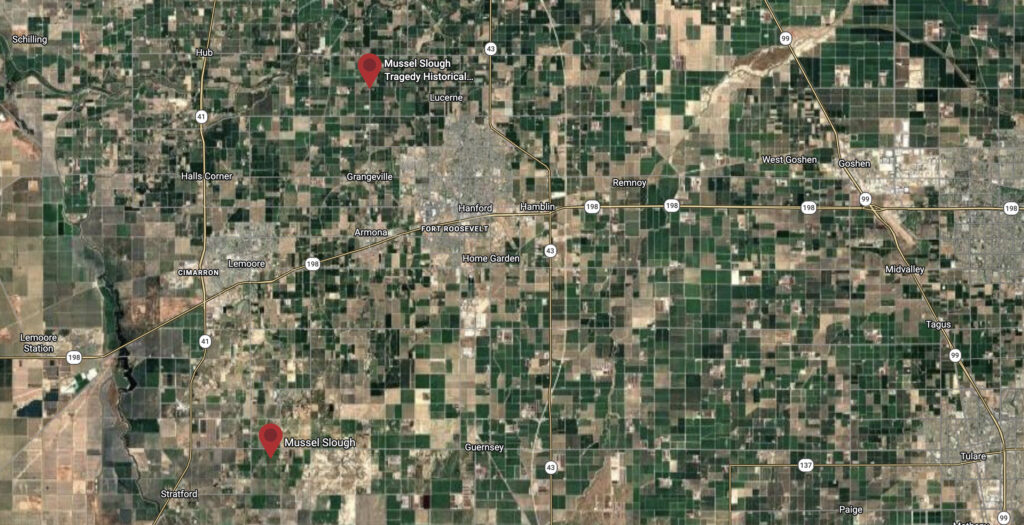
Mussel Slough was a slough, or waterway, 30 miles south of Fresno — and the site of an 1880 shootout between Californians and Southern Pacific Railroad agents, including at least one U.S. marshal.
The details are still contested. Settlers had built homes near Mussel Slough on railroad land, in anticipation of the construction of a new rail line nearby. This was standard practice. The railroad allowed people to build first and then purchase land from them later, once the railroad route was decided.
But Southern Pacific raised the land prices in Mussel Slough. The settlers — migrants, Civil War refugees, land speculators—wouldn’t pay, and wouldn’t leave. So, the railroad sent agents to chase after settlers and evict them. The settlers resisted.
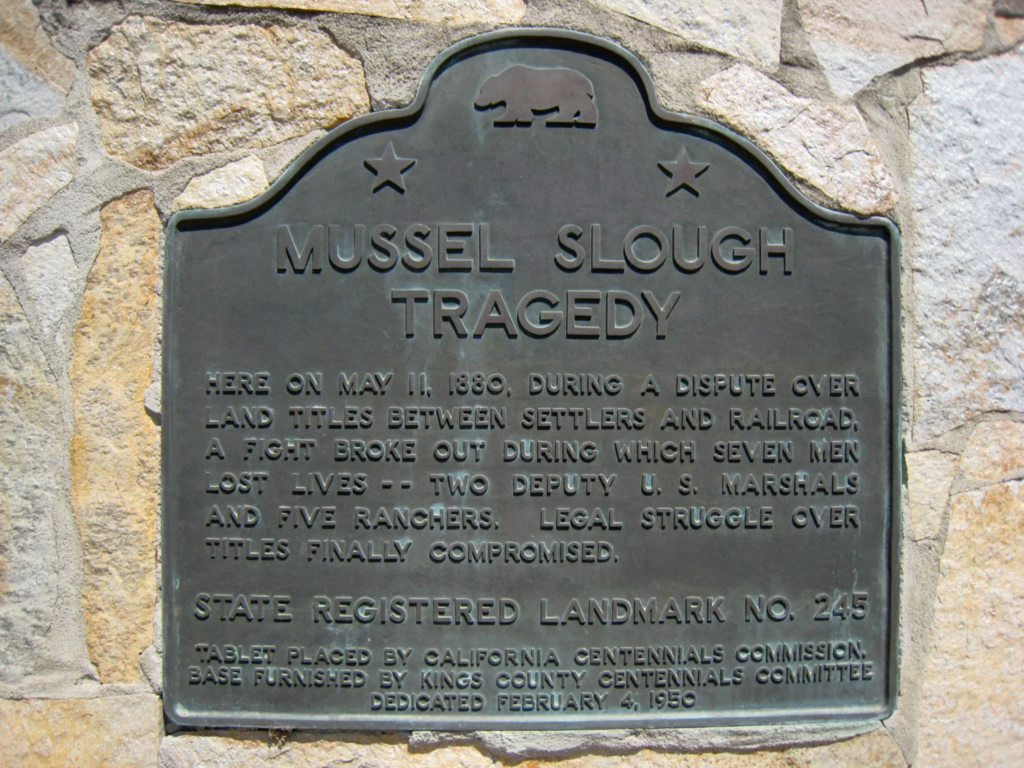
On May 11, 1880, five “railroad men”—U.S. Marshal Alonso Poole, Southern Pacific land appraiser William Clark, and locals Walter J. Crow and Mills Hartt (who some accounts describe as deputy U.S. marshals) — started evicting settlers from Mussel Slough.
Twenty or so settlers confronted them. An argument ensued. One railroad man, Harrt, opened fire on one settler, who returned fire, killing Hartt. Crow, another railroad man, then killed five members of the settlers’ party. Another gunfight victim succumbed later. Seven people died in all.
Railroad Never Held Accountable
But the railroad men were never held accountable for the settlers’ deaths. Instead, the federal government indicted 17 settlers, and won convictions against five of them, for “willfully interfering” with a U.S. marshal.
The shootout and those convictions stirred national outrage at railroad impunity. Mussel Sloughtbecame a fixture of popular culture for a half-century — in plays, early films and books.
Among these was Frank Norris’ 1901 novel The Octopus: A Story of California, a fictionalized account of Mussel Slough that channels despair at a corrupt political and economic system:
They own us, these task-masters of ours; they own our homes, they own our legislatures…. We are told we can defeat them by the ballot-box. They own the ballot-box. We are told that we must look to the courts for redress; they own the courts. We know them for what they are—ruffians in politics, ruffians in finance, ruffians in law, ruffians in trade, bribers, swindlers, and tricksters.
If such anger feels familiar today, it should. The fix is still in. The U.S. government violates law and constitution with impunity, while Big Tech executives — today’s railroad barons — go unchecked.
That’s why the history that followed Mussel Slough is worth remembering.
Mussel Slough Helped Birth the Progressive Era
Across California and the U.S., everyday people did not accept federal violence. They formed massive movements that birthed the Progressive Era, during which citizens and politicians overhauled the government to make it more responsive to the people..
A new Progressive Party established new regulators and agencies to govern California and the railroads. The voters approved women’s suffrage, nonpartisan local elections, and direct democracy. And lawmakers approved eight-hour workdays, workers’ compensation, child-labor laws, and food safety systems.
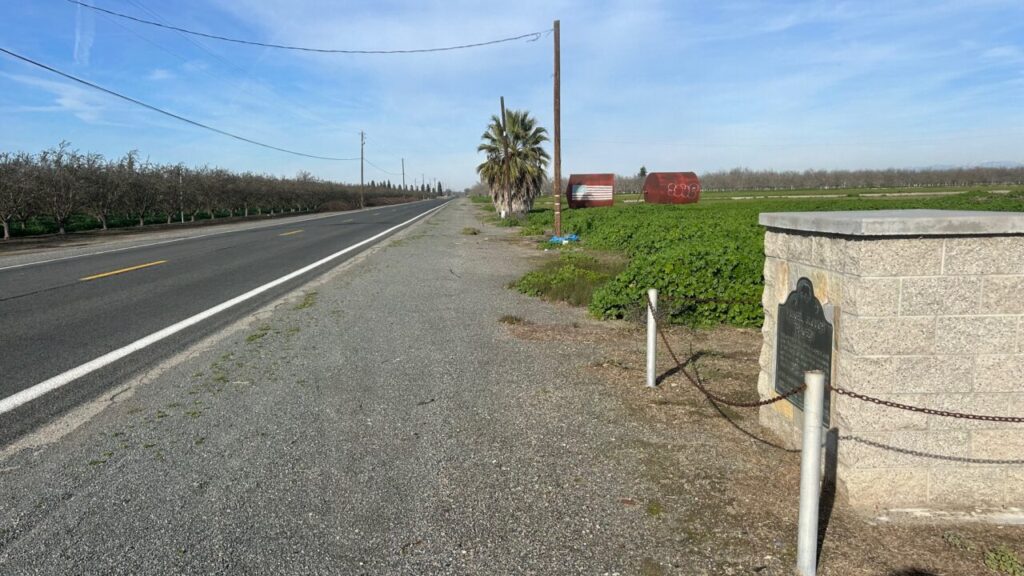
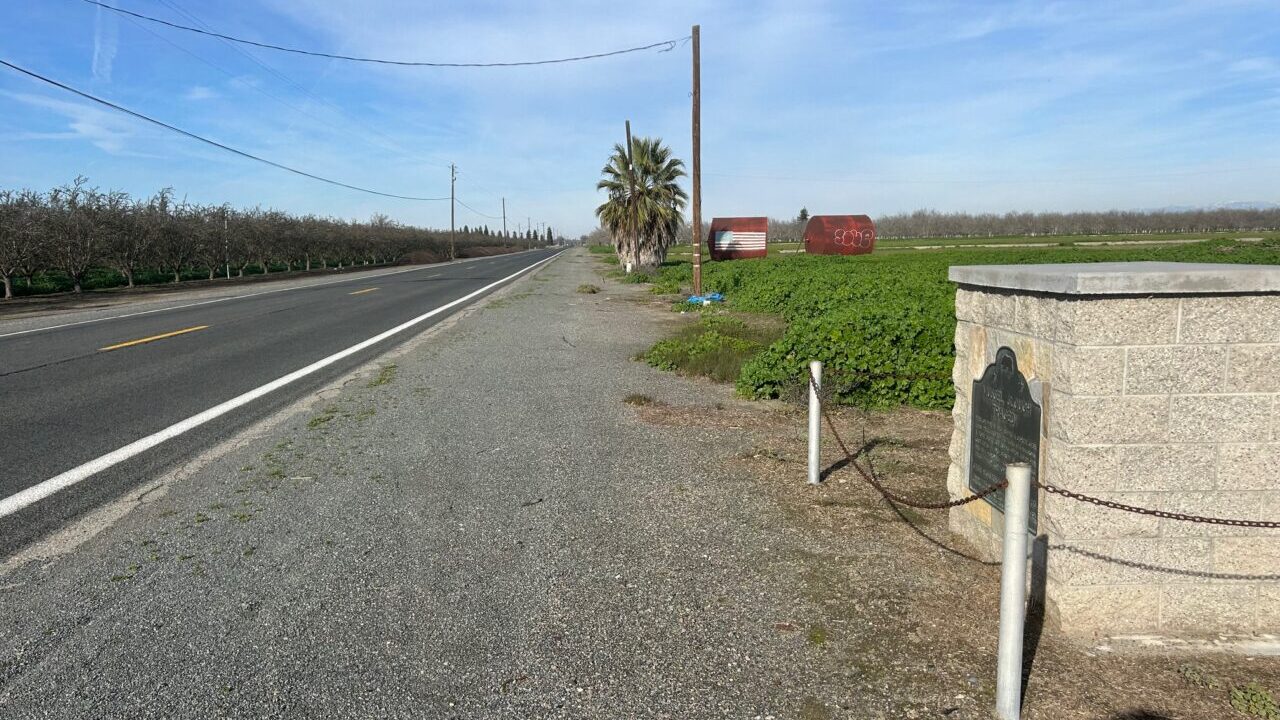
Unfortunately, you learn nothing of this at the Mussel Slough site, as I did recently. There’s a historical marker with a weather-beaten plaque, along 14th Avenue in Kings County near Hanford. Stopping to see the marker means pulling over into the dirt, with cars speeding past you just feet away. There wasn’t much water in a nearby slough.
But there is still plenty of blood in the old story, and no shortage of courage in us.
Fight the Power! Remember Mussel Slough!
About the Author
Joe Mathews writes the Connecting California column for Zócalo Public Square.