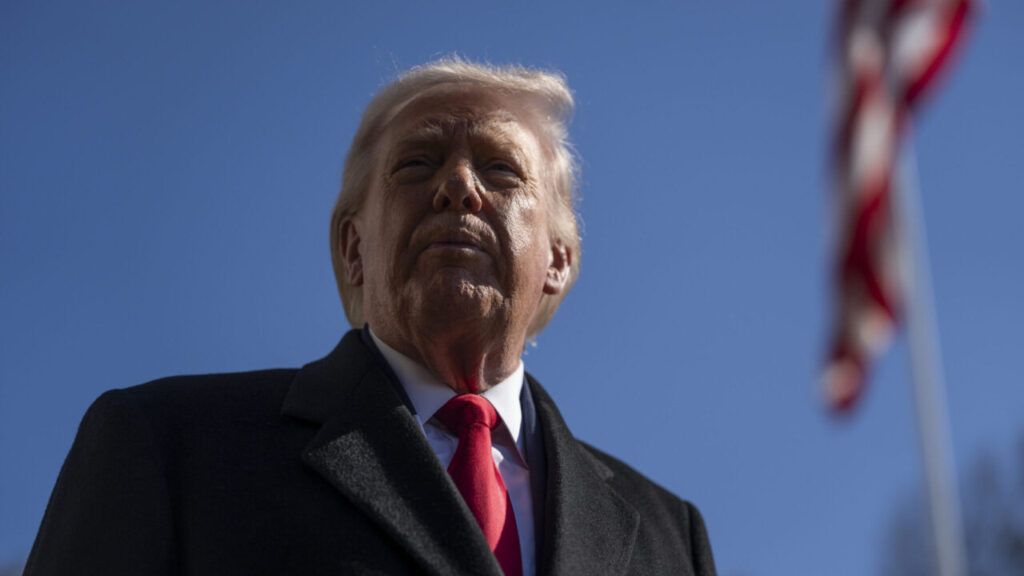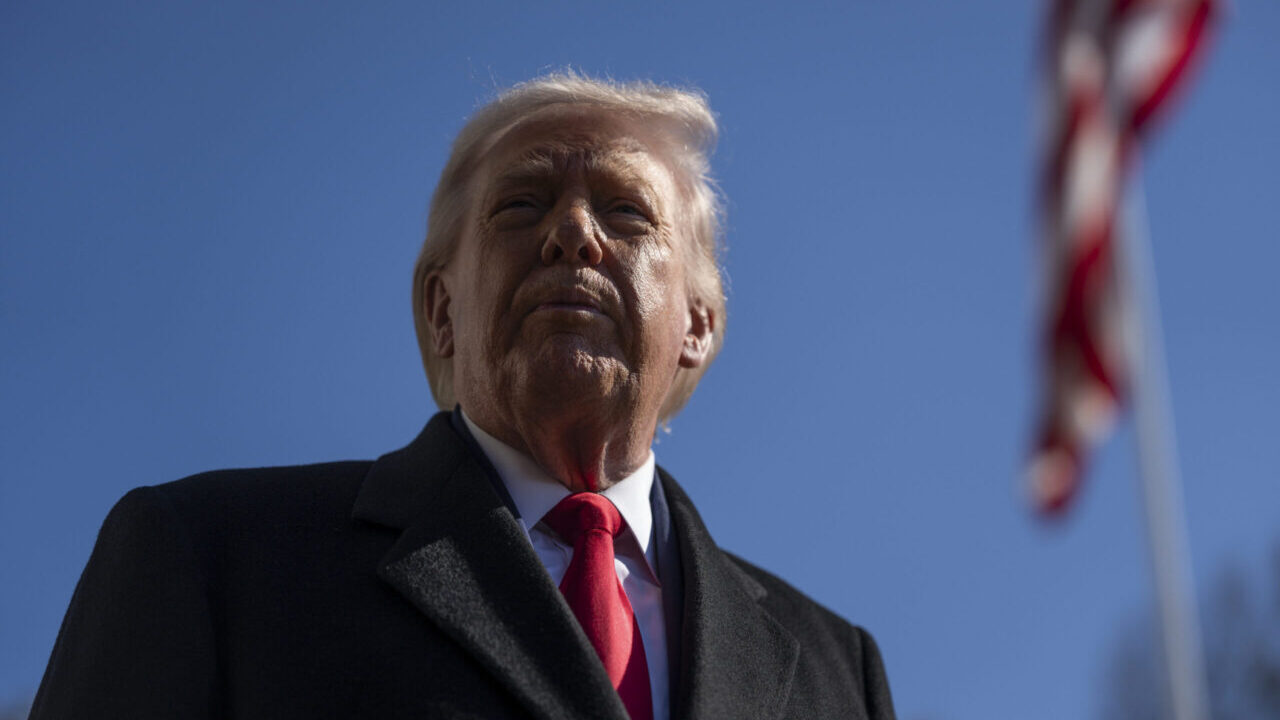
President Donald Trump speaks to reporters as he departs the White House in Washington, Feb. 13, 2026. Documents released by the Justice Department briefly mention a woman’s unverified accusation that Trump assaulted her in the 1980s, when she was a minor. But several memos related to her account are not in the files. (Tierney L. Cross/The New York Times)


- Missing FBI memos detail accusations a woman made of being sexually assaulted by Epstein and Trump when she was a minor.
- DOJ officials haven't directly addressed why the memos related to the woman’s claim were not released.
- The FBI did three interviews to assess her account in 2019 and made a summary of each interview, according to an index of records.
Share
|
Getting your Trinity Audio player ready...
|
The vast trove of documents released by the Justice Department from its investigations into convicted sex offender Jeffrey Epstein failed to include some key materials related to a woman who made an accusation against President Donald Trump, according to a review by The New York Times.
The materials are FBI memos summarizing interviews the bureau did in connection to claims made in 2019 by a woman who came forward after Epstein’s arrest to say she had been sexually assaulted by both Trump and the financier decades earlier, when she was a minor.
The existence of the memos was revealed in an index listing the investigative materials related to her account, which was publicly released. According to that index, the FBI conducted four interviews in connection with her claims and wrote summaries about each one. But only one summary of the four interviews, which describes her accusations against Epstein, was released by the Justice Department. The other three are missing.
The public files also do not include the underlying interview notes, which the index also indicates are part of the file. The Justice Department released similar interview notes in connection with FBI interviews with other potential witnesses and victims.
Related Story: Staggering Complicity of World’s Elite Saturates the Epstein Files
Unclear Why the Accuser’s Files Are Missing
It is unclear why the materials are missing. The Justice Department said in a statement to the Times on Monday that “the only materials that have been withheld were either privileged or duplicates.” In a new statement Tuesday, the department also noted that documents could have been withheld because of “an ongoing federal investigation.” Officials did not directly address why the memos related to the woman’s claim were not released.
The woman’s description of being assaulted by Trump in the 1980s is among a number of uncorroborated accusations against well-known men, including the president, that are contained in the millions of documents released by the Justice Department.
When the files were made public late last month, officials described the trove as including all material sent by the public to the FBI. “Some of the documents contain untrue and sensationalist claims against President Trump that were submitted to the FBI right before the 2020 election,” the department said in a statement at the time, calling such claims “unfounded and false.”
Trump has repeatedly denied wrongdoing. In a statement Tuesday, a White House spokesperson, Abigail Jackson, said Trump had “been totally exonerated on anything relating to Epstein.”
A lawyer who previously represented the woman in a lawsuit against Epstein’s estate declined to comment.
Questions About DOJ’s Compliance With the Law
The missing records deepen questions about how the Justice Department has handled the release of the Epstein files, which was mandated by a law signed by Trump last year after bipartisan congressional pressure.
Under the law, the Justice Department can redact material that could be used to identify Epstein’s victims, depicted violence or child sexual abuse, or would hurt a continuing federal investigation. But the law expressly prohibited federal officials from withholding or redacting materials “on the basis of embarrassment, reputational harm or political sensitivity” to public figures.
Some lawmakers and survivors of Epstein’s abuse have strongly condemned the department for how it handled redactions, noting that details identifying some victims were left exposed and nude photographs of young women were included in the public release, while material related to claims of abuse by other men had been heavily redacted.
The woman who made the accusation about Trump came forward in July 2019, days after federal investigators arrested Epstein on sex-trafficking charges, according to records in the public files of tips the FBI received during that period. She claimed that she had been repeatedly assaulted by Epstein when she was a minor in the 1980s, according to a summary of an FBI interview with her on July 24, 2019.
FBI Interviews Missing in Epstein Documents Release
The FBI did three subsequent interviews to assess her account in August and October 2019 and made a summary of each interview, according to the index of records compiled in the case. But the memos describing those three interviews were not publicly released.
The public files do contain a 2025 description of her account, as well as other accusations against prominent men contained in the documents. In that 2025 memo, federal officials wrote that the woman had said that Epstein introduced her to Trump, and that she claimed Trump had assaulted her in a violent and lurid encounter. The documents say the alleged incident would have occurred in the mid-1980s when she was 13 to 15 years old, but they do not include any assessment by the FBI about the credibility of her accusation.
The Times’ examination of a set of serial numbers on the individual pages in the public files suggests that more than 50 pages of investigative materials related to her claims are not in the publicly available files. The missing materials were reported earlier by journalist Roger Sollenberger on Substack and by NPR.
Rep. Robert Garcia of California, the top Democrat on the House Oversight Committee, said that when he reviewed unredacted versions of the Epstein files at the Justice Department on Monday, interview summaries related to the woman’s claim were also missing from that trove.
“Documents that are listed, which should be included, which are referenced in other documents, are not in the files,” Garcia said. He added that the Justice Department had also not provided them to the Oversight Committee, which issued a subpoena last year for all of the Justice Department’s investigative material regarding Epstein.
Garcia said the Justice Department had not provided a proper explanation for why the materials were missing. Democrats plan to open a separate investigation into why the documents are not available.
In the sole summary of the FBI interview that was released, the woman told investigators that she did not know Epstein’s full identity until 2019, when a friend sent her a photograph of Epstein. She said she then recognized the person who she said had raped her.
Accuser Feared Retaliation
The woman told the agents she still had the photo on her phone, and they noted that it was a widely distributed photo of Epstein and Trump, according to the document. She gave the agents permission to take a photograph of the image but asked them to crop out Trump. When asked why, her lawyer interjected that the woman “was concerned about implicating additional individuals, and specifically any that were well known, due to fear of retaliation,” according to the FBI memo.
It is unclear exactly what FBI agents learned about her claims related to Trump in their three subsequent interviews.
The woman spent most of the interview on July 24, 2019, describing in detail what she said were repeated violent assaults by Epstein that she had endured. She said that as a teenager in South Carolina, she was asked to babysit at a house on Hilton Head Island. But after she arrived, there were no children to babysit, and only a man she came to know as Jeff who she said plied her with alcohol, marijuana and cocaine. She described him raping her on multiple occasions.
The woman joined a lawsuit later in 2019 against Epstein’s estate. She subsequently dropped her claim. Court records do not indicate if she received any financial settlement. A court record from 2021 said she was separately deemed ineligible for compensation from a fund set up for Epstein victims, but it did not specify why.
This article originally appeared in The New York Times.
By Mike Baker and Michael Gold/Tierney L. Cross
c.2026 The New York Times Company