

|
Getting your Trinity Audio player ready...
|
Chicano poet Michael Jasso doesn’t plan his typewriter poems. He doesn’t outline, revise, or workshop them in advance. Instead, he listens.
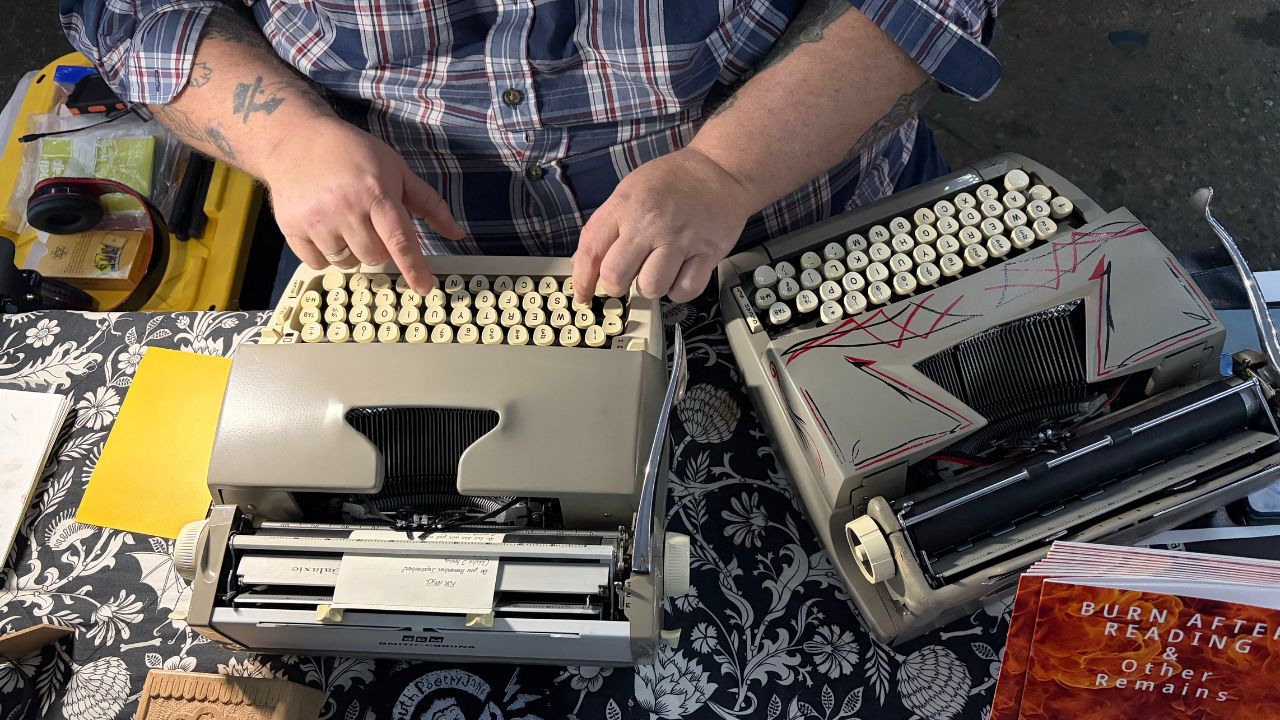
Sitting behind two vintage typewriters—one a Smith Corona fitted with looping cursive letters and the other with regular font, Jasso asks strangers a simple question: What do you want the poem to be about? Sometimes the answer is a name. Sometimes a memory. Sometimes a love story.
“I basically leave it to the universe,” Jasso said. “I often ask people to prompt me — give me a topic or a theme. Then I let it come out on the page as it needs to.”

Poems Written in Real Time
Jasso creates poems on the fly using word association and stream of consciousness, letting his fingers move faster than his inner editor can interfere. He says overthinking kills the moment. What people are paying for, he believes, isn’t just the poem, it’s the experience of watching it come alive.
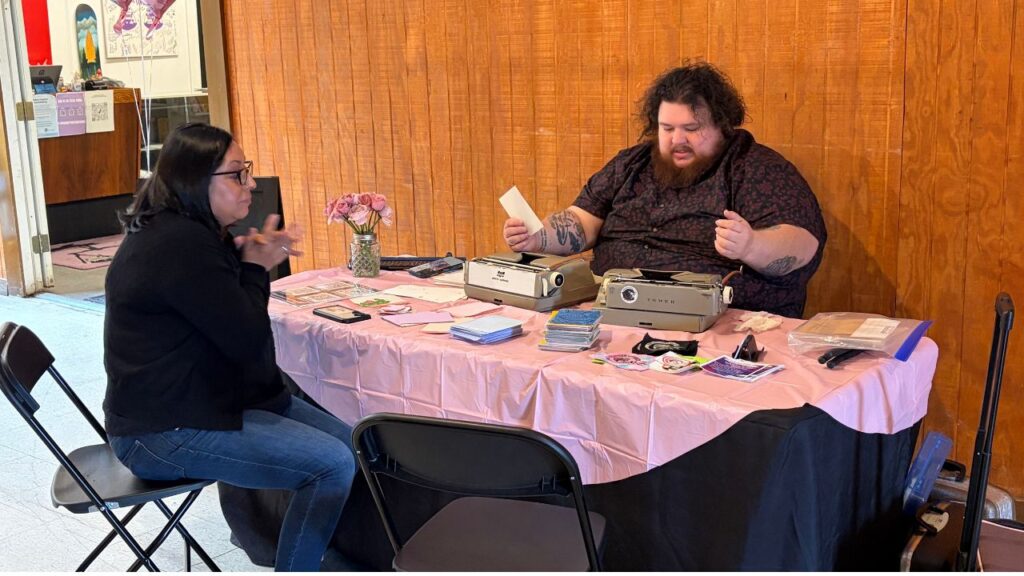
That experience was on full display Feb. 7 at Judging by the Cover, an independent bookstore in Fresno’s Chinatown, where Jasso set up his typewriters a week before Valentine’s Day. Store owners Ashley Mireles-Guerrero and Carlos Mireles-Guerrero gave him space to work, inviting customers to sit and watch the words take shape.
Carlos requested a poem about his wife.
“It made me cry,” he said.
Each poem is written specifically for one person, signed at the bottom, and handed over. While he photographs most of the poems for his own archive, he rarely keeps the originals.
“I think people are looking for connection,” Jasso said. “They want to feel seen.”
Pay What You Feel the Poem Is Worth
There’s no set price for that connection. Jasso lets people pay what they feel the poem is worth. Most offer between five and ten dollars. Some give more. Once, at a Visalia arts festival, someone handed him $100. Another time, he traded a poem for a small tattoo.
“It’s just a scrap of paper, I feel bad taking this much” he said. “But again, too, I guess something I wrote really resonated with them, something that they really needed.”
Jasso, a Visalia native, first discovered poetry as a teenager in a high school creative writing class. His English teacher, Melissa Link, introduced him to spoken word and slam poetry. Other artists like Saul Williams and Taylor Mali opened a door he didn’t know existed in poetry.
“People think poetry is something so academic or something so rigorous and following a format, when poetry really is what you should make of it ,” Jasso said.
Building a Scene in the Central Valley
After graduating from Redwood High School in 2012, Jasso began hosting poetry events almost immediately. At the time, spoken word spaces were concentrated in bigger cities like Fresno, Los Angeles, and San Francisco. Rather than wait for a scene to appear in Tulare County, Jasso built one himself.
A month after graduation, he launched Loud Mouth Poetry Jam, which has since become a cornerstone of the Central Valley’s spoken word community. Today, Jasso performs across the western U.S., from Oakland and Los Angeles to Albuquerque, New Mexico. He has also performed at The Cheech Marin Center for Chicano Art in Riverside, a moment he described as deeply affirming.
As a mixed-race poet — half Mexican, half white — Jasso says much of his work is shaped by questions of belonging. Raised white, he has spent the last decade reconnecting with his Chicano heritage, often writing in Spanglish and exploring cultural in-betweenness.
“Always never being white enough, always not being Mexican enough,” he said. “So much of my art, I think, is inspired by that feeling of belonging and reconnecting with other people that I know feel that diaspora from their cultures.”
When he’s not writing poems, Jasso drives for Uber and serves on the board of Arts Visalia Gallery, Tulare County’s only nonprofit community art gallery. The Tulare County Arts Consortium named him Artist of the Year for 2025-2026. It’s a recognition he’s used to expand access to poetry instead of promoting himself.
The Loudest Voice in the Smallest Room
That ethos is reflected in his current exhibit, The Loudest Voice in the Smallest Room, which opened Feb. 6 at the Peter and Carey Gallery in Visalia and runs through April 24. The show marks Jasso’s first attempt at translating spoken word into visual art, placing poetry, which he says is typically confined to stages or pages, on to gallery walls.
The exhibit also includes an interactive typewriter station where visitors are invited to write their own poems, continuing the cycle of participation that defines Jasso’s work. On the first Friday of each month through April, the gallery hosts live spoken word performances, including appearances by Tulare County youth poets participating in the annual Poetry Out Loud competition.
Mentorship, Jasso says, is as important as performance. This year, he’s stepping back from competing to coach a team of poets representing the Central Valley at national festivals.
“I’ve been really trying to do a lot of positive work with my title,” Jasso said. “Not only to get people into spoken word, but also to help people connect and know that this is a community that is very welcoming.”
Back at his typewriter, Jasso says he still can’t fully explain how the poems come together. He doesn’t try to.
“I really wish there was an actual process I could describe,” he said, laughing. “A lot of it is just connecting. Finding how I connect to the person’s theme as well.”