

|
Getting your Trinity Audio player ready...
|
This story was originally published by CalMatters. Sign up for their newsletters.

For 20 nights every year, police from UC San Diego depart from their usual school rounds and patrol the shores of La Jolla, Black’s Beach, and Torrey Pines. Powered by overtime pay provided by the federal Department of Homeland Security, the officers look for people crossing the border.
UC San Diego police have long participated in the federal Department of Homeland Security program known as Operation Stonegarden, which provides $10.9 million annually to dozens of California law enforcement agencies to collaborate with Border Patrol. The practice continued through Democratic and Republican administrations, and after the state adopted a sanctuary law in 2017 restricting law enforcement collaboration with immigration enforcement.

Now, UC San Diego is participating in the program at a time of heightened immigration enforcement by the Border Patrol. The school warns students about the locations of Border Patrol checkpoints on its website. Dozens of students had their visas revoked and later reinstated last year and at least one was detained at the border.
So far, the Stongarden program at UC San Diego has not prompted public criticism. Police departments usually spend the money on overtime pay for officers to carry out operations for Customs and Border Protection. The money can also pay for a wide range of surveillance equipment, from search cameras and devices that transmit their data, to facial and license plate recognition software. Three California counties — Imperial, San Diego and Riverside — accept the grant and distribute it to police forces in their area.
California Is Among Five Sanctuary States in the Program
California and four other sanctuary states — New York, Washington, Vermont and Minnesota — participate in Stonegarden, along with 18 other states and territories. California receives the third-most in grant money overall after Texas and Arizona.
Riverside County Sheriff Chad Bianco, a Republican who is running for governor, told CalMatters that the state sanctuary law should be renamed the “California Criminal Protection Act,” but he also said that his department’s participation in Stonegarden does not violate that law. Bianco added that he is extremely proud his department works with Border Patrol.
“By providing local law enforcement resources through Operation Stonegarden to combat … public safety concerns, Border Patrol and other federal agents are more able to dedicate their resources to immigration enforcement and border security,” Bianco said.
The California Attorney General’s office under Democrat Rob Bonta said it could not analyze whether Stonegarden grants violate the state sanctuary law. His representatives said the law permits state and local agencies to collaborate with federal agencies on joint task forces, “to the extent that the primary focus of those task forces is not immigration enforcement.”
Even though local agencies conduct the operations, civilians cannot access information about Operation Stonegarden activity from them. Once an operation is completed, police submit an activity report to Border Patrol chronicling their border enforcement actions, field interviews, arrests and citations, and other information they deem relevant.
An information officer with the UC San Diego police department said once they submit activity reports to DHS, they can still view them, but cannot edit them. Multiple police departments told CalMatters that, though they still have access to see the reports, they cannot provide them through public record requests, as the reports become federal property once entered into the Homeland Security Information Network. This database is available to the Department of Homeland Security and its international and private sector partners, but not to the public.
However, the Riverside County Sheriff’s Department provided several reports through a California Public Records Act request. The reports show that while carrying out Stonegarden operations, the department frequently made traffic stops in 2023 and 2024, working collaboratively with Border Patrol personnel. Most of the stops led to no arrests, citations or drug seizures. Instead, the stops resulted in “intel development,” meaning federal intelligence was developed regarding interactions between civilians and cops during those stops even when no crime was committed.
Scanning San Diego Waterways
Sgt. Patrick Dobbins, who oversees Stonegarden spending at the UC San Diego police department, said the patrols fall within the university’s jurisdiction. On patrol, the department monitors the university’s Scripps Institution of Oceanography, where nearly 6,000 students study ocean and earth sciences.
“The activity is the shoreline,” said Dobbins. “That’s not on the main campus itself, but it is campus property.” Dobbins said the department has received the grant for over a decade.
Dobbins said his department would conduct similar patrols in those areas “whether it be through Stonegarden funds or not,” adding that the grant allows for more patrols that are more visible, last longer, and don’t detract from university funds. The grant also pays for vehicle fuel.
The UC San Diego website says there are “unfortunately” Border Patrol stations in San Diego County, and that the school cannot predict when the stations become active. The website also says that the UC Police Department will not work with federal immigration agents to remove students from campus.
According to Dobbins as well as operational reports that have been posted online, campus officers search for pangas — open-air fishing boats often used to cross the border. Dobbins said panga crossings pose major safety risks to the travellers inside. Last November, a panga capsized near the San Diego coast, killing four migrants, according to the Los Angeles Times. One survivor of the accident was apprehended by federal immigration agents.
Dobbins added that the UC San Diego police department focuses on safety and security rather than immigration enforcement.
“We are prohibited from even asking immigration status or enforcing immigration law. So that’s not part of our duties, and we don’t even ask about it,” he said. Lately, he added, there’s “more of an emphasis on that, as a reminder that that’s not what our mission is.”
Stonegarden strengthens communication between university police and agencies like the Coast Guard to help respond to crises they cannot solve alone, said Dobbins.
Along with watching the water, police at the university conduct a couple of patrols each year on Interstate 5 to hunt for drug-smuggling vehicles. The patrols act as a deterrent against criminal activity, Dobbins said.
Mitigating Border Crime Stirs Controversy
Stonegarden grant documents from the Biden administration show that the program is meant to target border-related crime. The Federal Emergency Management Agency defines that crime as one of two things: trafficking, of humans, narcotics or weapons of mass destruction; or simply illegal border crossing.
According to a 2024 grant document for Imperial County, police forces are to apprehend all “criminal aliens” they assess to be entering the country illegally. The Biden administration document also states that increased enforcement under Stonegarden would ideally reduce border incursions.
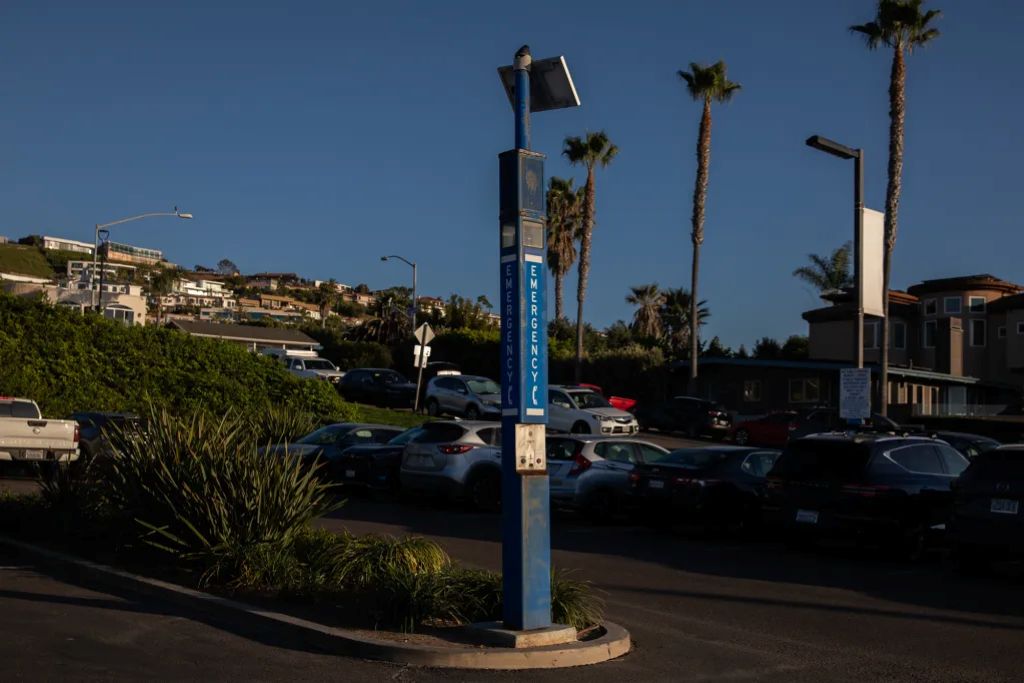
Tracy Rosenberg, who has researched Stonegarden for Oakland Privacy, a privacy rights organization, said the emphasis of the grant switches back and forth between drug trafficking and immigration arrests. According to FEMA, Stonegarden success is measured with three statistics: the number of participating agencies, overtime hours, and arrests.
“There’s nothing about crime or violence prevention in there,” said Rosenberg. “It is simply, how many people did you arrest and how many drugs did you seize?”
Several agencies across the country have quietly stopped participating in Stonegarden over the years, citing concerns about racial profiling, protecting asylum seekers, and endangering Latino communities. One Arizona sheriff withdrew from the grant after President Donald Trump took office in 2025, fearing his department would contribute to mass deportations.
“It is clear that you don’t get the money unless you agree to cooperate with Border Patrol in certain ways,” Rosenberg said. She added that sheriffs in California seem to believe they can uphold California’s sanctuary law and work with Border Patrol at the same time.
Tools of Surveillance
Logs of equipment bought with Stonegarden grants are part of operations order reports that the public is not supposed to see. Customs and Border Protection asserts they are exempt from the Freedom of Information Act. Some local governments have published them anyway, revealing purchases like mobile data laptops, GPS trackers, camera systems, unmanned aircrafts, patrol vehicles, and license plate readers.
UC San Diego police procured night vision binoculars through the grant, according to Dobbins.
Rachel Zaetz, senior director of communicators for the UC Board of Regents, the governing body of the UC, said in an emailed statement that there is no requirement for the regents to approve Operation Stonegarden acquisitions for UC police departments. Dobbins said the San Diego County Sheriff’s Department provides the grant to the UC San Diego police.
The Electronic Frontier Foundation, a digital privacy organization, implored the Trump administration to end Operation Stonegarden in a January 2025 memo. The foundation argued that technology companies manipulate police into applying for Stonegarden to sell them surveillance technology they don’t need and won’t use.
Pelco Encourages Police to Seek Stonegarden Grants
In 2021, the boat manufacturer SAFE Boats uploaded a promotional bulletin about Homeland Security grant opportunities to its website. And Pelco, a surveillance and security company headquartered in Fresno, runs a comprehensive blog encouraging police to seek Stonegarden funds, offering grant application assistance and a catalogue of the company’s border security cameras.
Local ordinances passed by elected officials can regulate surveillance tech used by small police forces, said Dave Maass, director of investigations at the digital privacy organization. He added that state universities are only subject to regulations passed by the university systems at large, or the state Legislature.
“Students don’t get to vote on who runs the university,” Maass said. “It’s not a democracy, unfortunately. And so the students don’t get a whole lot of power in deciding what rules affect them.”
Phoebe Huss is a contributor with the College Journalism Network, a collaboration between CalMatters and student journalists from across California. CalMatters higher education coverage is supported by a grant from the College Futures Foundation.
This article was originally published on CalMatters and was republished under the Creative Commons Attribution-NonCommercial-NoDerivatives license.