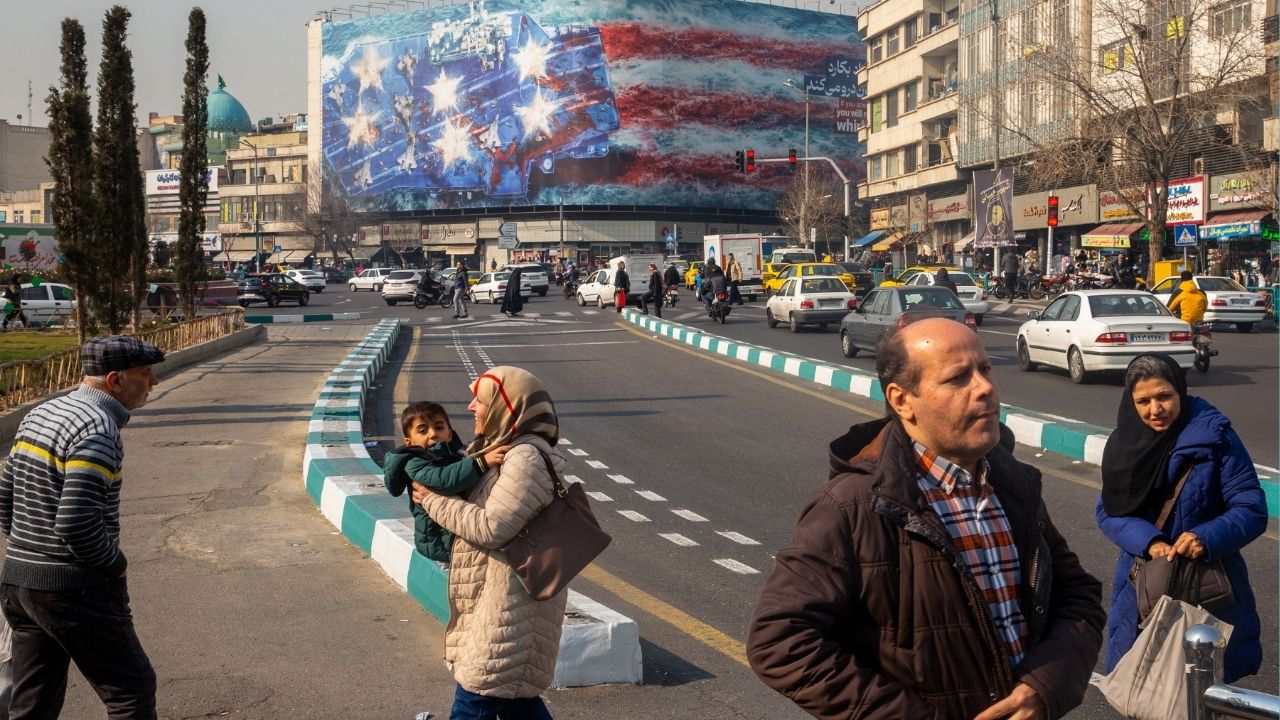
A billboard threatening action against American warships in Enghelab Square in Tehran, on Tuesday, Jan. 27, 2026. The president of Iran, Masoud Pezeshkian, said on Tuesday that he supported “fair and equitable negotiations” with the United States, as regional diplomats work to de-escalate tensions between the two countries. (Arash Khamooshi/The New York Times)

Share
|
Getting your Trinity Audio player ready...
|
The president of Iran, Masoud Pezeshkian, said Tuesday that he supported “fair and equitable negotiations” with the United States, as regional diplomats work to de-escalate tensions between the two countries.
Talks are expected to take place Friday in Istanbul between Abbas Araghchi, Iran’s foreign minister, and Steve Witkoff, President Donald Trump’s Mideast envoy, as well as the president’s son-in-law Jared Kushner, according to regional officials and diplomats. They say, however, that those plans are still tenuous.
In a post on social media, Pezeshkian said he had instructed Araghchi to meet with U.S. officials “provided that a suitable environment exists — one free from threats and unreasonable expectations.” He did not specifically refer to the talks expected to happen in Istanbul.
The Middle East has been on tenterhooks for weeks about the possibility of a military confrontation between Washington and Iran. After a surge of nationwide anti-government protests in Iran, which began in late December and were brutally crushed by Iranian authorities, Trump threatened last month to attack the country, telling protesters that “help is on its way.”
US Sends War Ships
The United States has since sent warships and fighter jets to the region, but Trump now appears more focused on reaching a deal over Iran’s nuclear and military program than on the plight of protesters.
On Tuesday, Witkoff landed in Israel for talks about Iran with Prime Minister Benjamin Netanyahu and the head of Israel’s Mossad spy agency, David Barnea, as well as other security chiefs, according to two Israeli officials. They spoke on the condition of anonymity to discuss sensitive diplomacy.
Pezeshkian said his decision to authorize the talks followed requests from “friendly governments in the region.” For days, regional officials from Turkey, Qatar, Egypt and other countries have been trying to mediate between the United States and Iran to de-escalate the situation.
Trump said Monday that he hoped for a positive outcome from the talks, but warned of potential consequences if diplomacy fails. “We have ships heading to Iran right now, big ones — the biggest and the best,” he told reporters at the White House.
Talks have rarely happened between Iran and the United States since the founding of the Islamic Republic in 1979.
During his first term in office, Trump withdrew from an international agreement with Iran to limit its nuclear enrichment in exchange for sanctions relief.
Last spring, he authorized several rounds of indirect nuclear talks with Iranian diplomats. But those negotiations collapsed after Israel launched strikes on Iranian nuclear and military targets in mid-June, attacks that were briefly joined by U.S. warplanes.
Besides the U.S. and Iranian officials, senior representatives from Turkey, Qatar and Egypt are also expected to attend the Istanbul talks, if they proceed.
—
This article originally appeared in The New York Times.
By Sanam Mahoozi/Arash Khamooshi
c. 2026 The New York Times Company
RELATED TOPICS:
Categories


Fresno County Authorities Seek Help Locating Missing Woman